Showing posts with label eucharist. Show all posts

Sunday, December 25, 2016

Gift and Sign


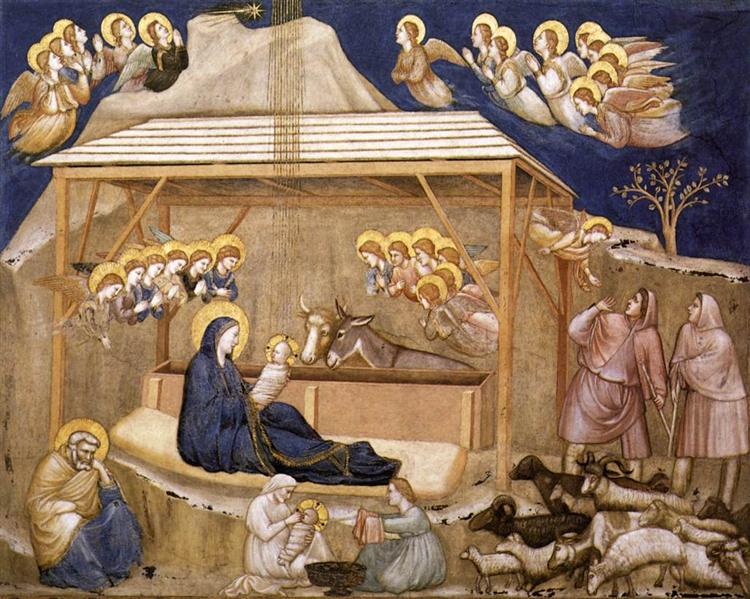
Nativity, 1311-1320 - Giotto 
Thirty years ago next month, I went to live at a sort of New Age commune in Massachusetts, where I worked on the construction of a new community center building in exchange for a bed in a dormitory and all the vegetarian food I could eat.   In the original house that came with the property there was an upstairs room that had been set aside for meditation, and it was there that I first began a daily practice of sitting down for a half hour before and after work to be silent and still.  And tonight I’m remembering one evening in that room when I experienced a kind of release in my breathing, an opening that began in my sternum and spread of the back side of my rib cage into my abdomen, an expansion of my body and my mind.
And afterward, as I walked out into the summer evening, down the country road to the neighbor’s house where the community dinner was happening that night, savoring the soft light and the sweet air, a thought came to me about air, about oxygen and the gases that I was breathing in and out—the thought that had also breathed.  Over the course of his lifetime, he breathed in and out countless atoms of this same atmosphere.  And have been dispersed by the ceaseless circulation of the elements, and mixed throughout the living system of the earth, so that it seemed likely to me in that moment that every breath I tooked must contain at least one atom that had also been breathed by Jesus.
Of course, I could have reasonably said as much about every other person, even every other creature, that has ever lived.  But in that moment it was the thought of sharing the breath of Jesus, that filled me with a sense of wonder, and quiet joy, and peace.  Which was strange, because I didn’t think of myself, then, as a Christian.  Now that I’ve attended church for twenty years, and been baptized, and graduated seminary and been ordained a priest, I can interpret that evening’s experience using theological language that wasn’t available to me at the time.  But I can’t improve on the freshness of that intuition, spontaneously arising from the life of my body, and what it said to me about Jesus. 
His was the life of a human body, in common with everyone on earth.  He breathed the same air, and ate the same food, the same blood ran in his veins, the same pains of mortality shadowed his days.  And yet there was something about his particular body, which transformed the very substance of this world.  By entering into it, taking it into himself, giving it back again to the shared matrix of life, he charged every aspect of earthly existence with new power and meaning.  And to those with the heart to receive it as a gift from God through him, he gave the world divinity.  This giving began at Christmas, on the night that Jesus took his first breath.
This makes Christmas different from the other birthdays of important people we commemorate on the calendar.  In no other case do we say that their births were, in and of themselves, significant.  On January 15th, for example, we do not gather to tell the story that begins, “When Calvin Coolidge was President, and Dr. L. G. Hardman was governor of Georgia, at the family home in Atlanta, Alberta King gave birth to her middle child, a son.”  We don’t do that, because to our minds there wasn’t anything particular extraordinary about the birth of Martin Luther King, Jr.  Whatever importance it has derives from the achievements of his later life, when he became a man. 
But the Gospel of Luke, which we hear tonight, and the Gospel of Matthew, which has a different version, tell stories that are full of the conviction that even the birth of Jesus was extraordinary.  Not that that Jesus himself did anything unusual.  He was simply born, as we all were born: he took his first breath; no doubt he cried.  Maybe he lay on his mother’s breast and tried to nurse.  She swaddled him tightly in a blanket and he slept.  Jesus’ birth was not significant because of anything he exceptional he did, but because of who he was.  His mere existence was already a gift to the world, and a gift does not become a gift because of anything the gift does.  It is a gift because of the intent of the one who gives it.
 And also because someone receives it.  The climax of Luke’s Christmas gospel is the angel’s promise to the shepherds that if they go to Bethlehem they will see a sign, a sign confirming angel’s good news about the birth of the Messiah, about peace on earth and God’s favor to all.  Tonight we didn’t go on to read the rest of the story, which talks about how the proclamation of the angels was received: how the shepherds did go and did find the baby lying in the manger; and how they told everyone what they had heard concerning the child, and went away praising and glorifying God; and how Mary took in everything the shepherds said, and treasured their words in her heart.   
For those shepherds the infant was the sign of God’s gift of life and love to the world, and they received the gift.  And this giving and receiving is the whole driving force of the gospel.  When Jesus heals the sick, he tells them that it is their faith in God that has made them well.  When he preaches the kingdom of heaven, he says, “let those who have ears to hear, listen.”  The words he spoke were the words of life, and yet he never wrote them down.  He gave them away, like seeds scattered on the ground; it was the people who received them, that remembered them, and told them to others, while others remembered other things he said, and passed them on, and it is only through this kind of crowdsourced transmission that we know anything about him at all. 
The most significant of all his words, judging by the frequency and devotion with which they are repeated, are the ones he said on the night before he was handed over to be killed, when he took bread and said, “this is my body, given for you.”  And he took wine and said, “this cup is my blood, poured out for you.”  They are words that are fulfilled when human beings take the substance of the earth—in bread,  in wine—and share it as the gift of God to them.  Eating and drinking together, they receive the life that was in Jesus.  They take it into themselves and they become what Jesus was in the substance of his being, from the moment of his birth: the gift of God to the world. 
This transformation is not something we can achieve by willing it to be so—we cannot even conceive how it happens.  We may not even notice until we have been eating this meal regularly, week after week, and year and year, for a long time, how it is changing us—making us less anxious about life, less fearful of death, more inclined to forgive and to ask for forgiveness, to be generous and caring toward others, more open to the promptings of the Spirit in our hearts, more entranced with the richness and the sweetness and the simplicity of the journey into God.
The gift of Christmas comes with such a simple sign—a newborn baby wrapped in bands of cloth and lying in a manger.  This simplicity makes it possible for anyone to receive it: even if we lack the means to decorate our home with a fragrant tree and shining lights and presents in colorful wrappings, even if we don’t have any home at all; even if there is no rich food and drink on our table, or any friends or family to gather around it; even if there is a chair at the table for the person dearest to us in the world sitting empty.  Every year, as the first, imperceptible turning of the earth toward the sun takes place, we come to this sign.  It reminds us that the gift of the presence of God is always new, always fresh, always available for those who care to listen--as soft, and quiet, and constant, as the breathing of a new-born child.        

Sunday, September 11, 2016

Homeland security


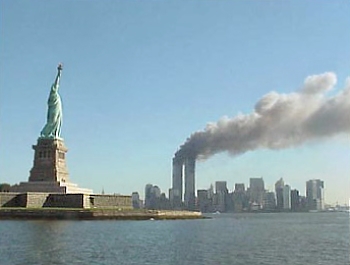
With the end of the Soviet Union, on Christmas Day, 1991, many in the world heaved a sigh of relief.   Here in the United States, it felt as though a great threat had been lifted, and there was hope that a new, peaceful, world might emerge.  The internet and the globalization of finance and commerce would tie everyone together, and we were going to lead the way.  Other nations would look to our expertise in business and technology; they would adopt our democratic institutions and norms.   Our military would intervene here and there as needed, to reign in the occasional dictator who got too big for his britches, or restore order where civil conflict raged out of control.  But we would have no rivals.  Here in North America, surrounded as always by our oceans, and friendly neighbors newly integrated with us into a single market, we would prosper and live without fear, at least where foreign enemies were concerned. 
This was the dream that came to an end on September 11th, 2001.  On that day a new word rose the top of the lexicon of American political speech, the word “homeland.” Though the word itself wasn’t new, national leaders started saying it frequently, and using it in a different kind of way.  And every time we heard it, it was a reminder of the fear of that terrifying day.  Because even if we did not lose friends or family members on September 11, many of us lost something else.  We lost the belief that massive political violence against innocent civilians was something that could only happen far away.  Even those of us who lived relatively secure lives, and generally felt protected in our homes, and workplaces, and the streets of our towns, lost our sense of invulnerability.  
I was one of those people.  I was eating breakfast in the kitchen of the apartment I had just moved into with Meg in Emeryville, when the radio said that hijacked planes had hit the Towers and the Pentagon.  And I felt an great sense of dread.  I didn’t know what it would mean for the future, but I knew that it wouldn’t be good.  Like someone in a dream, I put my tools in the truck and drove off to a gardening job, but at lunch I had to quit and go home with flu-like symptoms.  The news had literally made me sick. 
The human body and spirit are resilient, and I got better in a couple of days.  But it’s hard to say that collectively we’ve made a full recovery.  After fifteen years of “War on Terror”, we still feel vulnerable than ever, and it’s clear that Muslim extremism is not the only threat: economic anemia, simmering racial tension, and egregious inequality, rampant gun violence, and the unmistakable onset of climate change call us to profound soul-searching about what it really takes to make a homeland, let alone a world, that is truly secure.

It’s a spiritual crisis, not unlike the one that Jeremiah talked about in the 7th century BCE.  The mighty Assyrian Empire had long ago dismembered the northern kingdom of Israel, but the southern kingdom of Judah remained defiant.  Although the Assyrian army invaded Judah twice, it failed both times to capture Jerusalem.   And then, quite unexpectedly, over a few short years in the 620s and 610s, the power of Assyria melted away.  Suddenly Judah enjoyed a degree of national independence it had not known for over a hundred years.  Her kings took back some territory, the priests and scribes made some religious reforms, and the court prophets began to say that the tide of history had turned, that Israel’s God was pleased with her again, and the peace and security of the days of David and Solomon would return.
But Jeremiah saw something different.  He saw that the modest religious reforms had not brought the nation back to its covenant with God.  They did not cease practices, like human sacrifice, derived from foreign cults.  He saw that the people did not carry out the social justice commanded in the law.  Jeremiah cried out in pain and anger at the apostasy of Judah, and said it was the pain and the anger of God.  Far from thinking that God was about to restore Israel’s greatness, he saw a wave of destruction coming from the north.   
Jeremiah lamented for his poor people, because God had already made a judgment against them that could not be revoked.  And in Jeremiah’s vision, the consequence of Judah’s evil doings would be worse than military defeat.  It will be worse than the loss of the homeland.  “I looked on the earth,” he says, “and lo, it was waste and void; and to the heavens, and they had no light.”  This is a vision of the undoing of the creation of the world.
History proved Jeremiah right about destruction from the north.  A new empire rose out of the ruins of Assyria, and in a few short years that empire would take Jerusalem, destroy the temple of Solomon, and carry the last king of David’s line away in chains to Babylon.  And in the loss and trauma of exile the prophets and sages of Israel began to re-think what it would mean to come home.  Some Jews would indeed eventually go back and repair the walls of the holy city, and build a second temple, bigger than the first.  But the hope of restoring Israel as a national entity would from then on always be in tension with hope of a different kind. 
This new hope sprang from a vision of renewal, not merely of Jerusalem, but of the whole of creation.  Israel began to receive a new vocation for herself, that of leading all humanity home.  Cut off from their land, they found that in repentance and prayer, in justice, compassion, and love they could still take life from the spirit of God.   And in that spirit they found the grace not just to maintain their faith, and survive as a community—they found the source of true security, abundance, and peace.  
  
Every Sunday in church we have an altar call.  It is not an invitation to individuals to come forward and confess their personal sinfulness and need to be saved.   It’s not a celebration of individual repentance and return to the community of God’s elect.  At least, that’s not the main focus.  What we do is invite everyone to come to the altar together.  After we all confess our sinfulness together, we gather at the altar in thanksgiving for what God has done for all of us to bring us home. 
This celebration continues the feasting that Jesus did, when he came to seek the lost sheep of Israel, and sat at table with tax collectors and sinners.  Nowhere in the gospels does it say how many of those sinners changed their ways.  From scattered hints we know that many of them did, but as Jesus himself says, even one is enough to make the angels in heaven rejoice.  And that is what our celebration is about: that God cares enough about that one lost sheep to send Jesus to go and find it.  That one lost coin matters enough to God to light the lamp, and sweep the house, and look under the sofa cushions until she finds it.
Jesus calls us sinners all together for a feast to celebrate the love of that God, and this inclusivity leaves it open for each of us to ask ourselves “am I that one?” “Am I the one for whom Jesus left the other ninety-nine behind to come and find?  Am I the one he is carrying home on his shoulders?”  But it also means we can look at the sinner beside us at the altar rail and wonder, “or is it him?”  “Is she the one?”  That open possibility is what makes this feast a sign of the Kingdom of God. 
Jesus says that the Kingdom of God is like a great net thrown into the sea, that catches every kind of fish, the good and the bad.  It is like a field of wheat, in which someone came and sowed some noxious weeds, and the weeds grew up with the wheat so there was no way to pull them out.  And this makes God’s Kingdom a mixed-up kind of homeland, a place where we have to be vulnerable.  It’s not a place we can hunker down behind the walls of our judgements of others, or an exclusive club, where only the people who think and act and look like us belong.  It’s a place where security and health are gifts of the spirit of repentance and forgiveness, the spirit of always being able to begin again.    
            

About Me

My photo
Petaluma, California, United States
I am a priest in the Episcopal Church, and have been (among other things) an organic farmer and gardener, and a Zen monk. I have a lifelong interest in social and spiritual renewal on the basis of contemplative discipline, creative nonviolence, and ecological practice. In recent years my work has focused intensely on the responsibility of pastoral ministry in the humanistic, evangelical, and catholic branch of Christianity known as Anglicanism. I'm married with a daughter, and have three brothers and two parents.