Showing posts with label history. Show all posts

Sunday, September 11, 2016

Homeland security


With the end of the Soviet Union, on Christmas Day, 1991, many in the world heaved a sigh of relief.   Here in the United States, it felt as though a great threat had been lifted, and there was hope that a new, peaceful, world might emerge.  The internet and the globalization of finance and commerce would tie everyone together, and we were going to lead the way.  Other nations would look to our expertise in business and technology; they would adopt our democratic institutions and norms.   Our military would intervene here and there as needed, to reign in the occasional dictator who got too big for his britches, or restore order where civil conflict raged out of control.  But we would have no rivals.  Here in North America, surrounded as always by our oceans, and friendly neighbors newly integrated with us into a single market, we would prosper and live without fear, at least where foreign enemies were concerned. 
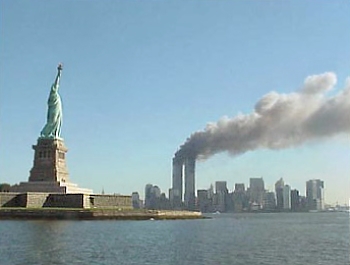
This was the dream that came to an end on September 11th, 2001.  On that day a new word rose the top of the lexicon of American political speech, the word “homeland.” Though the word itself wasn’t new, national leaders started saying it frequently, and using it in a different kind of way.  And every time we heard it, it was a reminder of the fear of that terrifying day.  Because even if we did not lose friends or family members on September 11, many of us lost something else.  We lost the belief that massive political violence against innocent civilians was something that could only happen far away.  Even those of us who lived relatively secure lives, and generally felt protected in our homes, and workplaces, and the streets of our towns, lost our sense of invulnerability.  
I was one of those people.  I was eating breakfast in the kitchen of the apartment I had just moved into with Meg in Emeryville, when the radio said that hijacked planes had hit the Towers and the Pentagon.  And I felt an great sense of dread.  I didn’t know what it would mean for the future, but I knew that it wouldn’t be good.  Like someone in a dream, I put my tools in the truck and drove off to a gardening job, but at lunch I had to quit and go home with flu-like symptoms.  The news had literally made me sick. 
The human body and spirit are resilient, and I got better in a couple of days.  But it’s hard to say that collectively we’ve made a full recovery.  After fifteen years of “War on Terror”, we still feel vulnerable than ever, and it’s clear that Muslim extremism is not the only threat: economic anemia, simmering racial tension, and egregious inequality, rampant gun violence, and the unmistakable onset of climate change call us to profound soul-searching about what it really takes to make a homeland, let alone a world, that is truly secure.

It’s a spiritual crisis, not unlike the one that Jeremiah talked about in the 7th century BCE.  The mighty Assyrian Empire had long ago dismembered the northern kingdom of Israel, but the southern kingdom of Judah remained defiant.  Although the Assyrian army invaded Judah twice, it failed both times to capture Jerusalem.   And then, quite unexpectedly, over a few short years in the 620s and 610s, the power of Assyria melted away.  Suddenly Judah enjoyed a degree of national independence it had not known for over a hundred years.  Her kings took back some territory, the priests and scribes made some religious reforms, and the court prophets began to say that the tide of history had turned, that Israel’s God was pleased with her again, and the peace and security of the days of David and Solomon would return.
But Jeremiah saw something different.  He saw that the modest religious reforms had not brought the nation back to its covenant with God.  They did not cease practices, like human sacrifice, derived from foreign cults.  He saw that the people did not carry out the social justice commanded in the law.  Jeremiah cried out in pain and anger at the apostasy of Judah, and said it was the pain and the anger of God.  Far from thinking that God was about to restore Israel’s greatness, he saw a wave of destruction coming from the north.   
Jeremiah lamented for his poor people, because God had already made a judgment against them that could not be revoked.  And in Jeremiah’s vision, the consequence of Judah’s evil doings would be worse than military defeat.  It will be worse than the loss of the homeland.  “I looked on the earth,” he says, “and lo, it was waste and void; and to the heavens, and they had no light.”  This is a vision of the undoing of the creation of the world.
History proved Jeremiah right about destruction from the north.  A new empire rose out of the ruins of Assyria, and in a few short years that empire would take Jerusalem, destroy the temple of Solomon, and carry the last king of David’s line away in chains to Babylon.  And in the loss and trauma of exile the prophets and sages of Israel began to re-think what it would mean to come home.  Some Jews would indeed eventually go back and repair the walls of the holy city, and build a second temple, bigger than the first.  But the hope of restoring Israel as a national entity would from then on always be in tension with hope of a different kind. 
This new hope sprang from a vision of renewal, not merely of Jerusalem, but of the whole of creation.  Israel began to receive a new vocation for herself, that of leading all humanity home.  Cut off from their land, they found that in repentance and prayer, in justice, compassion, and love they could still take life from the spirit of God.   And in that spirit they found the grace not just to maintain their faith, and survive as a community—they found the source of true security, abundance, and peace.  
  
Every Sunday in church we have an altar call.  It is not an invitation to individuals to come forward and confess their personal sinfulness and need to be saved.   It’s not a celebration of individual repentance and return to the community of God’s elect.  At least, that’s not the main focus.  What we do is invite everyone to come to the altar together.  After we all confess our sinfulness together, we gather at the altar in thanksgiving for what God has done for all of us to bring us home. 
This celebration continues the feasting that Jesus did, when he came to seek the lost sheep of Israel, and sat at table with tax collectors and sinners.  Nowhere in the gospels does it say how many of those sinners changed their ways.  From scattered hints we know that many of them did, but as Jesus himself says, even one is enough to make the angels in heaven rejoice.  And that is what our celebration is about: that God cares enough about that one lost sheep to send Jesus to go and find it.  That one lost coin matters enough to God to light the lamp, and sweep the house, and look under the sofa cushions until she finds it.
Jesus calls us sinners all together for a feast to celebrate the love of that God, and this inclusivity leaves it open for each of us to ask ourselves “am I that one?” “Am I the one for whom Jesus left the other ninety-nine behind to come and find?  Am I the one he is carrying home on his shoulders?”  But it also means we can look at the sinner beside us at the altar rail and wonder, “or is it him?”  “Is she the one?”  That open possibility is what makes this feast a sign of the Kingdom of God. 
Jesus says that the Kingdom of God is like a great net thrown into the sea, that catches every kind of fish, the good and the bad.  It is like a field of wheat, in which someone came and sowed some noxious weeds, and the weeds grew up with the wheat so there was no way to pull them out.  And this makes God’s Kingdom a mixed-up kind of homeland, a place where we have to be vulnerable.  It’s not a place we can hunker down behind the walls of our judgements of others, or an exclusive club, where only the people who think and act and look like us belong.  It’s a place where security and health are gifts of the spirit of repentance and forgiveness, the spirit of always being able to begin again.    
            

Thursday, August 14, 2014

To the other side


It’s not easy to see why Jesus would send his disciples away at nightfall to start rowing across a lake, but there might be a clue in the larger order of events in the gospel.  You see, the story the feeding of the multitude comes right after the sordid episode where Herod, the ruler of Galilee, has John the Baptist beheaded at a dinner party.  Word then comes to Herod about this new fellow, Jesus of Nazareth, and he declares that this must be John, come back from the dead.  News of this comes to Jesus, and that is the point at which he leaves town and heads out into the bush.  A great crowd goes after him—with John dead, Jesus is the only prophet they have left, the only one who can challenge the violence and corruption of their rulers in the name of God’s justice and truth. 
It’s not clear whether Jesus set out to have the great world-changing career that he did.  It seems to me that a lot of what he did was spontaneous and personal.  He had a profound personal experience of God’s love for everyone, and he related to everyone he met on that basis.  But because of his historical circumstances, every little thing he said and did to relieve people’s suffering, to satisfy their basic needs, to lift their spirits and bring them together, had revolutionary impact, and this is the point in the gospel story where that starts to be clear.  Jesus had to know that news of miraculously feeding a multitude would travel fast, and that the reaction might be swift and brutal.  Maybe he sent his disciples out in the boat that night because he feared for their lives, and decided they should slip away under cover of darkness. 
From the evidence we can piece together, Matthew’s gospel came out of a community that was crossing over from their ancestral home in the world of Judaism to the strange new reality called the Church.  It was a journey that put them in a boat with other people they would never have given the time of day before, and now they were all depending on each other for their very lives.  They were running into unaccountable hostility from their fellow Jews, who rejected and denounced and even persecuted them for preaching and praying and gathering in the name of Jesus. 
Yet it was a community that had experienced the fulfillment of what it means to be human.  In their gatherings they had received gifts of the Holy Spirit in baptism and the Eucharist.  They had died with Christ and been reborn in his resurrection to a new life of imperishable glory.  They had tasted the heavenly banquet of God’s justice and love, where all pain and grief are at an end and evil and suffering are no more.  But somehow they still found themselves on this side of things, in the world where children die of hunger and nations are laid waste in war.  Or more precisely, they found themselves in a small boat in the dark, rowing against the wind and against the waves, trying to cross over to the other side.  
The image of Jesus coming to the disciples over the sea, calming the storm, and their fears along with it, must have been a great comfort to these people.  Less comforting is the little story that Matthew works in at this point about Peter.  The troubling part is where Jesus says to Peter, "You of little faith, why did you doubt?"  It has always struck me as an accusation that if Peter really had faith, he should be able to do like Jesus.  But that just doesn’t seem fair, to Peter, or, for that matter, to us.  If walking on water is the minimum standard of faith, we’re all in trouble. 
But reading the story this time around, I realized that walking on water isn’t the only thing Peter has doubts about.   Before that even happens, Jesus calls out to the terrified disciples, "Take heart, it is I; do not be afraid." But Peter doesn’t calm down and wait in the boat for Jesus to come and rescue them.  He doubts that it is really Jesus, and he demands proof.  He wants Jesus’ power, for himself and nobody else, so he can take matters in his own hands.  “Go ahead, knock yourself out,” says Jesus, and Peter leaves his brothers behind and steps out of the boat. 
I don’t imagine Jesus was surprised when Peter started sinking.  Peter’s faith wasn’t big enough to believe that Jesus was a living man, and not a ghost.  It wasn’t big enough to just sit tight in the boat with everybody else.  So it sure as anything wasn’t big enough to walk on water.   Now just a little faith is enough, as long as it is faith in Jesus and solidarity with the others in the boat.  But it seems like there were some in the early Christian community who weren’t content with that.  They began to doubt that faith was sufficient to their historical situation. They wanted some kind of supernatural escape plan, to leave the whole soggy mess behind and walk away over the waves.
In May I was with a bunch of priests and deacons from our diocese, when Sally Hubbell, from St. Paul’s church in Healdsburg, asked the group if we knew anyone who might be able to do a service in Spanish.  St. Paul’s has a small but lively Spanish-language congregation and one of the girls from the was going to celebrate her quinceañera on August 9.  Sally would be away on vacation and neither of the priests who usually substitute for her on such occasions were going to be able to do it either.  With a certain amount of trepidation I raised my hand and said, “I can.” 
For the past six years all the time and money that I get allotted for Continuing Education has gone to learning Spanish.  I have a weekly lesson via an internet video call with a man in Guatemala, and I spend three or four hours of my free time every week doing written exercises.  Progress has been painfully slow at times, but I’ve stuck with it.  So yesterday I preached in Spanish for the first time.  The same goes for celebrating the Eucharist.   For that matter, it was the first quinceañera I’d ever been to.  When I first agreed to do it, I was excited about the chance to show off my skills.  But by the time it came around it was all I could do to get through it. 
Friday night I hardly slept a wink, and I got up yesterday morning feeling like death warmed over.  It didn’t help that I was coming down with a cold.  I made it through okay, though, with a lot of help.  I used my Spanish lesson on Thursday to go over my homily with my teacher, and he helped me polish up my grammar and use more popular idioms.  I got a lot of help from a lady named Gretta, who is a kind of bridge person between St. Paul’s Anglo and Latino congregations.  Her Spanish is way better than mine, and she was the emcee for the event.  The family had hired a fabulous trio of musicians who had a huge repertoire of Mexican folk music.  Whenever I decided I needed a little music, I’d just give them a nod, and away they’d go. 
But the biggest help of all was having someone there who was, if anything, even more scared than I was.  I mean, of course, fifteen year old Jessica Castañeda.  She was sitting in her tiara and purple dress and high heeled shoes, in the center aisle right in front of the altar, so we were physically close and looking at each other throughout the service.   We traded off being the center of attention, and had to take a lot of cues from each other.  And I think the fact that both of us were coming out in public, in different ways, at the same time, that both of us were thrilled to be there and at the same time just getting by on a wing and prayer, enabled us to help each other, to keep rowing against the wind and waves.
One year-old Ave Marie Boazman is having a coming-out part of her own this morning, at her baptism.  We can’t know how historical circumstances are going to shape her life.  I’d like to be able to say it’s will be smooth sailing, but a quick glance at the headlines, or even the weather report, suggests otherwise.  Lucky for Ava she has parents who recognize that she’s not going to get very far walking across the water.  She needs a boat, and a Lord who can still the wind and the waves.  She needs people who will stay in the boat with her, no matter what happens.  And so do we, so we are glad to welcome Ava aboard.

Tuesday, April 29, 2014

Touching the wounds


God brought Jesus back to life—this is the pivotal event of history.  But it is not a historical event in the same way the Battle of Waterloo is, or the signing of the Magna Carta.  Because the resurrection of Jesus is ongoing.  Easter morning was the continuation of the work of Jesus’ life, of bringing others back from physical, or moral, or spiritual death.   And it was also the beginning of a process of renewing the life of the whole creation, a process that is ongoing in our present and is our hope for the future.  God is bringing Christ to eternal life in us, and this is ongoing, and gradual, and happens in different ways and at different times for different people. 
Which is what today’s text from the Gospel of John is about.  The story of Thomas shows us ourselves, and how it is that we come to know and to live Jesus’ resurrection.  The process can’t occur without our participation, but just for that reason it is something of a problem.  Because we aren’t always sure it’s what we want, or how to do it?  In part it is a question of evidence—how can I affirm what I do not believe, and how can I believe what I have not seen or touched or experienced for myself? 
It is also a problem of recognition.  We may feel like we can see evidence in our lives, or in the world around us, for the living presence of the Spirit, or of God, but it is not always clear what these have to do with a man who lived 2,000 years ago.  In what sense are they signs of Jesus?
Finally, there is the question of action, or practice.  When I am asked whether I believe in the Resurrection, isn’t this a question about the way I live and act, about what I do?
Today’s gospel story addresses all these aspects of the problem, and it does so in the way it describes the risen body of Jesus.  It is a remarkable body, one that passes instantaneously through locked doors, one whose physical breath is the Holy Spirit of God, the kind of body that speaks of a transformation in which it has become something more than human. 
And yet this body bears the marks of crucifixion, and this is precisely what makes it recognizable as Jesus.  It is in his demand to see the marks of Jesus’ wounds, and to put his own fingers in the places where the nails pierced his hands, and in the opportunity that Jesus graciously provides to do just that, that Thomas knows the truth.  But Thomas is not alone.  John says explicitly that this story is written for us, so that we also may believe.  So I don’t think it is stretching the point to say that this story’s message is that it is in touching the wounds of Christ that we come to know and to believe that he is our Lord and our God. 
Now, when I say “the wounds of Christ,” there is probably at least one person here in this room who thinks about guilt.  Centuries of Christians have thought this way, meditating on the crucified body of Jesus and feeling responsible for his wounds, because of our own sins.   And that isn’t such a bad practice—for Lent. But the body in this story is the resurrection body, and these wounds are not bleeding accusations of guilt and judgment, but openings—to insight, to reconciliation and peace, to awe and gratitude, joy and faith.
Maybe the wounds of the risen Lord are the places where the work of Jesus is still open, still unfinished.  They invite our exploration and participation, because we also are unfinished.  Christ’s resurrection is still not a reality in our lives and in the world because we have been afraid, or unwilling, to see and to touch his wounds. 
We struggle to affirm that Jesus is Lord, because we don’t see the evidence.  But what if that longing for direct, personal knowledge of God, that sense of missing the most important thing, that nagging dissatisfaction with a superficial, conventional, and materialistic approach to life, that hunger for something more vivid, more meaningful, more enduring and true—what if that wound was the evidence?
We may wonder what this longing has to do with Jesus, or with the church that claims to do what it does in his name.  But maybe this itself is an opening, an invitation to feel our way into Jesus’ own pain over religion.  He experienced the immediate presence of the Kingdom of God, and then he looked at the indifference and hypocrisy of the religious leaders of his day: their sterile rehashing of old arguments, and quibbling over minor differences of interpretation; their pursuit of worldly power and prestige, and easy accommodation to corrupt and violent elites; their contempt for the outcast, the poor and the mentally and physically disabled, and inordinate focus on petty offenses and sexual sins.  Jesus saw this and was wounded with anger, and with a burning compassion for the sufferings of God’s people.  We could turn away from the corresponding problems of religion today, as so many people do, and say “that’s someone else’s problem,” but then there would be no opening for us in the risen body of Christ, only a old and fading scar.
And when we think about how we are to practice, how to live in a way that is consistent with Jesus’ compassion, and his urgency for the Kingdom of God, we often assume that this a question of knowing what to do.  But here also we might find greater freedom and power if we understood that here, too, there is an open wound.   We think of Jesus as supremely sure of himself and his plan, so we forget how often he had to go off by himself to pray for guidance and for strength.   We forget his prayer in the garden that the cup of betrayal and suffering should pass from his lips, but that, in the end, “your will, O Lord, not mine, be done.” 
Last night, I attended, along with some members of our congregation, and several hundred others, a celebration of the ministry of the Reverend Tim Kellgren, who is retiring today, at the end of this morning’s services, after 37 years as pastor at Elim Lutheran Church.  There was a lengthy after-dinner program of songs and remembrances and tributes, and many people made mention of the ministries that Pastor Tim and the Elim congregation helped to found that have had a transforming impact on this community and the world.  These include PEP, providing subsidized senior housing, COTS and the Petaluma Kitchen, sheltering homeless persons and helping them get back on their feet, Petaluma Bounty and the Interfaith Food pantries, that feed the hungry.  But for me it was also inspiring, and encouraging, to hear passing mention of the many false starts, the big ideas that never got off the ground, or were attempted, but later given up as impractical, or just too difficult to sustain.
Maybe we bring Christ to life not when know what to do, but when we know that we are sent, as Jesus was sent, and go in his peace and try something, anything, to touch the wounds of the world.  And in this we could ask for no better patron saint than Thomas.  In the popular imagination, Thomas is most associated with his doubts about the resurrection.  But the Gospel of John also depicts him as the apostle of courageous action.  When Jesus announces he is going back to Judea, to the grave of his friend Lazarus, the other disciples say, “Rabbi, they were just seeking to stone you, and are you going there again?”  But Thomas is the one who says “Let us also go, that we may die with him.”   And when the rest of them were hiding out after Jesus’ crucifixion, with the doors locked, and the lights out, and the shades drawn, Thomas wasn’t there.  So where was he?  Out and about, abroad in the city?  I can imagine him saying, “This is crazy.  We can’t just cower here in fear forever.  Life has to go on—the Sabbath is over, I’m going to the market to get us some bread.”  In church tradition, Thomas is the apostle who went the furthest to spread the Gospel.  Others went to Syria, or to Asia Minor, or even to Rome, but Thomas, it is said, went to India, and died a martyr’s death there. 
Maybe for some people discipleship begins with believing in the resurrection, and moves from there to recognizing the wounds of Christ, and then to doing something about them.  But for Thomas it works in reverse.  His story suggests that we first should overcome our fears, and just try something, anything to touch the wounds of Jesus.  Then, maybe, our doubts will begin to fall away and we will be able to cry, with the joy of firsthand experience, “My Lord and my God!”

About Me

My photo
Petaluma, California, United States
I am a priest in the Episcopal Church, and have been (among other things) an organic farmer and gardener, and a Zen monk. I have a lifelong interest in social and spiritual renewal on the basis of contemplative discipline, creative nonviolence, and ecological practice. In recent years my work has focused intensely on the responsibility of pastoral ministry in the humanistic, evangelical, and catholic branch of Christianity known as Anglicanism. I'm married with a daughter, and have three brothers and two parents.