Showing posts with label victory. Show all posts

Tuesday, March 29, 2016

Signs of Life


One of the really strange things about this story I just read is that it features such minor characters.  Mary Magdalene and Joanna merit exactly one prior mention in Luke’s Gospel, back in Chapter 8, where there are a couple of verses about some women whom Jesus cured of diseases, or cleansed of evil spirits, who went around with him in Galilee and supported his mission out of their own means.   Mary the mother of James appears in this story here, for the first and only time.  And the men, the male disciples who have been Jesus’ chief companions, witnesses to his adventures, and foils for his teaching, are nowhere to be seen. 
Which, of course, is how they wanted to be.  When the chief priests and elders and temple police came to arrest Jesus, led to him by one of the twelve, the other eleven scattered and melted away into the night.  Except for Peter.  Peter tailed them furtively all the way to the high priest’s house, and even went after them into the courtyard, and sat down with them around the bonfire.  But when a servant girl recognized him as a friend of Jesus, he denied it three times.  This story epitomizes the danger that the disciples were in, in the aftermath of Jesus arrest and trial and crucifixion.  They didn’t know whether the authorities would be hunting down his known associates and get rid of them, too.  So Peter and the other disciples go underground.   
But it is different for the women.  The powers-that-be in Jerusalem would not have seen them as leaders who might take Jesus’ place at the head of his movement, or as teachers who would continue to spread his blasphemies.  They would have considered such activities to be the work of men.  So the women are left in relative peace to do the work that women do: of grieving; of caring for bodies, the living bodies of children, brothers, and husbands, of elders, and the bodies of the dead.  The people who killed Jesus wouldn’t give a second thought to some women going to his tomb.  Their concern is with maintaining their rule over the living, and Jesus doesn’t pose a threat to that anymore. 
So the women come to mourn, to take their final leave of Jesus, so that they can begin to move on.  But his body, that was to be the tangible presence of irretrievable loss, is gone.  Only the linen wrappings that shrouded the corpse remain, lying where he left them when he walked out of the tomb.  And the women see a heavenly visitation that lights up as clear as the dawn what Jesus had been trying to tell them all along.  They understood how he could only have accomplished what he had come to do by giving himself over to the servants of death, and so to rise in the fullness of life in the Spirit of God.  And these unimportant characters, who came from the margins of the story to pour out their grief on the stark proof of death’s irresistible power, go away from the tomb as the first of all, to bring news to the universe of the final victory of life, of love, of joy.
But first they have to go and tell the guys.  And no doubt they find the male disciples wrestling with urgent questions: Is it safe to go out into the city, or are we wanted men?  We could try to slip secretly out of town by night and go back to Galilee, but news about what happened here will get there before we do, and what kind of fools will we be, slinking home with our tails between our legs?  What was Jesus thinking, bringing us here, and what did we think was going to happen?  And what about the things we saw when we were with him, the things we did, and heard, and thought we understood—it all seemed so true, so powerful and real, but what are we to make of it now?  Should we even stay together, even try to carry on, and if so, who will lead us?  Who decides what we will do, and where we will go, now that Jesus is gone?
So while these important debates are underway the women burst in.  Breathless from running, faces strangely aglow, scarcely able to get the words out in their eagerness and excitement, babbling about an empty tomb, about men in dazzling raiment who asked them why they looked for the living among the dead.  “And don’t you remember,” the women ask, “how he told us back in Galilee, that he would be handed over to sinners, and die on a cross, and on the third day rise again?  Now it has happened, just as he said!”  You can imagine the awkward silence, as the guys look around from one to another, and then finally one of them clears his throat, and starts to speak: “So—like I was saying…”
At first the male disciples of Jesus took the resurrection story as the hysterical chatter of some grief-crazed women.  But then they began to see the signs of the risen Christ for themselves.  It wasn’t always easy for them to recognize him.  And that’s still the way it is, for us.  We still tend to think that the power of resurrection depends on what can be believed about what did or didn’t “really happen” to the body of Jesus in the darkness of the tomb.  And more and more, people don’t even care.  To them it is an idle tale, a quaint, outmoded superstition, a distraction from the important discussions about saving for retirement, or how to crush ISIS, or keeping the kids off drugs. 
But the approach to the resurrection that I try to take is to follow the lead of the messengers who spoke to the women at the tomb, when they reminded them of what Jesus was talking about all along.  Because all along Jesus talked about people who prefer for their god a hard taskmaster only they can please; a god of stern judgment, whose favor we can earn by working hard and following the rules.  We spawn a thousand myths to deceive ourselves about this god, not all of them what we would necessarily call “religious.”   But all these myths are self-serving, all view some other human beings as rivals and threats to what’s rightfully mine.  All justify coercion and violence in the name of keeping order, and exclusion in the name of keeping our selves pure.  All these myths demand sacrificial victims, and Jesus knew his enemies would make him one of these.
But he was also talking all along about a God whom he called “Daddy,” a God of unconditional grace and love; of boundless compassion and healing forgiveness, who continually makes the world anew.  Jesus talked about a God whose first and final word is “yes”, “yes” to the whole creation and to the goodness of life, who is effervescently present and active everywhere, like a mustard seed or yeasty dough, as abundant as a great catch of fish or a ripening field of grain, as simple and playful and open-hearted as a little child. 
And Jesus taught that this God sent him to laugh at the gods of death, and to show the world how they are overcome.  Which all sounds great in theory, but the worldview of resurrection is hardly second nature to us.  It has practical implications that cut deep across the grain, such as “love your enemies, do good to those who hate you, and bless those who curse you.”  Which is why we have places like this one here: places to come back week by week to listen again to the words and deeds of the one who had the mind of resurrection all along; places where we help one another to slip free of the snares of the idols of death, and discover again that the empty tomb is not an idle tale; places where we learn to see the signs of the risen life of Christ, as he left them for us—new birth in a bath of water, and a wedding feast of bread and wine—so that, little by little, we will come to see them everywhere.         

Death's counterfeit--or God's glory?


In 1994 I was in Berlin, and one day during my visit, I took a commuter train north of the city to a suburb called Oranienburg.  There I got off, and walked a few blocks from the train station to a place known as Sachsenhausen.  What I found there was field of symbols, representing conflicting stories about what happened there, and why.
The first such symbol meets the visitor at the entrance to the place, an imposing two-story guardhouse with an arched entryway underneath in which there is a wrought-iron gate.  And worked into the structure of the gate itself are bars that spell out the notorious motto of the Nazi concentration camps—Arbeit macht frei—which means, “Work makes you free.”  It is a note of historical interest that one of the notable forms of “work” to which the slave laborers of Sachsenhausen were put was the manufacture on a massive scale of counterfeit foreign currencies—English pounds, Swiss francs, American dollars.
And this single fact encapsulates, in a way, the whole world of the camp, and of the Nazi state of which it, and other camps like it, were the quintessential expression.  It was a counterfeit social order, in which people were punished and killed for that which was no crime, in which the “work” which supposedly made them “free” had no productive or beneficial purpose, in which the whole system, which was supposed to be saving civilization from barbarity and chaos was in fact a vast and barbaric criminal enterprise. 
We can see this now with no difficulty at all, having the 20-20 vision of hindsight.  The Nazi system and its demonic ideology is long vanquished, reduced to rubble, and so is the counterfeit worker’s paradise that took its place.  In the center of Sachsenhausen a massive granite column built during the Communist East German period.  It is both a memorial to the thousands of leftist political prisoners and Russian prisoners of war who died there, and a monument of victory, celebrating the Russian army that liberated the camp and crushed Fascism.  And next to the column, almost as a wry aside, was a newly-installed interpretive sign noting that Sachsenhausen remained in operation for another decade after 1945, as a place of internment for former Nazis and other enemies of the new, Communist state.
That sign was itself a symbol of victory, a claim to have woken from the nightmare of the past, in the clear day of a new liberal and democratic Germany, where the truth about Sachsenhausen could now be told.  It is a reunited Germany at the center of a pluralistic Europe, that has moved beyond the nationalistic and ideological conflicts of her history into political, cultural, and economic integration.  And this Europe is a linchpin of new global order of unprecedented productivity, opportunity, and prosperity, where work really does make you free.  Of course, more than twenty years after 1994, it is less clear than it was how lasting that order will be.  And it remains to be seen what irony people a century from now will find in the symbols it produced to demonstrate its goodness.
But in the meantime, people were making the most of that open space to transform the symbolic landscape of Sachsenhausen.  I saw this in the camp’s “infirmary,” where doctors trained to comfort and heal practiced a counterfeit of medicine, torturing living human subjects in the name of scientific experimentation.  I happened to visit that place at just the same time as a group of pilgrims from Israel was laying wreaths of fresh flowers on the operating tables and saying prayers for those who suffered there.  And in another place, on the outer wall of the camp, there was a memorial to the members of the thriving gay subculture of Berlin who were rounded up en masse and died in Sachsenhausen.  It was in the form of a giant pink triangle, the badge, analogous to the yellow star for Jews, that Nazi laws forced homosexuals to wear.

In this way, persecuted groups have turned symbols of horror into defiant signs of life.  They say we will not accept your attempt to erase the ones we love from the face of the earth.  It is too late to save their lives, but it is still possible to preserve their memories.  We may not know their names, but we know that they lived, and we know how they died.  We remember, and even honor, the instruments of shame and death that were applied to them, as symbols of our refusal to hide the truth that these were human beings, whose torture and murder no rationalization could ever justify. 
The cross is just this kind of symbol.  For many centuries of the history of Christian art, the cross was a prevalent symbol, but until the later Middle Ages it was rarely, if ever, a crucifix.  That is to say, it did not depict a dead or dying man hanging on it.  This was because the cross is more than a memorial to the death of one person.  It had a more universal meaning, as a reminder that the imperial system of Rome, that was supposed to bring law and order, progress and enlightenment to its subject peoples, was a brutal counterfeit that relied on the terror of the cross to keep its slaves in line. 
It was a reminder that the Romans had their collaborators in putting Jesus to death, the Jewish elite who decreed that it would better for an innocent man to die in a travesty of justice, than to allow his imagination of the kingdom of heaven to stir the common people up to challenge their subjugation.  It is a symbol of all our human pretensions to decide for ourselves who is in possession of goodness and truth and who is a threat to these, to decide who is fit to live and command, and who is condemned to slave and to die.
And it is a revelation of the humanity of the victims that such pretensions inevitably make.  The cross is a symbol of the witness that these victims bear.  When we remember the martyrs, we remember human beings whom systematic violence tried to erase, whose example of true humanity shines out all the more for being engulfed by darkness and falsehood.  We recount the gruesome details of their deaths because we wish to honor their courage, and the price they paid for standing firm in the truth.  Without memory of the manner in which they gave their lives, the truth for which they laid them down is in danger of being lost, and without that truth how can there be compassion, forgiveness, or restitution?
But the cross is not only the sign of those who died heroically in the cause of truth, whose names we hold in honor.  It stands for hope of remembrance, and thus of compassion, restitution, and forgiveness for all the countless victims of murderous violence whose names are unknown, who died for no good cause, and with no particular nobility or courage.  And such hope could only be hope in God. 
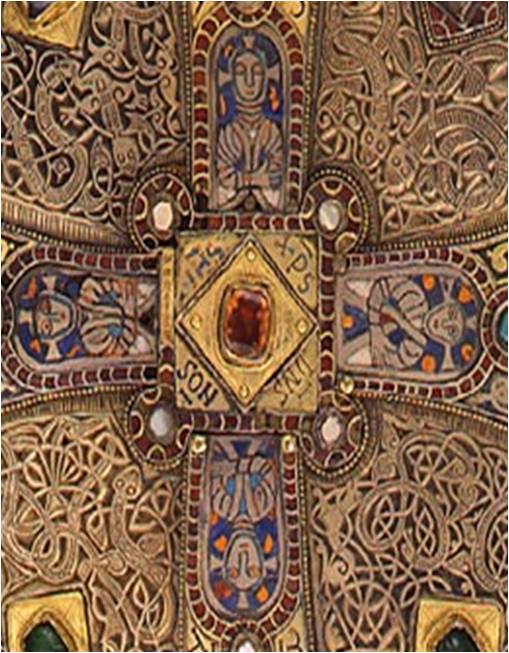
That is why the earliest crosses in Christian art, and countless crosses throughout the centuries down to the present day make no attempt to present a historically accurate representation of the cross on which Jesus died.  They are geometrical forms, often highly stylized and adorned.  Because the cross is not simply a memorial to the suffering and death of Jesus; and it is not only a disclosure of the falsehood of every rationale for terror, violence, and murder; it is first and foremost a revelation of the glory of God.  The cross is a sign of God who is life, whose love of life reached into our world of death in the person of Jesus.
Because he gave himself to the cause of life, the life that is the free gift of a loving God to all creatures, the forces of death gathered around Jesus.  Because he spoke the truth about the mercy of God, that is for the unjust as well as the just, for sinners as well as the righteous, for the poor and persecuted and afflicted as well as the proud and powerful and prosperous, they showed him no mercy.  But Jesus did not turn away from the end that meets all human life in a world enslaved to death.  He accepted its sentence, and suffered and died like all its other victims.  Yet he died without submitting to the power of death, without succumbing to fear or self-pity, or crying out for vengeance.   He completed on the cross the work of his life, of giving glory to God who is love that is unfazed by hate and life that has no traffic whatsoever with death.   And so his cross became our enduring symbol--of what death is not, and of who God really is.


About Me

My photo
Petaluma, California, United States
I am a priest in the Episcopal Church, and have been (among other things) an organic farmer and gardener, and a Zen monk. I have a lifelong interest in social and spiritual renewal on the basis of contemplative discipline, creative nonviolence, and ecological practice. In recent years my work has focused intensely on the responsibility of pastoral ministry in the humanistic, evangelical, and catholic branch of Christianity known as Anglicanism. I'm married with a daughter, and have three brothers and two parents.