Showing posts with label consciousness. Show all posts

Sunday, April 16, 2017

What we see is glory


There is something anti-climactic about the story of Easter.  It’s not like the Passion Story that comes before it: now that’s a story, the kind that bears telling and re-telling.  And we did that; we told and re-told the story of the Passion of Jesus, beginning last Sunday with a dramatic reading taken straight from the Gospel of Matthew and then re-telling and re-enacting, in traditional ceremonies of the church (locally-adapted, of course), the journey from supper at sundown on Thursday, through the long night of watching and praying in the garden, through the three hours of horror and sorrow on Friday afternoon, to the peace of Saturday morning, and the silence of the tomb.  It is a tragic story, but like all great tragedies it is cathartic.  It lets us feel the way we really experience the world a lot of the time but rarely get to express in community.  So there’s a way in which the betrayal, and trial, and crucifixion, and burial of Jesus feels like an entirely satisfactory climax to his story.
And yet if it ended there, it would not be the great story, the sacred story of two thousand years of religion, and music, of painting and sculpture, of drama, film, and literature, of the folk art and ritual of cultures from South Africa to Siberia, and Fiji to Guatemala.   It would not be the story that turns ordinary men and women into saints.  Not because it would be a sad story—the world is full of sad stories, and many of them beautiful—but because it would be only another sad story among so many.  The whole story of Jesus only becomes what is because of Easter.  But what kind of story does it become?   Does it change from a sad story to happy one?  Or from a true story to a myth?
Mary Magdalene and the other Mary run away from the tomb of Jesus not with fear and not with great joy but with both mingled together.  And this combination of fear and joy is what accompanies an encounter with what the great rabbi and philosopher Abraham Heschel called “the sublime”: that which transcends and radically calls into question our normal categories of experience.  Which is why it is essentially irrelevant to ask, concerning the resurrection of Jesus—“did it really happen?”  That is the question of a humanistic age, and its import is, “is this something we can fit into our conventional human story of reality?”  When you put it like that, the answer is clearly “no.”  But if the answer is “no; the resurrection does not fit into the story we human beings prefer to tell about ourselves,” it is because it is the answer to a different kind of question.  The resurrection comes into a human story, the story of Jesus and his disciples, but it is not our question to ask about that story.  The resurrection is the essential question that story asks about us. 
The story of Jesus and his disciples is our story, because it raises the essential questions put to us by our own existence.  They are the questions asked of us by being alive and being human: by our experiences of joy and love and healing, of freedom and forgiveness, and belonging in community; and our experiences of fear and hate, affliction and loss, of conflict and oppression and despair, of missing the mark, and being at loose ends.  These experiences, and the way they all somehow come together as the one experience of being alive and being human, also come together as a single question; a question that is bigger than we are, that we cannot answer and don’t even really know exactly how to ask. 
Reading the Bible is one way, our way, of entertaining that question, of letting it live, and work on us, so that we are not simply drifting half-asleep down our passage through this world being satisfied with our own answers to our own superficial questions.  For Christians the story of Jesus and his disciples is the crystallization of the question that the Bible asks us.  And in the story of the resurrection we find our answer.  And the answer is “yes.”  “Yes.”  The resurrection is God’s “yes” to the question of what it means to be human, a “yes” we can give in answer because we believe it was first given to Jesus, and then to his disciples, by God.
Just for that reason, faith in Christ’s resurrection is not a mental exercise, not a matter of convincing oneself that “I believe it really happened.”  We can believe that, but just as it is the answer to the question posed to us by our whole lives, it is an answer we must give with our whole lives.  That is why St. Paul urges us, in the Letter to the Romans, to understand that when we were baptized we died and were buried with Christ.   Which can’t have “really happened,” because here we are, alive.  So Paul must not be speaking to our rational intellects, to the part of us that asks and answers our own questions.  Rather he is speaking to the heart of our consciousness, to that inner image we have of being “I”, a person, unique and entire unto myself, who is alive and has a life story. 
And what Paul is saying is that to be “in Christ,” to really know and really live in God’s grace and spiritual power, it is not enough to accept the certitude of doctrinal assertions about Jesus.  It is not even enough to obey him as the authoritative moral teacher, and to attempt to practice what he preached.   These things are valuable and even necessary, but in and of themselves they are not enough.  Because what it really means to be “in Christ” is to surrender everything we are to God.  All of it—even that deepest, most essential heart of our being, that very sense of being a person who owns the copyright on the story of “me.”  If we give that up to God, with the nakedness of faith we see in Jesus, praying in the garden, “not my will, Father, but yours be done”; if we say “yes” to God with the abandon of love that we see in Jesus on the cross, we will get it back.  
It will be very like what it was before.  We will be the person we always were, the same weak, gifted, happy, sad, simple, complicated, stupid, brilliant, virtuous, sinful person.  The same mere mortal—only completely new.  We will be raised with Christ.  United with Christ.  “It is not I who live,” says Paul in Galatians, “but Christ who lives in me.”  And in Colossians: “You have died, and your life is hidden with Christ in God.  When Christ who is your life is revealed, then [who you really are] will be revealed with him in glory.” 
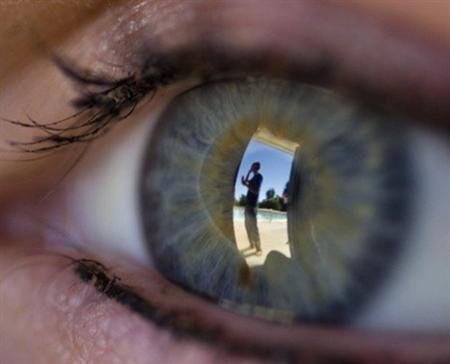
 
“The glory of the Father,” says our passage from Romans today, is what raised Christ Jesus from the dead.  Which is a curious way to put it.  Why the “glory”?  Why not the power, the mercy, the love, or the justice?   I think to understand what Paul is saying here we need to know that glory is not just one among many attributes that we assign to God by analogy to human characteristics.  The Glory of God is what belongs to God alone.  You could say Glory is God, because in so far as human beings can see God, Glory is what we see.  But what Christ’s death and resurrection renews in us is the knowledge that God does not keep his Glory to himself, but gives it away.   We may be looking upward at heaven, or outward at the earth, or inward at the uncreated image in ourselves, but if ours are the eyes of a heart that says “yes” to God, what we see is Glory. 
Mary Magdalene and the other Mary, arriving the tomb, experience it first as a kind of anticlimax, the emptying out of their expectations for how the story of Jesus will end.  But then, running away from the tomb with their strange new message, they meet the glory of God in person.   He greets them: “Hey!”—just the way one person would greet another on a bright spring morning on a garden path.  And they fall to their knees and prostrate themselves before him in the first-ever act of Christian worship.  But they also grab onto his feet, just to be sure.   

Saturday, January 3, 2015

Enlightenment on display


As has been reported in the Petaluma Argus-Courier,  I once lived for a number of years in a Zen Buddhist community, and if you spend much time hanging around with Buddhists you will sooner or later run across the concept of “enlightenment.”  Now, I’m not a Buddhist, or a Buddhist teacher, so I’m not going to try to explain that concept to you, but I did learn enough about it to realize that “enlightenment,” which is also sometimes called “awakening,” or “liberation,” is a lot more subtle and complex in Buddhist thought and practice that than our society’s popular notion about it might lead you to believe.  However popular notions are powerful things, and so at least part of the attraction that drew folks to the Zen Center was the hope of attaining enlightenment.
And that popular idea is a little easier to explain than the authentic traditional teachings.  It goes something like this: that a person might, through strenuous meditative discipline under the guidance of a master teacher who is him- or herself enlightened, achieve a direct, intuitive experience of ultimate truth that would dramatically and permanently alter his or her consciousness—in a good way.  This notion of enlightenment is not popular only with people who practice Buddhism. All over the world, and especially in certain places like Northern California, there are people following all manner of spiritual paths and traditions who have in common the cultivation of meditative states of consciousness and the desire for enlightenment. 
Some of them are even Christians, and I’m of the belief that if you study the history of Christian spirituality you will see that there is nothing inherently un-Christian about enlightenment or the pursuit of it.  In fact, beginning in January I’ll be leading a Sunday adult study course on a book that represents Jesus as a wisdom teacher, skillfully provoking his disciples to a radical transformation of consciousness.  It’s an image that speaks to an urgent desire that many people feel today to go beneath outward forms of traditional ritual and religious doctrine, which they find have lost their freshness and vitality, and to plumb the depths of direct religious experience.  So I’m not one of those who preaches fear and suspicion of this phenomenon, but see it as part of a welcome and much-needed reawakening of the Spirit.
But I also can’t help noticing that the image of Jesus as a kind of guru, who teaches the way to spiritual enlightenment, is missing something very important, maybe the essential thing that makes Christian religion what it is.  It might be hard to see if you’re sitting on your meditation cushion with your eyes closed, repeating a Jesus mantra in your heart.  But it is plain as day if you go to where Christians gathering on Sunday to hear the Word of God in the Holy Scriptures, and to celebrate the Sacraments.  It is at the heart of this yearly Church festival called Christmas, and our scripture lessons for today are all about it.
It is the news given in the Gospel of John that the true light, which enlightens everyone, has come into the world.  This light is nothing less than the life of all things, without which not one thing came into being, and now we have seen his glory, full of grace and truth.  This is not the cryptic language of esoteric instruction, but the plain-spoken, public announcement of something that is there for all to see.  Because the gospel of Jesus Christ does not begin from the premise that if we just find the right teacher and practice diligently in the right way we also have the capacity to attain the hard-won prize of enlightenment.  The gospel begins from the premise that the one who is light has come into the world, and offers enlightenment to anyone who wants it, absolutely free.
That doesn’t mean that we shouldn’t make an effort to open our lives to a more whole-hearted acceptance of this gift.  But it does mean that our basic religious attitude is not one of anxious striving or restless seeking, but one of celebration and thanksgiving, of trust, and wonder, and joy.  It is, as the scriptures point out in various places, the attitude of a child.  This is not just because Jesus himself had that attitude, and taught that it was fundamental, but because it is the stance that accurately reflects our relationship with ultimate reality.  Jesus’ own name for that reality was “Abba,” a word sometimes translated as “Father.” But that translation is not exactly right, because “Abba” is a child’s word—“Papa”, or “Daddy” would be better.
Every year at Christmas we encounter an image of Jesus, not as the masterful teacher of enlightenment, but as the tiny child at Mary’s breast.  It’s a powerful image not just because babies are cute, and people are sentimental.  It is powerful because it is an image of a person who hasn’t accomplished anything except to be born, who doesn’t desire anything except to be fed and kept dry and warm.  He hasn’t had any great mystical experiences, or said any timeless words of wisdom, or performed miraculous healings or heroic sacrifices.  He spends most of his time nursing and sleeping.  No one could be more helpless and vulnerable, and yet the scriptures insist that he is already the light that darkness did not overcome. 
I think it is instructive that in the ancient church, “enlightenment” was just another word for baptism.  Recently I had a meeting with our parish Worship Committee, which is a fairly new group that has formed to do some in-depth study and theological reflection about what it is we are actually doing when we gather together on Sunday in this building, so we can do it with more joy and sense of purpose.  We were talking about a book we’d read that said that when we come together for worship, it is not just the priest who is doing the work.  It is priestly work, but everyone participates in it, in whatever way they can, in hearing the words of scripture, and singing the hymns, praying the prayers, passing the peace, and sharing the bread and wine of the Holy Communion, and so the entire service is an act of the whole community.
The folks on the Worship Committee had no trouble with that concept at all, but some of them balked at the part in the book that said that the authority to share in the priesthood of the Body of Christ comes from our baptism.  I could understand where they were coming from.  How can we equate the decisive breakthrough to a whole new life, a new identity, and purpose, and way of being, with an experience that few of us can remember, that happened to most of us as infants?  When we go to church and see a baby having some water poured over its head, maybe crying about it, it doesn’t really square with our idea of what spiritual enlightenment is.
But maybe that’s because we’ve got the wrong end of the stick.  In the Worship Committee meeting we decided to forget about baptism for the moment and start a list of other words that might express the idea that all of us are called to be equal partners in the work of the church’s worship.  We came up with terms like “welcome,” “membership,” “belonging,” “initiation,” and “covenant.”  They were all words that have to do with community.  And, interestingly enough, they have all long been used to describe baptism, which says to me that we can’t really understand how baptism is spiritual enlightenment, if we think about it only from the point of view of the person being baptized.
Maybe what happens at baptism is the enlightenment of the community that is gathered to do the baptizing.  This would be true in all cases, but especially so when we baptize a child.  What we look at Christina and Cason, Tristan and Vincent, being picked up and washed in the water, maybe we are seeing a revelation of ourselves, as we really are in Christ: persons whose significance is not defined by human preconceptions, even our own, but is a word spoken in secret the full meaning of which is yet to be revealed; persons whose potential will not come to fruition without the love, guidance, support, and testing that a family and a community provides; persons participating in a drama we don’t ourselves fully understand, but in which we are called to play our own conspicuous role as one of the vulnerable but beloved children of God.


About Me

My photo
Petaluma, California, United States
I am a priest in the Episcopal Church, and have been (among other things) an organic farmer and gardener, and a Zen monk. I have a lifelong interest in social and spiritual renewal on the basis of contemplative discipline, creative nonviolence, and ecological practice. In recent years my work has focused intensely on the responsibility of pastoral ministry in the humanistic, evangelical, and catholic branch of Christianity known as Anglicanism. I'm married with a daughter, and have three brothers and two parents.