Showing posts with label Ascension. Show all posts

Tuesday, June 3, 2014

Bound for Glory


The glory of God, as the bible talks about it, is not a fact “about” God that we can use or not as we see fit.  It is not an “attribute of God” as a philosopher of religion might say, trying to describe what God is like.  Strange to say, the bible is not interested in describing God.  Rather, the bible is about the glory of God, and that is something that transforms the ones to whom it is revealed.  It awakens a response of the whole person, the whole community—a response of praise, of thanksgiving, of awe and joy and worship, of obedience and love. The glory of God shows us how much glory of our own we have to give. 
That’s why we sing in church, “Glory to God in the highest.”  Glory is not just something we can receive, it is something we can give.    So the essential question that the bible puts to us as human beings is, “to whom will you give your glory?”  Will you return it to the giver, to the one who is truly glorious?  Or will you give it to something lesser?  Will you follow the fallen angels and the ruler of this world, who try to keep the glory of God for themselves?  

When we talk about Jesus, about what makes him the Messiah, the Son of the Father, Christ the Lord, we very often say that he, unique among human beings, was without sin.   But the Gospel of John offers us a different vocabulary for thinking about Jesus, and it is all about glory.  John announces this in the prologue at the very beginning of his story, when he says, “the Word became flesh and dwelt among us, full of grace and truth; we have beheld his glory, glory as of the only Son from the Father.”  And after the wedding in Cana of Galilee, where Jesus changes water into wine, John adds that this was “the first of his signs,” that “manifested his glory; and his disciples believed in him.”

And if we also believe in him, it is not because we believe this or that thing about him.  We believe in him because of his glory, that brings the presence of God to us.  When we say, before the reading of the gospel at every celebration of the Eucharist, “Glory to you, Lord Christ,” we are not praising a book, or even the words in the book, but the presence we sense in the words.  We are saying that, listening to these words of Jesus, we are beholding life and truth.  We are on the way that leads to the fullness of presence, that we have a foretaste of in our sacramental celebration, where together we ascend into heaven, and unite with the chorus of angels singing “Holy, holy, holy Lord, God of Power and Might.  Heaven and Earth are full of your Glory.” 

Today we come to that part of the gospel of John where Jesus is ready to complete his work, by giving over everything that a human being can receive of the glory of God.  This he will do on the cross.  But before he does, he prays that the Father will receive his gift, and give him an even greater one, the glory of the Father himself.  And this God will do, by raising him from the dead, and exalting him to heaven.  We are now 43rd days from Easter.  It has taken us six weeks to get to this point, where we can understand just how far Christ’s resurrection takes us.  Because when Jesus prays to share the glory of God the Father, it is not for his sake, but for ours.   From now on, those who know the name of Jesus Christ, who keep his word, and believe that the Father sent him, will be the glory of God in the world.  And they will do this, says Jesus, when they are one, as the Son and the Father are one.

I spent last Wednesday and Thursday in the company of our Bishop, and the priests and deacons of our Episcopal Diocese of Northern California.  And I am happy to be able to report to you that the desire to be one, as the Son and the Father are One, is alive and well in this diocese.  It was manifest in the friendship and collegiality among the clergy, and between the clergy and the bishop.  The perspective I got was of a church that has ridden out the storms of conflict over biblical authority and human sexuality, and now desires something more than an end to hostilities—more unity, greater interrelatedness, a deeper sense of purpose, to glorify Christ for the sake of the world the Father sent him to save. 

In his informal report on Wednesday evening about what he’s been up to and thinking about, the Bishop told us about a church-wide conference that he attended in April in Memphis, called Reclaiming the Gospel of Peace.  It is part of a growing sense in the church that we need to speak out in response to our nation’s epidemic of self-inflicted violence.  And Bishop Beisner brought back from Memphis an invitation to send youth from every part of our diocese to join a pilgrimage taking place next summer in North Carolina, along the route of the Freedom Rides of the Civil Rights movement.  And if we decide we want to, and this first pilgrimage is a success, there will be an opportunity to join another, in the summer of 2016, which is going to Auschwitz.  The purpose of these pilgrimages will be to engage our whole diocese in supporting and learning from these young people as they become formed as ministers of reconciliation.

In a meeting of the clergy of the Russian River Deanery, the geographical subsection of our diocese that stretches from Sonoma and Petaluma in the south, to Fort Bragg and Willits in the north, we rediscovered our strong mutual interest in working together to support initiatives we cannot carry out on our own.  Among other potential arenas of collaboration we talked about supporting the Latino ministry currently centered at St. Paul’s, Healdsburg, and expanding it to other parts of the deanery.  I came away from that meeting with an invitation to preside at a girl’s traditional QuinceaƱera service in Healdsburg on August 9, where I will lead the Eucharist in Spanish for the first time in my life.

These are only two of the exciting possibilities that I heard about at the clergy conference, but they are enough to give you the gist of whole event.  And all this came along at a moment when I, personally, am quite tired.  It has been a long run from Ash Wednesday, and I’m ready for some summer vacation.  But when I think about these opportunities, even along with all the good work that we are already doing here at St. John’s, I get energized.  I think that is because this week showed me something about the church I’ve never quite understood before.  In the church we love the world, and our impulse to seek unity across barriers of race, religion, language, class, and even species, is how we give our glory to what God has made.  But it’s hard to know if we are going about it the right way.  Some of the projects that we talked about at the clergy conference may never get out of the starting gate.  They may never fulfill the potential we can imagine for them now.

But the real work of the church is not to improve society.  It is to bring the world our witness to its glory, as we have seen it in Christ.  We can only do this united, in an attitude of worship.  Our unity in prayer is our basis of hope for reconciliation, and healing, and peace, which is what we have to offer to the world.  When we are together in this way, we can dare to try almost anything, and it may succeed beyond our wildest dreams, or it may fail miserably.  We may even, as First Peter says, be reviled and suffer, but still we are blessed, because we know that our brothers and sisters in all the world are undergoing the same kinds of suffering.  Besides, being a smash hit and admired by everyone wasn’t what we set out to do anyway.  So there’s no reason to be anxious about any of it, because our only real purpose was to be united in giving Glory to God.   


Sunday, May 19, 2013

The true history of the world


Because today is Mother’s Day, I have to begin with a story about my Mother.  When I was a 8th-grader in Charlotte, Vermont, the principal of the Charlotte Central School was a man named Larned Ketcham.  He was a horse breeder in his off hours, and his manner with children reflected that.  A tall, solidly-built, square-jawed man with a proud bearing, he used to appear without warning in the school yard during recess and walk around, watching keenly everything that happened, and when he saw something amiss he would put his fingers in his mouth and let out a whistle that made 300 laughing, yelling children freeze in an instant.  One morning Mr. Ketcham must have decided that there was a general drift toward unruliness going on, and that it was no longer sufficient merely to intervene in individual cases; because when the final bus had arrived, and before the bell rang to mark the beginning of classes, he herded us all into the cafeteria. 
When we were all indoors and seated he whistled, and the din was instantly replaced with a dead silence.  He announced that the talking-to that he was about to give us was so important that the next child who spoke would spend an hour after school with him in his office that evening, which was Monday, and every evening for the rest of the week.  So nobody talked.  Nobody, that is, except me.  In the illusory safety of the far corner of the cafeteria I whispered some wisecrack to my friend Jim Mack, and from across the large and crowded room I heard the voice of Mr. Ketcham like the trumpet of doom—“Mr. Green!”  I stammered out a feeble denial, but my fate was sealed.  I, who had made it through seven-and-a-half years of compulsory public education without ever once being sent to the Principal’s Office, was sentenced to go there for the next five days.
That afternoon, filled with dread, I walked down to the lobby, and as I watched the other children happily bursting out of the doors toward the line of buses waiting to take them home, I took the left turn of the condemned man, and entered the school office.  There I was surprised to find Mr. Ketcham in a relaxed, if not outright friendly, mood.  He let me use his phone to call home and explain to my mother why I wouldn’t be on the bus, and what time she would have to pick me up.  He then made small talk with me for a couple minutes, after which we spent the rest of the hour in silence, him working at his desk and me doing my homework in a chair in the corner. 
The peace was shattered at 5 o’clock by the arrival of my mother.  I don’t know how much of her outrage was due to the harshness of my punishment, and how much was because of her inconvenience at having to fetch me home from school, but she went into battle with all guns blazing, while I sat to one side, feeling a mixture of relief and embarrassment.  Mr. Ketcham offered valiant resistance, but after manfully weathering a couple of salvos of Katie Green’s fury, he gave me a look that betrayed the slightest hint of a smile, and then we all knew he was beaten.  I packed my books into my bag, nodded soberly at the principal’s warning about learning my lesson, and followed my mother out to the car, my debt to society paid in full.
When somebody tells us that right now Jesus is with the Father in heaven, interceding on our behalf, this is often the kind of thing that comes to mind.  But the image of the redeemer pleading with a wrathful God, who must be talked out of inflicting on us the full punishment we deserve, doesn’t really fit the one example we have of Jesus’ intercessory prayer.
In John’s Gospel Jesus speaks and acts as one who is fully conscious of having come from God, and fully confident that he is returning to God.  This is especially true in the so-called “farewell discourse,” the long speech that he gives his disciples after supper on the night before his death.  In these three chapters, Jesus speaks of his impending death as if it is just a part—an important and indispensible part, but just one part—of a whole process of transformation that he calls being “glorified.”   And he speaks of this process that is about to take place as if it were already accomplished.  In the 17th chapter, which is where today’s gospel lesson comes from, Jesus completes his farewell discourse with a prayer, a prayer in which he speaks as one who has already left the world, who even now is standing face to face with God.
I don’t think that this is an accident.  John tells the story this way on purpose.  He wants his community to understand that the way that they  think and talk about Jesus, the relationship they have with him at the end of the 1st century, or whenever it was that the Gospel was written, is a relationship that Jesus himself anticipated and initiated.  The story of Jesus that John tells his church is not an invention after the fact, but flows directly out of Jesus’ own words, his own works, his own purpose.  And these words, these works, this purpose do not exist only in the church’s memorial, but they live in the present, hidden from sight, in God.
To the ones who reject him, the story of Jesus is only lies and broken promises—a man who claimed to be the Messiah but who failed and died.   But to those who believe in him, the rejection and the death are only the beginning of a journey that takes Jesus from life to death, to resurrection, to ascension to the glory of the heavenly throne, from which he sends the gift of the Holy Spirit.   And these events are the key that unlocks the meaning of a much greater story.  They retell the great story of the creation of human beings in the divine image, of our misuse of our freedom, and of God’s undying love for us, of God’s desire to restore us to our place as partners with him in the creation of a sacred universe.  The journey of Jesus into glory is what proves that this is no myth, no mirage, no human fabrication of any kind, but the true history of the world. 
John’s Gospel says that Jesus knew from the beginning that he was the person in whom God’s age-old story would be renewed and fulfilled.  He also knew that his rejection and murder would be the fork in the road.  Those who took his death as proof that Jesus was wrong and his story was over, would go on as before.  The world’s story of itself would continue, repeating its cycles of violence, its conquests and revolutions, its booms and busts, its spectacular achievements and just as spectacular catastrophes.  But on the night before his death Jesus tells his disciples that along with all of that something new would be happening, a new turn in God’s story of the world, that was beginning right at that very moment in that very room.
He told them that from the vantage point of one who had already renewed and fulfilled the story.  He told it to them as one who was already reconciled to the Father, as co-creator of a sacred universe.  He told it to them as one who had already entered paradise and stood face-to-face with God.  And standing there he had already begun his ongoing work, the work that he was doing when John wrote his Gospel, the work he still does now as I stand here preaching and you sit there listening, the work that he does whenever we pronounce his name with faith, hope, and love.  It is the work he does for us and through us when we pray, when we break the bread and drink the cup as he instructed, when in humble service we love each other as he loved us.  It is the work of revealing to the world its own true glory, and he will do it, and we will do it with him, until the world’s story of itself and God’s story of the world are the same story once again.
  

Tuesday, May 7, 2013

Letting Jesus be free


This week I heard from one member of our congregation about how he said good-bye to his dying father.  The same day I heard from another one about an unexpected test result and an uncertain diagnosis and the sudden possibility of having to say good-bye.  Not good-bye in the sense of “have a good night, see you tomorrow,” but as in “thank you for being a part of my life, I will never forget you.”  Having these kinds of conversations reminds me just how commonplace and yet complex a business saying good-bye is. 
And the closer the relationship, the more love there is between us, the more complicated goodbye becomes.  The man whose father died this week told about the strangeness of being in his father’s house, the day after, expecting any minute to see him come shuffling out of his bedroom to take a seat in his favorite chair.  And that it wasn’t going to happen, that it couldn’t happen, was a truth less real than the space his father had in the heart of his son, a space that remained alive and full. 
The ancient calendar of the church year allows us forty days to say good-bye to Jesus.  Since Easter Day, readings from the Gospel of John have been guiding us through this process.    Some of them have been stories of encounters with Jesus after his death, when he showed himself to his disciples and ate with them and told them things they couldn’t understand before he died.  He showed them that the space that their love for him had created in their hearts was still alive and full.  There was even a body.  But it wasn’t a body that didn’t die—the marks of his wounds proved that.   And it wasn’t a body they could hold on to.  Jesus’ resurrection doesn’t mean we don’t have to let him go.
We have to let Jesus go just like we have to let each other go.  It is the price of loving him.  It is how we learn who he really is, and what he really means to do for us.  But it’s not easy to let him go, because we haven’t seen his risen body with our own eyes.  We haven’t touched him with our hands, and so we make the same mistake with Jesus that we make with one another.  We imagine that because he is not here anymore, we have lost him.  We fear that his going away is absolute, final separation.  This can make us cling to our image of him.  But this only hinders us from knowing him as really is now.
When I left my previous position at All Saints’, Carmel I said good-bye with great care.  I knew when I was leaving, and where I was going, for three weeks before I announced it to the congregation.  The vestry of St. John’s, Petaluma kept the secret from the people here for the same length of time, and the public announcement in happened simultaneously in both places, on the same Sunday morning.  You see, we wanted people to hear about it first from me.  We also wanted to time the process of leave-taking so it would be not-too-long and not-too-short. 
All of this was based on sound professional advice.  There are whole schools of thought in clergy circles about how leaving a congregation ought best to be done.  There are numerous books and articles on the subject, all of them cautioning the importance of careful planning and preparation.  Now, I don’t intend any disrespect to my profession, or to make the light of the insights of people with far more experience than I.  But I do have to wonder why someone would wait until the very end of a pastorate to start saying good-bye.  What kind of relationships would make departure such a crisis?  What had those people been taught to expect?  Where were they placing their ultimate trust? 
In the Gospel of John, on the night before his death, Jesus gives his disciples a long good-bye speech.  It is consistent with his teaching in the rest of the gospel; whenever people are getting hung up on the details of his personal biography, questioning his credentials as a religious teacher, and whether his words and his works can be trusted, Jesus points them away from himself in the direction of the one he calls “Father.”  “I only say what the Father has given me to say;”  “The Son can do only what he sees the Father doing;” “If you knew me, you would know my Father also;” and so on like that.    
And now Jesus tells his disciples not to let their hearts be troubled or afraid.  He is saying good-bye, but it is a good-bye full of hope.  Because in going away Jesus will not be simply extinguished.  He will not become nothing.  He is returning to the Father, to the creative source of life and love.  And he is not going back simply to melt away into the Father like a drop back back into the ocean.  He is going back as the only Son of the Father, but also as the Son of Man, to dwell as the human Jesus in the heart of the eternal God. 
The relationship that we have with Jesus as a human person, that Jesus-shaped space in our hearts, can become the place where we meet the eternal wellspring of life and love.  But his coming to dwell with us, to be the saving justice that sets the world right, to be the spirit of truth that fills our hearts with peace, and confidence, and love, requires that we first say good-bye.  He has his own ultimate purpose, his own loving relationship to the absolute mystery.  It was that relationship that gave him his will, his words, and his power.   We have to allow him to pass beyond our knowledge into that dazzling darkness if we want him to come back as the source of freedom and grace.

Today’s lesson from Acts gives us a picture of how that works.  First of all, Paul has a dream.  A man from Macedonia appears to him in a dream and says, “Come over to Macedonia and help us.”  And that is all the prompting Paul needs, and he and his assistants set sail across the Aegean Sea, to a place where they know no one.   Following a hunch, they go outside of the city of Philippi one Sabbath day, looking for a place where Jews might gather to pray.   They find a group of women and sit down and speak with them.  And then, the scripture says, the Lord opened the heart of one of them, just one, named Lydia, “to listen eagerly” to what they said, and she got baptized and invited them to be guests in her home. 
This story describes how the word of Jesus Christ makes its way in the world.  It moves here and there in a manner that is hard to account for, that at times seems almost random, and yet suggests a deep and powerful purpose.  And what moves it along is the human heart, the dreams that we follow, the things that we learn to desire, the wisdom that we hears and recognize as the compelling and liberating truth.  It is the same truth that moved in the heart Jesus himself, the truth of who God really is, and what kind of relationship God wants to have with us, and how that can take shape in the lives we lead and the way we relate to each other.
This story shows us human beings who are free.  Though they are moved from within, it is in response to a love and a purpose that comes to them from somewhere else.  They are like actors in a drama whose main character never simply walks out onto the stage, but whose place is continually shifting.  He can show up in whatever manner the moment calls for, and always in a way that invites a free human response.  That invitation extends to you and me.  You and I can live with Jesus in that relationship of trust and purpose and freedom.  We only have to love him and seek to know him, and to keep his word.  That, and to let him be free.

Tuesday, June 7, 2011

Someplace Else.


Recently my daughter Risa has begun a new chapter in her life.  She’s begun to sleep over at the homes of her friends.  And so, Meg and I have been experiencing the strange new sensation of waking up in the morning and going to her room and remembering that she is not there.  This is the next natural step in a process that began that morning, over four years ago, when we first dropped her off for a few hours at the home of a friend who does child care.   And we can expect that with each year that passes the absences will continue to grow longer and more frequent.  It is becoming easier to imagine the day when she is grown, and her presence is the exception, rather than her absence.

When you think about it, absence is one of the salient experiences of our lives.  Our bodies occupy a single point in space, like a mote of dust swirling in the infinity of the places where we are not.   Each moment of present time is like a tiny boat drifting across the ocean of a past that is gone and a future that has not yet come.  And as real and compelling as our relationships and interactions with other people are for us, we are absent from the lives of those others, even the ones we are closest to, as much if not more than we are in them.

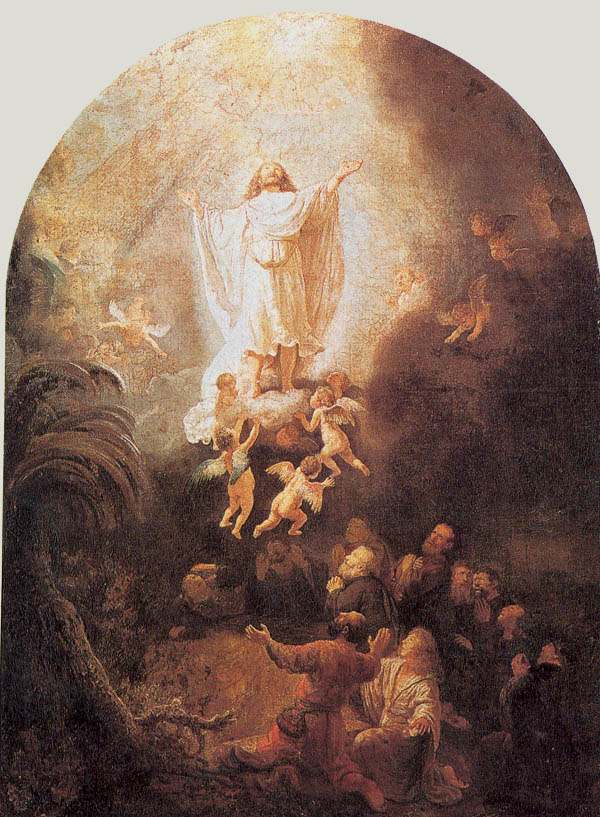
Perhaps when we think about these things we know what the apostles felt like, watching Jesus disappear from their sight into the cloud.  From the time they had first met him they had been drawn in by the power of his presence, by his proclamation of a kingdom that had finally, definitively come.  In him they found that the spirit of the prophets, so long absent from Israel, had not only come back but in spades.  In him the old promises of what would happen someday in the future, of return from exile, of a new King to sit on David’s empty throne, seemed to be coming to fulfillment. 

Then he died.  For two days he was nowhere, or if he was anywhere he was in the land of death, where nothing is remembered and from which nobody returns.  But then he came back.  “He is not here,” said the angel to the women at the empty tomb, which is to say, “He is alive, but not in the way he was.”  For forty days he was here and then gone, appearing and disappearing, suddenly present where his absence was most keenly felt, and then gone again.  

The apostles kept waiting for him to pick up where he had left off, as if his death had been just a kind of temporary setback, a flat tire that had been fixed.   But now, as they see him go away again, it is suddenly clear that the destination of their journey is not what they had thought.  He is lifted up before their very eyes, not suddenly vanishing but disappearing gradually from view on his way to…someplace else.  Which is where he still is today.  Not gone.  Certainly not dead.  But someplace else.  Someplace where he is alive in a way that only God can be alive, where he is present in a way only God can be present. 

Where is Jesus now?  Someplace which is not a place at all, because it is not limited by the extent of space or the duration of time.  Just as the division between Divine and Human nature is overcome in Christ’s Incarnation, just as sin and death are transformed in his Cross and  Resurrection, Jesus’ Ascension into heaven is where God’s grace reduces to zero duration and extension.  We can’t know any world but the one our minds construct out of concepts of space and time, this world of the speck of dust dancing in infinity and the tiny boat drifting across the bottomless ocean.  Where Jesus Christ is now is not in this “world.”  But his absence is the fullness of his presence.  The “someplace else” is the Glory of God.

Yesterday, I went with the elected lay leaders of St. John’s to the Bishop’s Ranch up in Healdsburg where we held our annual board retreat.  We went someplace else, so we could get a fresh perspective that would help us be more effective leaders.  But we took this place with us.  We were in beautiful surroundings on a forested hillside overlooking the vineyards that line the Russian River valley, but the whole focus of our prayer and our conversation was this community at the corner of 5th and C in Petaluma.  And Jesus’ ascension into heaven is like that. 

He goes up out of this world to another place, but he goes in his body.  In the gospel passage from John we hear today, Jesus prays on the night he is betrayed.  His public work is done.  He has eaten the Passover with his disciples, and washed their feet.  His betrayer has left, and he has instructed his disciples on what is to come.  And now he prays: “I glorified you on earth by finishing the work that you gave me to do. So now, Father, glorify me…”  All that follows is the answer to that prayer.

On the cross, God glorifies the body of Jesus, lifting him up as the enduring sign of forgiveness and compassion for the depths of our suffering and blindness.  On Easter morning, God glorifies the body of Jesus, raising it from the bondage of death and hell.  And on Ascension Day, God glorifies Jesus again by exalting him bodily to heaven, restoring the Son to the glory he had before the existence of the world.  But now he shares the glory of the father in a human body.  

And, as Jesus says in his prayer, all this is consummated in us.  The upward movement of the world into God in Christ is followed by the downward movement of the Holy Spirit, bringing God into the world.  Through this gift, Christ is glorified yet again in us, in the communion of those who believe in his name.  We are his body that transcends the extension of space and duration of time, filling the gulf of absence with the presence of glory.

Every time we celebrate Holy Communion, we sing of the holiness of God, saying “heaven and earth are full of your glory.”  This hymn comes from the prophet Isaiah’s vision of the heavenly throne, and the Eucharistic preface says that we are singing the same song as the angels and archangels who stand in attendance on the Most High.  Thus the song does what the song says.  Heaven, the someplace else where Christ reigns, and Earth, where his body is broken bread and poured wine, are united in the Spirit, in the fullness of his glory. 

This same Spirit unites us in one glorified body with absent brothers and sisters throughout the world, transcending the divisions of tribe and language and nation.  Likewise with our departed loved ones, and all God’s holy people of ages past and all who are yet to come.  All are present, all united in a single symphony of praise that fills creation and rings through eternity, “all of us”, as Paul’s Second Letter to the Corinthians, says “with unveiled faces, seeing the glory of the Lord as though reflected in a mirror, are being transformed into the same image from one degree of glory to another; for this comes from the Lord, the Spirit.”   Come Holy Spirit, that we may see the world in this light, not as the desert of your absence, but as the luxuriant garden where you dwell.

About Me

My photo
Petaluma, California, United States
I am a priest in the Episcopal Church, and have been (among other things) an organic farmer and gardener, and a Zen monk. I have a lifelong interest in social and spiritual renewal on the basis of contemplative discipline, creative nonviolence, and ecological practice. In recent years my work has focused intensely on the responsibility of pastoral ministry in the humanistic, evangelical, and catholic branch of Christianity known as Anglicanism. I'm married with a daughter, and have three brothers and two parents.