Sunday, November 13, 2016

Excluded by wealth


I got grants and loans to help my parents pay for the elite private college I went to.  But I had to earn the money for my personal expenses by working at a campus job.  In the public schools I’d attended in Indiana and Vermont, my family’s income was somewhere in the upper half of the broad tier of those of us who knew we weren’t poor, but weren’t rich, either.  Which included almost everyone I knew.   But when I got to college I grasped for the first time that there are some people who are rich.  Not rich like we are all in this country relative to peasants in the underdeveloped world, but really rich.  Like, children of middle-eastern despots or Wall Street hedge-fund managers kind of rich.   And I found being in the same world as them to be intimidating.  I was lucky, in that I was spared the humiliation of wearing a hairnet and slinging hash in the dining hall.  My job was in the library, re-shelving books.  And it’s funny to me now to think back on the embarrassment I felt wheeling my book cart past my fellow-students as if there were something shameful about being on a scholarship. 
But one Saturday evening in my sophomore year, a friend invited me to party with a friend of his in the next dorm over from mine.  This friend of a friend was someone every on our small campus recognized, because his last name was on, not one building on campus, but an entire quadrangle of science classrooms, and laboratories, and faculty offices.  And after I’d been hanging out for a while, feeling kind of awkward, I asked our host if I could play a record from his collection.  (Side note here--I’ll never forget how Bob Marley’s Babylon by Bus album sounded on his unbelievably awesome stereo).   And in his eager response to my request, I perceived something that had not occurred to me before.  Which was that he was deeply lonely and almost pitiably eager to be liked.  In that moment I saw that his privilege was an isolation cell, keeping him from ever knowing the freedom of being just an ordinary guy.  
The fellow named Zacchaeus who features in today’s Gospel lesson is not the only one in Jericho eager to see Jesus.  The crowd that lines the road through the town is so dense that a little guy like Zacchaeus can’t see over it.  The people in the crowd know who Zacchaeus is—everyone does—and if he had any friends among them, they might have moved aside a little and let him push his way through to the front.  But they all detest him, this rich tax collector, who hardly needs another privilege granted him.  So they stand, shoulder-to-shoulder, with their backs to Zacchaeus, while he jumps behind them, trying to get a glimpse of the man everyone’s talking about. 
But Zacchaeus is nothing if not resourceful.  He runs through the back alleys, to get ahead of the parade, and clambers up a sycamore tree to get an obstructed view.  And when Jesus gets there he looks up and greets Zacchaeus as if seeing an old friend.  “Hurry down from there, Zacchaeus.  I need to stay at your house tonight.”  And with touching eagerness, Zacchaeus scrambles down from his perch, and welcomes Jesus to be his guest.
Now where the point in the story where we learn that Zacchaeus is driven to try to see Jesus by something more than idle curiosity.  And maybe this is only just dawning on Zacchaeus, too.  But when Jesus recognizes him and calls him down out of the sycamore tree, and tells him he is worthy to take Jesus under his roof and be his host, Zacchaeus suddenly understands what he was really looking for— to put things right in his life.  He sees what he has to do to be restored to wholeness, and he finds the resolve to do it.  “I will give half my possessions to the poor, Lord, and if I have defrauded anyone of anything, I will pay it back four times over.” 
Now Jesus confirms that Zacchaeus has got it right.  He says it there, in the street of Jericho, in front of the whole crowd, so everyone can understand, that no matter what kind of person Zacchaeus has been in the past, no matter how his wealth, and his manner of getting it, have alienated him from them, today Zacchaeus belongs again to the community.  He is once again truly what he has always been in his essence, a member of the family of Abraham.   Because today he sets out on a new path, the path that Jesus call everyone to follow, no matter their history, or station in life, the path of integrity, and generosity, and compassion.         
This is the story of the call of a disciple, the final such story in the Gospel of Luke, and Luke’s is the only Gospel that includes it.  Mark and Matthew tell of a different encounter that Jesus had in Jericho, which also turned into a call to discipleship.  And Luke tells that story, too, right before the one about Zacchaeus.  It is the story of a fellow who also wants to see Jesus but can’t, not because he is short, but because he is blind.  Like Zacchaeus, he is marginalized, kept at the back of the crowd because he cannot see.  But he cries out “Jesus, Son of David, have mercy on me!” and the more those in front of him tell him to shut up, the more he shouts it out.  And as with Zacchaeus, Jesus stops, for the one that others tried to exclude; he asks the blind man “What do you want me to do for you?” and he asks to receive his sight.  Jesus tells that his faith has saved him, and immediately he is able to see, and goes after Jesus, praising God.
In one sense the rich tax collector could not be more different from the blind beggar by the roadside.  But by adding in the Zacchaeus story, Luke sets up a parallel which seems to suggest that they are really much the same.   They share the same determination to make a connection with Jesus in spite of the disapproval of the crowd.  In both cases, Jesus takes notice of them, and initiates a conversation.  In both cases, the result is healing and transformation.  And yet the differences are also significant.  The beggar asks for and receives a gift from Jesus, the physical restoration of his sight.   While for Zacchaeus the restoration is social and moral, and it begins with giving Jesus what he asked for—the hospitality of his house.  The one man goes off to follow Jesus, on the final miles of the journey to Jerusalem, but Zacchaeus is to stay put and set things right with the folks in Jericho.  
It might help us understand what Luke was trying to say here if we consider that this is not the only place in his gospel where wealth is a wedge dividing people from each other—think of the rich man who feasts while Lazarus lies starves at his gate, or the younger brother who squanders his inheritance, and is too ashamed to go home.  The strange parable of the dishonest steward is a story, only found in Luke, in which ill-gotten wealth, like that of Zacchaeus, becomes a means of reconciliation.  All of which suggests that Luke was wrestling with a problem that wasn’t much of an issue for Matthew and Mark, namely how to bring people of unequal economic status together in the same community. 
Luke’s says nothing to soften the warnings we hear in the other Gospels against making an idol of wealth.  And, if anything, he makes an even stronger case for what modern theologians have called God’s “preferential option for the poor.”  But when Jesus calls Zacchaeus to come down from his high place, and join the rest of us, he adds nuance to this picture, a nuance sometimes missing from our contemporary debates about inequality.  We see a growing awareness nowadays of how destructive our grossly unequal distribution of wealth is to the poor, and even to the endangered middle-class, how it is corrupting our public institutions, and eroding social solidarity.   But the gospel reminds that it hurts the rich, too, who in their own way are excluded from the unity God wants us to share.  Like people marginalized by disability or poverty, or ethnic or sexual prejudice, they need a way to be reconciled and restored to communion.  They are called to a path of discipleship.  And the example of Zacchaeus provides it, a path that, like the struggle of the oppressed for liberation, requires courage and sacrifice.  It begins with redistribution and reparations.

Guilty like me


A few weeks ago, the church Stewardship Committee drafted a cover letter for the forms we pass around every year at this time, so that people who wish to can go on record about how much they hope to give to the church in the coming year, in time, and talent, and money.  And every year, because this letter goes out in the name, not only of the Stewardship Committee, but also of the vestry (which board of directors), a draft goes to the vestry for review.  In the past, the vestry has typically given the letter a quick once-over, and said, in essence, “looks fine to us—where do we sign?”  But this year was different.   Maybe it was because the letter talked about making changes to the Stewardship program in order to deepen the conversation, but in any case, this year your vestry took a hard look at it.  They made editorial suggestions to clarify its message, but more than that they raised substantive concerns about its contents, and questioned some of its basic assumptions.
The vestry’s comments were mainly concentrated on those parts of the letter that talked about giving money to the church in proportion to one’s income, and in particular the traditional norm of the tithe, that is, of giving one-tenth of it.  Now tithing is a biblical standard, with a solid weight of church behind it, so I was a little surprised at first when the vestry called it into question.  After all, the Stewardship Committee’s language in the letter about these things had been simply carried forward from last year’s letter, and last year’s from the year before, and no one raised an eyebrow about it then.  But, of course, maybe that’s just because no one was paying attention.  
However, one of the things that I value most about this congregation is that its’ members do notice, sooner or later, when we are doing things that don’t sit exactly right with them, even things that are “traditional,” and they aren’t afraid to question them.  And the truth is, we haven’t really taken the time before now in the vestry, or even in the stewardship committee, let alone the wider congregation, to look at why and whether tithing really is an expectation we have of ourselves and one another.   So I took the discussion about it in the vestry meeting as a sign that the Stewardship Committee is on the right track in saying it is time for us to open this topic up for a deeper conversation, and as a promising start in that direction.
The most telling moment in the discussion, for me personally, came when someone said, and I’m paraphrasing here, “I don’t tithe, so how can I tell the congregation that this is something they should be doing?”  Which would have been the perfect opportunity for me to lead by example, and to take a stand for the traditional norm, by saying, “well, I do.”  Except the truth is that I don’t.  Most of the time I feel guilty about this, like it makes me, on one level, a fraud, who is shirking his ordination vow to “pattern your life and that of your household in accordance with the teachings of Christ, so that you may be a wholesome example to your people.”  Somehow, though, when that vestry member spoke out in such a forthright way, I felt relieved.  I was even thankful that I have, as yet, failed to meet the standard of the tithe, because if I hadn’t I would have been sorely tempted in that moment to say so.  And there would have no way to do that without putting others in their place.  As it was, I had no leg of moral superiority to stand on.
I do know people, even some in this congregation, who can speak quite movingly about how committing to the tithe has helped them to grow spiritually.  But none of them talks about their satisfaction in setting a good example for others.  Nor do they mention a feeling of relief at having rid themselves of the guilt of not tithing.  They are more likely to talk about discovering a freedom and joy in giving that makes them want to do more.  And when you think about it, there is something arbitrary about the tithe--if the idea is to honor God and acknowledge our dependence on God’s providential goodness, why stop at ten percent?  It’s a norm that comes from the Jewish law, and without negating it, Jesus sets quite a different standard.  You can find it in the 18th Chapter of the Gospel of Luke, a few verses after today’s reading: “One thing you still lack.  Sell all that you have and distribute to the poor, and you will have treasure in heaven.” 
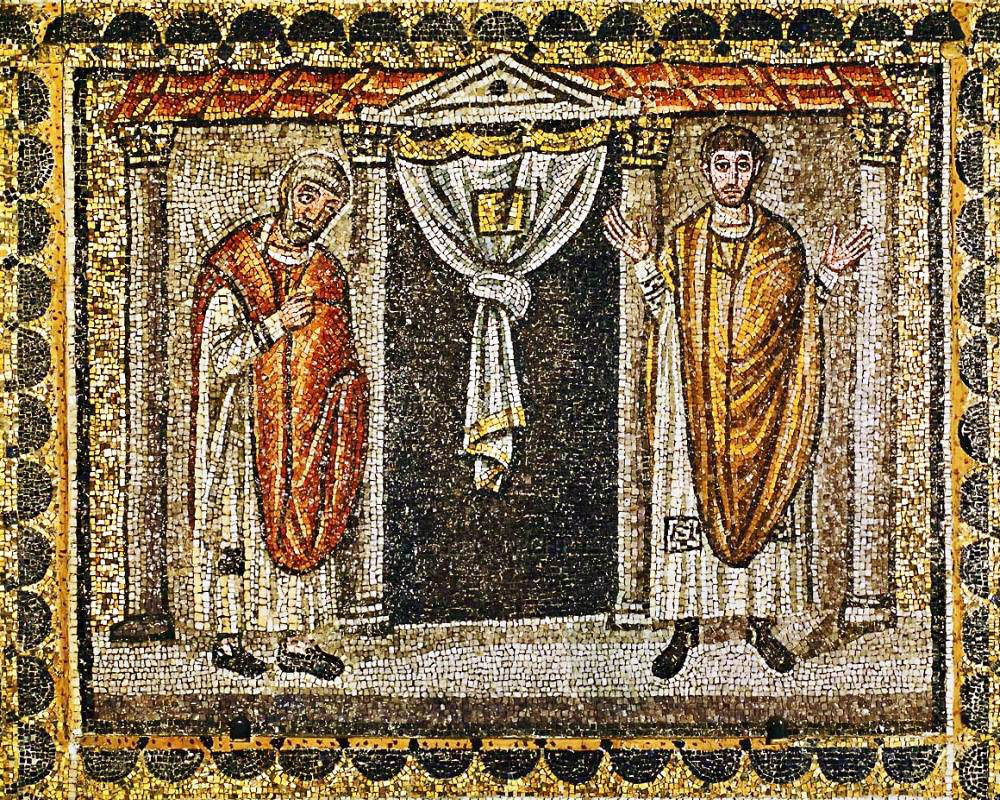
There’s nothing in the Gospels to suggest that Jesus was against tithing, but teachings like the story of the Pharisee and the tax collector warn against thinking that tithing or not tithing makes a difference to God.  Jesus seems to assume that most of his audience don’t, or why else would the Pharisee imagine that his tithing sets him apart from other people?  Of course the tax collector thinks of himself as set apart also, for a different reason.  People despised tax collectors as treacherous and wicked because they collaborated with the pagan and idolatrous Roman overlords.  And for a person with a sensitive conscience that must have been a heavy burden to bear.  No doubt that is why this man is beating his breast and crying out “Lord, have mercy on me a sinner.”  But Jesus seems to think that this is an appropriate way of relating to God, not just for tax collectors, who were generally landless people, just doing what they had to do to survive, but for all of us—“Lord, have mercy on me a sinner.”    
We modern liberal Christians are wary of such lavish expressions of guilt and repentance, which we associate with an oppressive religion that is, thankfully, out of date.  And it is true that the church has used guilt to terrible effect, causing untold harm to countless persons.  But that is because its teaching has often implied, whether openly or not, that there are some people who are not guilty, saints or pastors or priests or popes who have made the grade with God and now stand in moral superiority over the rest of us. 
But if you look at the moral standards Jesus sets, they are so high that only God can meet them, and this has the effect of showing that we are all guilty.  Consequently, no one is in a position to condemn.  Any money we have is dirty money, as long as there are people who have none, and the tax-collector in the story is far more ready to admit this than the Pharisee.  Which makes him the kind of person God can work with, a potential member of the new, redeemed community that Christ is bringing to birth.
I think that Jesus has that community in mind when he comments at the end of his story--“for all who exalt themselves will be humbled, but all who humble themselves will be exalted."  To me, this is not a description of a system of rewards and punishments, but of what it will realistically take to arrive at a community where there are no longer superiors and inferiors, but where we can all look each other in the eye.  And the allure of that community is enough to exert a draw even on a greedy, bewildered, and cowardly person like me. 
For that reason, I value the tithe as a personal guidepost.  Jesus’ advice to sell all I have and distribute to the poor seems impossibly remote from where I currently stand, sinner that I am.  But giving away ten percent is a goal that is, at least imaginably, within range.  It is close enough to exert a gravitational pull on my generosity, stretching me to give a little more every year, not only to the church, but to other organizations that also do the work of exalting the humble.  I say this as someone who lives in security and comfort, in no danger of going without the necessities of life, at least for now.  What Jesus reminds me is that this is not a condition that I, any more than the poorest person in the world, can claim to deserve.    

Don't lose heart


In the Godly Play room, where our children are right now, hearing about the Exodus, the storytelling materials for the parables of Jesus are on their own special set of shelves.  And while the other materials are out in the open, in uncovered baskets or displayed on little racks, or just sitting there on the shelf for anyone to see and pick up as she wishes, the parables are each hidden away in a box.  With a lid.  The boxes and their lids are painted a shiny gold color, and we tell the children that this is because there is something precious inside, something more precious than gold.  But the box has to be opened, like a gift.  And unlike a present wrapped in paper at a child’s birthday party, the gift of a parable is often hard to open.  It takes time, and a certain inner readiness, to wait and watch and be present to the gift until it opens of itself.

Now that can be frustrating, because the language of Jesus’ parables is so deceptively simple, it seems they should be easy to understand.  They describe everyday things or people in situations not very different from the ones in our own lives.   So if they are closed to us it is not because of specialized technical vocabulary, or because they don’t make sense on their own terms.  They are closed to us because it is hard to see sometimes what these stories could possibly be telling us about God.  And in that sense, the parables open from inside of us, if they open for us at all, because they make us examine what we think we know about who God is, and how God acts, and where God is showing up in the story.  Jesus teaches in parables so that we will do our homework, and not just take someone else’s word for it when it comes to questions of faith.
Which can be a problem if you’re trying to explain those teachings to someone else.  Today’s epistle reading counsels Timothy to be persistent in proclaiming the message, whether the time is favorable or unfavorable, and to teach with utmost patience, because people tend to prefer religious instruction that is comfortably tailored to fit what they already believe.  They aren’t necessarily interested in opening for reexamination their basic religious assumptions.  This may be why the authors of the Gospels, while they sometimes simply give us Jesus’ parables as-is, often will take pains to set them in an interpretive frame, as if we won’t be able to open the gift without a key.  In the case of today’s Gospel story, the author of Luke gives us what he thinks is the key, by introducing it in this manner: “Jesus told his disciples a parable about their need to pray always and not to lose heart.”  Which is fair enough, and we’ll come back to it later, but first we have to see what’s going on in the parable itself. 
It is the story of a judge, self-admittedly a hard-hearted and arrogant man, who eventually gives in to the persistent badgering of a widow—not because he is persuaded of the justice of her cause, but in order to stop her from hounding him.   Now, our translation actually takes a little bit of the edge off the story when it has the judge say that he fears the widow will “wear him out”.  Because what the Greek text literally says is that she will “give him a black eye.”  Now, I don’t think this means he’s afraid she will show up in his courtroom one day with a rolling pin and give him a good one upside the head.  But in English we sometimes use the figure of speech “to give so-and-so a black eye” to talk about shaming that person publicly, or doing damage to his reputation.  And I wonder if the popular speech of Jesus’ day had a similar expression.
And let me tell you why I think the story actually makes more sense if we read it that way.  You see, widows are often cited in the Bible as a class of persons who need special social and legal protections, because they are particularly vulnerable to exploitation.  One reason for this is that a widow has no husband to help her with the hard work of earning subsistence in an agrarian society.  But a less obvious reason why a widow is vulnerable is that she has no one to advocate for her interests in the public square.  Under Jewish law, women did have certain legal rights, such as being able to own property.  But a right that exists on paper is not effective if you don’t have the means to defend it. 
And, as in many conservative societies even in today’s world, women in ancient Israel were supposed to confine their activities to the domestic sphere.  While the widow in Jesus’ story would have been entirely within her rights to go to the public court, it would have been unseemly for her to do so, to stand in the middle of a crowd of strange men and argue her case.  So she doesn’t only have to deal with the callous disdain of our judge; she also risks the scorn of her neighbors.  But she goes anyway, again and again, and, over time, she begins to appear less and less like a figure of ridicule, and more and more like one of valiant persistence in the face of justice denied.   The taint of shame that follows her begins to bleed over onto the judge, who eventually comes to see that he may be the one to end up with a black eye.
All of this reminds me of a marvelous documentary film that came out some years ago, called “Pray the Devil Back to Hell.”  It is about the mass movement of women in Liberia, originating in the Christian churches, but growing to intentionally include Muslim women as well, that unseated a tyrannical president and put an end to that country’s 14-year civil war.  The decisive scene in the film comes after the women’s nonviolent protests have forced the government and rebel factions to engage in UN-sponsored peace talks in Accra, the capital of Ghana.  But the negotiations have stalled.  And so the women raise funds to buy a group of their senior leaders tickets for the three-day journey by bus to Accra.  When they get there they find the young men of the so-called peace delegations happily whiling away the days in UN-provided hotels, drinking the UN’s liquor, and making boastful and defiant speeches to each other vowing never to compromise.
So the women again take matters into their own hands.  They surround the exits to the building where the peace conference is taking place and tell the men inside that if they try to leave the building before reaching an accord the women will take off their clothes.  Because in their culture it is a shameful thing for a woman to be seen naked by a man not her husband.  But it is, if anything, even more shameful for a man to see a woman naked, especially one the age of his mother.  Two weeks later President Charles Taylor was exiled to Nigeria, UN peacekeeping forces entered the Liberian capital of Monrovia, and a transitional government was formed, leading to democratic elections.  On November 23, 2005, Liberia elected Ellen Johnson Sirleaf the African continent’s first woman president.    
This victory, as the title of the film, “Pray the Devil Back to Hell” suggests, came about through prayer.  And Jesus suggests the same of vindication of the widow in the Gospel.  In both cases, it is prayer founded on faith, a faith in the justice of God so powerful that it moves these women to courageous and persistent action.  Theirs is prayer for God’s justice, made right in the face of those who deny that there is any such thing as justice, those who have no fear of God and no respect for people.  It is prayer founded on a faith that is ridiculous in the eyes of those who have lost heart, those who don’t bother to pray for such things anymore.  It is the prayer, and the faith, of Jesus himself.  
This parable of the widow and the judge is one of the last that Jesus gives before he enters Jerusalem.  It begins the same chapter where he says “he will be handed over to the Gentiles; and he will be mocked and insulted and spat upon. After they have flogged him, they will kill him, and on the third day he will rise again.’ And Luke says that when he said this, his twelve disciples understood “nothing about all these things; in fact, what he said was hidden from them, and they did not grasp what was said.”  Which makes it sound like they’d been given a parable. 
       

About Me

My photo
Petaluma, California, United States
I am a priest in the Episcopal Church, and have been (among other things) an organic farmer and gardener, and a Zen monk. I have a lifelong interest in social and spiritual renewal on the basis of contemplative discipline, creative nonviolence, and ecological practice. In recent years my work has focused intensely on the responsibility of pastoral ministry in the humanistic, evangelical, and catholic branch of Christianity known as Anglicanism. I'm married with a daughter, and have three brothers and two parents.