Tuesday, August 23, 2011

Grounded in this new and different thing


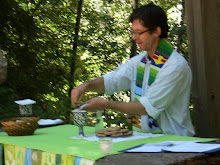
Last Saturday I spoke at the wedding of my cousin Julie at a ridge-top ranch near Calistoga.  She had called me a month or so ago and said that she and Andrew, her fiancĂ©e, had talked it over and decided that they wanted a touch of something traditional, even religious at their wedding and would I be willing to provide it.  I said I would..  If it sounds a little vague, that’s because it was.  A subsequent conversation a week or so before the wedding didn’t make it any clearer exactly what I was being asked to do.  But I finally got more specific instructions at the rehearsal on Friday evening. Andrew and Julie’s “life coach”, named Kate, who was officiating, let me know that I was to give an invocation and prayer at the beginning of the ceremony, right after the entrance procession and her opening words of welcome.
So I composed something that I thought would be suitable for the occasion, and at the appointed time I made my way to the front of the assembly and offered it.  It wasn’t a bad place to pray, with Mt. St. Helena filling the horizon behind me, and a flamboyantly-attired collection of my family, the groom’s family and assorted hipster bohemians from San Francisco baking in the sun before me.  I did use the “G”-word, right up front, but I carefully avoided gendered pronouns and I left Jesus out of it.  Basically I invited us all to become aware of God’s eternal loving presence, to give thanks for our blessings, and to pray for further blessings for my cousin and her husband.  It was over in a little more than a minute and then I returned to my place.
If anybody took offense at what I said, they were polite enough not to say so to me.  And several people told me they appreciated it.  In particular, Kate, the life coach, thanked me for helping her get “grounded” as she put it, for the things she had to say, and the role she had to play.  And I was especially touched on Monday when Andrew, the groom, came by with Julie to pick up their dog, which we’d been babysitting for the weekend.  He told me that he hadn’t really anticipated what it was that I was going to bring to the ceremony, or how different it was going to be from what Kate had to say, until I got up there and started saying it.   And he wanted me know that when I did what I did, he realized it was important, and that he would have missed it if it hadn’t been there.
In her words at the wedding Kate had many wise and meaningful things to say about Julie and Andrew and their relationship, about the importance of the assembly of family and friends that was there to witness and to offer support for their marriage.  But all of it was on the human level.  There would have been something incomplete about it without the acknowledgment that all of these good and praiseworthy things come to us from God and speak to us of who God is. 
As I reflected on this experience this week I thought about how privileged I am to belong to a community where we get “grounded”, as Kate put it, every week, where the “something different” that Andrew talked about is at the center of everything we do.  And I thought that this might be what Jesus means when he says in today’s reading from Matthew, “on this rock I will build my church.”   
I could contribute that missing piece to Julie and Andrew’s wedding because I’ve learned a little about how to pray.  I’ve come by what I know not by magic, but by regular and repetitive practice.  If I know something about what it takes to help a group of strangers to become a community of blessing, it’s because I have participated regularly for many years in assemblies like this one here.  And if I have a sense of trust and confidence in addressing myself to this “God” character it is because I have come again and again to hear what the Bible has to say about her and to be nourished at her table.
When Jesus asks his disciples “Who do people say that the Son of Man is?” they answer him on the human level.  “Well, some say this person, some say that one—but all agree that you are some kind of rerun of one of the great prophets of the past.”  But when he asks “Who do you say that I am?” he’s asking them a different kind of question.  And it is Peter who is able to give a different kind of answer, “You are the one we have waited for from the future, the one who is coming to make everything new.  You can only be understood in relation to God’s own self.”   
Now the point of the story is not that Peter was the contestant with the right answer, and so won the prize.  What matters most is that Peter understood that Jesus wasn’t asking for a right answer, but a creative response.  “Who do you say that I am” is a question for all of us.  What we are being asked to do is not to repeat Peter’s answer because it is the “right” one, but to give our own answer, an answer that says “In you I recognize God.  Whoever I thought God was, whoever I thought I was, you have shown me that there is something different going on.” 
Each person comes to this question, “who do you think that I am?” by a different path.  And we may not always even recognize our response as a faithful one.  When I first came back to church in my late twenties it was the music and the communion that spoke to me, but much of the rest of it, the Creed, the confession, the scriptures, the congregation with its social events and its committees, was an obstacle.  It took me a long time to appreciate that, while I had to answer the question for myself, I wasn’t doing it alone.  It took me a while to understand that he “you” in the question “who do you think that I am?” is plural. 
Peter may have been the first to give Jesus a truthful answer, but later on in the story, on the night of Jesus’ betrayal, he will deny him three times.  It will take the witness of the women at the tomb, and Jesus’ forgiving presence in the resurrection community, for Peter’s answer to become rock-solid.  It is for the sake of that resurrection community, against which the gates of Hades will never prevail, that God revealed to Peter that Jesus is the Christ.  In the same way, any answer we would give is just an opinion about the past, unless it is fitted in some way into this thing we call “the church,” this new and different thing that someday will really be.   
Knowing that we are founded on this rock give us the confidence to give our own answer to the question even if it is provisional, partial, and shot through with uncertainty.   And we can do it in all kinds of circumstances, with all kinds of people, using all kinds of language.  We find ourselves in situations all the time where talking to people about Jesus is not going to be helpful.  But that does not mean that Christ is any less present. 
We don’t worry too much about whether we have the answer exactly right, because the true, objective fullness of who Jesus is has yet to be revealed.  But even with our imperfect faith we can proclaim that he is the Christ because we belong to the body in which God reveals it.  It’s not an idea for us, not a doctrine we try to believe—it’s the ground on which we stand, whether we or not we feel it on any given day.  Sometimes when I make my way along the communion rail putting pieces of bread in your hands and saying “the Body of Christ,” it is your faces, your hands, your postures of prayer that make these words true for me.  And sometimes, for you, it is my saying them. 

Miracles not meant for us


The closest thing I’ve ever experienced to the perilous sea-crossing that we hear about in today’s Gospel lesson happened one summer day when I was about 13 and my Dad and I borrowed a sailboat from a neighbor and sailed across Lake Champlain.  It’s a long lake, and very deep, but not terribly wide at the place we crossed, maybe two or three miles.  Anyway, we got over to the west side, to Essex, New York, where we tied up at the municipal pier and walked around a bit and got an ice cream cone, and then we started back.  We’d gone about a third of the way when two things happened at the same time.  First, the wind died.  Second, out of the dense black cloud that seemingly formed in an instant over the mountains to the west came a deep roll of thunder.
The little sailboat didn’t have an outboard motor but there was a canoe paddle and so my father leaned over the side and paddled while I created a little propulsion with the rudder by pushing and pulling the tiller to and fro.  We crawled along like that, with the sky getting darker and the thunder sounding closer, glancing up nervously from time to time at the tall aluminum mast and the sails that hung limply from it.  After what seemed like a long time we saw a line of different colored water advancing toward us across the surface of the lake from the direction of the storm.  It was wind and it hit us in an instant, filling the sails. The rain was right behind it, and we ran before that wind through a heavy downpour, all the way to the Vermont side.   And when we got there Judy, the owner of the boat, and my mother were waiting for us on the beach with their hands on their hips.  I’m not sure which was worse for my poor father, the sight of the storm behind us or the sight of those two women ahead.  But we tried to play it off as if we’d never really been worried-- “What’s wrong?” “Why did you doubt?”
“Why did you doubt?” is Jesus’ question to Peter after his short-lived excursion walking on the sea.  I used to read this as a veiled accusation, as if Jesus were disappointed with Peter for failing his test.  But now I think it’s a question offered with compassion and affection.  It is something that Jesus really wants Peter to think about.  “You of little faith, why did you doubt?”  But of course Peter could not sustain his total focus on getting to Jesus.  Of course his mind wandered, his attention shifted, he saw the wind, and was frightened.   Out there on the face of the water, with his friends and his boat left behind, even with the grace of the God incarnate flowing through him, it quite naturally occurred to him to think about the habitual object of his worry and preoccupation--himself.  And when he did this, he sank.   His heart is not pure, his will and consciousness not united completely moment after moment after moment with God.  Jesus knows this about Peter.  And he knows this about us.  But does this mean that we have failed?  Does this mean that we are doomed?  I don’t think so.  What is lacking in us shows up in this story but only to illuminate in greater relief what is present in Jesus, which is what the story is really about.
You see, Jesus did not test Peter by having him walk on the water.  That was Peter’s idea to test Jesus.  He showed himself as a man of little faith not when he got afraid and sank, but when he said to Jesus, "Lord, if it is you, command me to come to you on the water."   Peter is not satisfied when Jesus says, "Take heart, it is I; do not be afraid," but demands that he prove it by giving him something—in this case a supernatural power he is not ready or able to use.  And this is how it often is with us.  We may feel like the disciples, like we’ve been rowing all night against the wind, and the waves are battering the boat, and we are beginning to fear that we aren’t going to make it.  In such times we might turn to God for help, but very often what we hope and pray for is a miracle. 
We assume that if there is a God, he would give us the thing we lack.  It might be money, or the healing of a disease, or a new job, or even a new attitude of confidence and faith in ourselves, but whatever it is, we hope and pray that there is a God who will give us mastery over this situation that feels out of our control.  But the truth is that there are some lakes we don’t get pulled out of.  There are some problems that never get resolved.  Maybe that husband never will quit drinking.  Maybe that child never does come home.  Maybe that illness isn’t going to get better.  Maybe those times of prosperity aren’t coming back. 
But does that mean we’ve failed?  Does it mean that we weren’t faithful enough, didn’t want it badly enough, didn’t pray hard enough?  No, it does not, because that wasn’t the test.  The test of our faith is not whether we can get God to work a miracle for us.  God works miracles for us every moment of every day.  There are just some miracles that aren’t meant for us, as much as we might be sure that they are.
The real test of our faith is this—do we despair of God?  I don’t mean do we get down sometimes, or do we have our bad days, or even go through long periods of doubt and darkness and grief—we do all these things, and Jesus knew all about them.  But do we give up hope?  Do we give in to our fear and imagine that God has abandoned us, or worse, that God is some kind of avenging ghost, stalking us angrily across the dark water?   The message of the gospel is that even when things are at their worst, even when we’re far from land and the storm is raging, and we’ve been rowing all night and the dawn seems it will never come, even in times when it seems as if we are helpless and chaos will overwhelm us, Jesus Christ is still able.  Jesus Christ can still find us, even in the stormy darkness, and in his presence there is hope and peace. 
This accords well with what Paul is saying in Romans when he writes that the word of faith is not “who will go up to heaven to bring Christ down?  Or who will go down to the dead to bring him up?  But the word of faith is near you, on your lips and in your heart.  If you confess with your lips that Jesus is Lord and believe in your heart that God raised him from the dead, you will be saved.” It is a shame that this teaching, which is about the grace that gives us faith and restores our hope and is close by at all times, has been turned into another kind of test. 
To say that Jesus is Lord is to say that he is Lord of Chaos and Creation, he is master of Life and Death, he is sovereign of Bliss and Suffering.  And so to be “saved” is not to happy and upbeat at all times, or to never struggle, or to get everything you pray for.  It is rather to know that even though we may not be perfectly aligned at all times with God’s will for our lives, and may even be in the dark about what that is, there is one who is, and does, and he will not lose track of us.  It is to know that even though we cannot walk on water there is one who can, and will use even our floundering in the service of his great mission.  It is to have confidence that however feeble and unsatisfactory our performance may sometimes be, he does not condemn us, but accepts whatever we can give and calls us to take heart, to keep going, to keep hoping for the completion and renewal of the whole creation that has already begun in him.

Monday, August 1, 2011

Fundamentals


Last Saturday my family and I arrived at my sister-in-law Cathy’s house near Washington, DC after a long day’s drive from the beach in North Carolina.  Cathy and her family had left the same beach house we did a couple of hours before us and on the ride home had turned on the radio to get caught up on the news.   After we had unloaded our bags and were having a drink and a snack in the kitchen, she asked if we’d heard about the terrorist attack in Norway.  She stole the subtlest of glances at me out of the corner of her eye and said that it was being reported that the perpetrator was a “fundamentalist Christian.”  I said something like “I wonder what fundamentals of Christianity he thought he was observing?”   Which is pretty typical of how I handle such situations.  
 Actually, I’ve gotten so tired of practicing that kind of rhetorical jujitsu that I often don’t even bother anymore.   Earlier in the week, Meg’s stepbrother had announced at the dinner table that he could never espouse a religion that would tell him what books he couldn’t read or whom he had to kill.  This was followed by an uncomfortable silence.  I don’t know whether anyone at the table besides me thought that I was supposed to field that remark.  But what could I say, “Well, me neither”?  I should think that would be pretty obvious to anyone who knows me.  So I didn’t say anything. 
Christian identity can be a burden in today’s world, because of the prejudice that non-Christians hold against the church and its members, but also because of those Christians who insist on confirming the stereotype.  We can end up feeling a little like St. Paul, who writes in the Letter to the Romans about “the great sorrow and unceasing anguish” he bears in his heart over the refusal of his fellow Israelites to accept that Jesus is the resurrected Messiah.  When it came to the violence in Norway, I guess I felt compelled to make sure Cathy understood that Anders Behring Breivik and I do not share the same faith.   
When Monday came and I was back home and doing a little catching up on the news myself I found that the national spokesmen for the Christian right had been making the same argument.  Breivik cannot be a Christian, said Pat Buchanan and Bill O’Reilly and Bryan Fischer of the American Family Association, because no follower of Jesus can be a mass murderer.   Like I might have done, they pointed out that being Christian is not a racial, or national, or even a religious identity.  It has something to do with following Jesus, with living as he lived and believing as he believed, or at least trying to.  Like me, those conservative pundits resented the failure of the media to make that distinction. 
So I got to enjoy the novel experience of agreeing with those fellows.  Or so it seemed for a moment.  But then they went on to say that while they reject Breivik’s methods, and disown him as a Christian, they find his social and historical analysis “accurate.”   They had read the massive manifesto that he posted on the internet the morning of his crimes and concluded that he is right about many things.  He is right that Western civilization is facing an existential threat from Islam, which commands its followers to conquer and kill infidels in the name of Allah.  He is right that Muslim immigrants into Europe and America are the advance scouts in this holy war.  He is right that they are being given aid and comfort by liberals, whose insidious doctrine of multiculturalism has muddled our thinking and sapped our will to resist.
Now I don’t intend to minimize the real problems of mass immigration.  There can be no doubt about the real social and economic stresses it is causing in North American and Western Europe.  But I can’t agree that demonizing the immigrants, or those who call for their acceptance, is the remedy.  So I’d like to counter Anders Behring Breivik with a little historical and social analysis of my own.  As I see it, the problem of Muslim immigration is but one part of a larger historical process.  In an earlier phase of history, the nations of the “West” expanded outward in a great thrust to colonize and “Christianize” the world.  In a more recent period that expansion has taken on a different form, called “economic globalization.”  Western governments and corporations have used the ideology and institutions of capitalism to integrate the resources and appetites of the entire world into a single cultural and commercial system.
But the idea that somehow this process would be an endless one-directional movement of values  and culture (and people) from “the West” to the rest of the world has proven to be a pipe dream.  What we are seeing now is this fantasy collapsing under the weight of the facts.    One of the facts that we have to reckon with is that is impossible to have a free market of money, goods and services, and information flowing all over the world while confining the labor market within national boundaries.  It’s just not sustainable to have one population living in wealth and security on one side of the Rio Grande or the Mediterranean Sea while another population lives on the other side in deepening violence and poverty.  Globalization has promised a free, prosperous, and democratic world for all.  In large measure it has failed to deliver it.  But that’s how most people want to live—even, as events in Egypt, Tunisia, Syria and elsewhere have shown, Muslims.  If they are denied those things on one side of the water, they will cross it to get them.
And so what we see happening now is a colossal failure of nerve.  The globalized capitalist economy that was supposed to deliver a new world order of endless peace and unlimited prosperity suddenly appears unable to provide basic employment and material security even to citizens of the homelands.  The dream of infinite abundance shattered, many have now swung to the opposite pole.  Haunted by the specter of scarcity, they say that now there is not enough to go around; not enough money, not enough jobs, not enough rights.  From the one interconnected world of globalization, people are retreating to the old tribal identities—this is a Christian nation, an English-speaking country.  You don’t belong.  Get out.  This is all quite ordinary, very understandable, completely human.  It’s just not very Christian. 
When Jesus’ disciples were trying to understand how they were supposed to carry on his work in a frightening and confusing world, one of the stories they loved most to remember was how they found themselves in a deserted place late one day, with a large crowd of uninvited guests; uninvited, and from their point of view unwanted, although Jesus seemed to care about them and cured their sick.  The disciples went to Jesus and asked him to make them go away to fend for themselves.  And what did Jesus say?—“you give them something to eat.”  They protested.  All they had was five loaves and two fish, hardly enough for them, let alone for five thousand men and their assorted women and children.  But Jesus said, “Bring your five loaves and your two fish here to me.”
This is a story of the triumph of generosity and compassion over the fear of scarcity.  When the instinct of the disciples was to draw tight the inner circle and keep what they had to themselves, Jesus sent them out into the crowd as sharers of the hospitality of God.    As the world falls into the grip of anxiety that there is not enough to go around, as people start hoarding precious metals and cutting pensions for seniors and the disabled, nothing is needed more desperately than the confidence of Jesus.  The need is seemingly endless, our resources suddenly seem far too few, but if we are disciples of Jesus our plan of action must be to do as he did, to include everyone, to take, to bless, to break and to share away what we have.  What happens next is up to God, but the Gospel tells us there was more than enough.  Trusting in God’s abundance, sharing with compassion and confidence, the disciples ended up with more than they started out with.  No one got rich, but everyone got fed.  
                                                                                                      

Sunday, July 10, 2011

The United States of Heaven


A couple of months ago I decided to put a new welcome message on the home page of St. John’s website.  I wanted to try to communicate something to curious visitors, right off the bat, about what makes our congregation special.  So I decided to mention the recent schism that tried and tested, and at the same time renewed, this community.  I wanted to do this for two reasons; first, because it highlights our commitment to being an inclusive church, where people of all different kinds are welcome and affirmed.  This commitment, and the high cost that St. John’s paid for it, is nothing to be ashamed of, and indeed is attractive to some people. 
The second reason was that a lot of people in our surrounding community know that something happened here, something painful or scandalous or at least controversial, and I thought we should set the record straight at the outset, so visitors aren’t left wondering what we’re hiding.  So I wrote my new little welcome blurb that contained this sentence: We are proud of our commitment to inclusion, having recently reclaimed our parish from a breakaway sect opposed to equality for women and LGBT Christians within the church. 
Then, in early June, I got an email from a woman who described herself as a frequent visitor at St. John’s over the years, who keeps up with us via our website.  She copied that sentence in her email, with the words “breakaway sect” highlighted in red.  And then she wrote the following:
“Really?  
It is revealing that you find it necessary to attract new members by denigrating your fellow Christians. Were I to consider joining your congregation for one Sunday, or forever, I could not set foot in the place based on that statement alone.”
I wrote her a reply in which I thanked her for staying in touch with us, and assured her that I didn’t mean to give offence or to denigrate anyone.  I told her everything I just told you about the reasons why I’d put those words up there, and that I’d merely been trying to describe, as accurately as I could, what happened.  I explained that the American Heritage Dictionary defines “sect” as, "a religious body, especially one that has separated from a larger denomination", and that I’d used that word because it was the most precise one I could find.  But I also told her that I had a grave concern that she had interpreted that language as insulting, and, because others might read it the same way, I’d have to seriously re-consider using it.
I meant to communicate one thing, but what that woman heard was something very different.  Saying what we want to say, in a way that others can understand it, is one of the great challenges of being human.  This is true even with the people we trust the most and love the best.  But it is especially true with strangers, and when the subject matter is something people have passionate feelings and firm convictions about, such as politics or religion, it’s that much more difficult.  We might think that if we were more eloquent, or charismatic or persuasive, we’d be more successful in getting others to understand us, and that might be true up to a point.  But the fact is, people are going to hear what they want to hear, or are ready to hear, no matter what we say or how we say it.
Maybe we can take some comfort in knowing that Jesus had the same problem.   When Jesus spoke to groups of people, he had a very specific purpose.  He wasn’t trying to impress them, so that they would go away saying, “Wow—that was awesome.  I can’t wait to tell my friends what I heard.  Maybe they’ll want to come with me next time I go hear him speak.”  He also wasn’t trying to persuade them to agree with his opinions, so they’d say “You know, I’ve always been skeptical about ‘eternal life’, but Jesus really made a convincing argument.  I think I’m going to believe in that from now on.” 
No, I think what Jesus was trying to do with his teachings was to bring his listeners into a completely different perception of reality.  He was trying to use words that would break through into their hearts and awaken a profound response of recognition.  He was betting on the possibility that if they could see themselves the way he saw them, and know God’s loving, and empowering presence the way he did, that they would be changed forever. 
Just in case we might think that he was talking about something vague and subjective, some kind of private experience that only certain people can have but that isn’t actually relevant to your average person or everyday life, Jesus called this reality the “kingdom of heaven” or “the kingdom of God.”  No “Kingdom” is one translation of the Greek word basilea.  Basilea is a word that the people gathered on the beach at the Sea of Galilee would have known very well.   They would have already heard an earful about a certain Basilea that some people said was divinely ordained to bring peace, order, and prosperity to the world.  They would have heard that anyone who opposed this Basilea was a public enemy, a criminal who should be killed as an example to others.  Another translation of Basilea is “empire.”  The Basilea that Jesus’ listeners would have known best was the one centered in Rome.   
I think we have to assume that Jesus knew what he was doing when he used that word.  He knew what associations it would have in the minds of his audience.   He had to know that when he talked about the Empire of Heaven there would be some people who wouldn’t understand. Some who would think that he was setting himself up as a rival Caesar, that he was calling them to join him in a war of liberation.  Which he certainly he was not.  But he also understood that as long as they lived in fear of that other Basilea, so long as they believed in its claims to be the hope of humanity, and the supreme and eternal reality in an uncertain world, they would never know what he knew, or see what he saw.
So when he spoke to them about the Empire of Heaven, he used parables.  He used figures of speech drawn from the everyday experience of farmers and fishermen, so his audience might understand that this Empire was not governed from some great city far away, but was fully present in and around them.  He knew that some people would not understand, and that the spirit of violence and rivalry would snatch this vision away from them before it could sprout in their hearts.  There would be others who would embrace it for a time, but lose it when faced with the blazing hatred of the uncomprehending.   Others might be drawn to the message but find it only good for Sunday morning sermons, and not for the gritty realities of trying to feed your family and get ahead in the world. 
But there would be some people who did understand.  Not very many.  At the end of Jesus’ life it would be clear how very few there were.  Some of his closest disciples wouldn’t get it until he was raised from the dead.   But when that happened they remembered what he’d said.  They remembered the parables of the Empire of Heaven, and the seed that fell on the good earth and bore fruit.  And the new life in the spirit, the indwelling power of the God who raised Jesus from the dead, was suddenly not just some nice words, not just  a “religious idea”—it was a reality.  It was the reality, in comparison with which all their former lives were a living death.
They in their turn became sowers of the word, and we are their harvest.  And because a share of the harvest is the seed of the next year’s crop, we, also are sowers.  St. Francis of Assisi told his followers, “preach the Gospel at all times—even, when necessary, using words.”  We don’t have to be knowledgeable and articulate.  We just have to share, to the best of our understanding, what is in our own hearts about The United States of Heaven.  The birds will get some of it, some will land among the rocks, and the thorns.  But some of what you communicate will land in the good soil, and bear fruit, one hundred-, sixty-, thirty-fold.  

About Me

My photo
Petaluma, California, United States
I am a priest in the Episcopal Church, and have been (among other things) an organic farmer and gardener, and a Zen monk. I have a lifelong interest in social and spiritual renewal on the basis of contemplative discipline, creative nonviolence, and ecological practice. In recent years my work has focused intensely on the responsibility of pastoral ministry in the humanistic, evangelical, and catholic branch of Christianity known as Anglicanism. I'm married with a daughter, and have three brothers and two parents.