Saturday, June 17, 2017

Thick accents of love


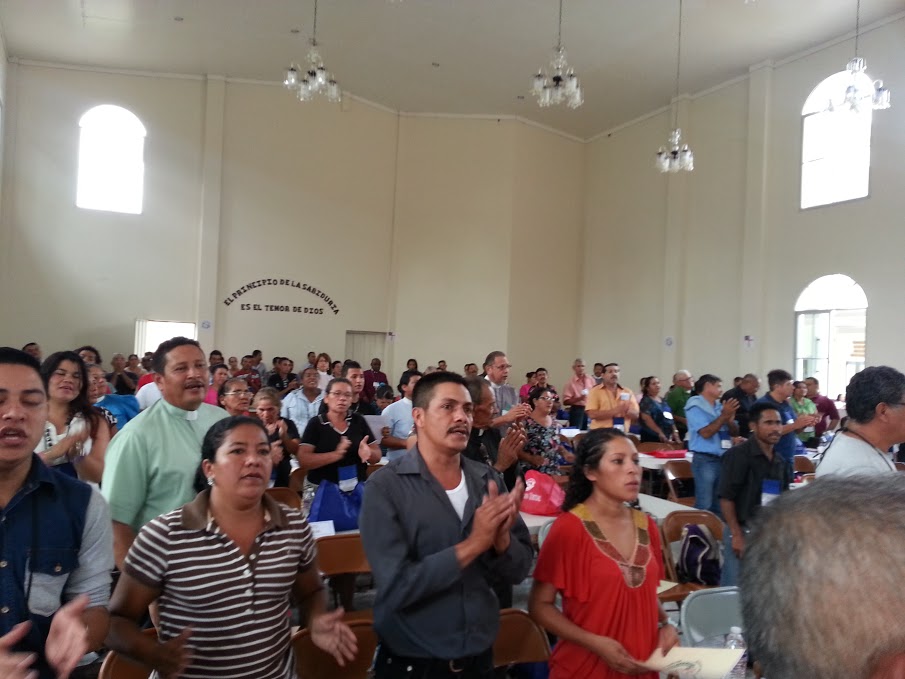
Last weekend I was a special guest at the annual convention of the Episcopal Diocese of Honduras, and all during the long flight down there, and the journey by pickup truck from the airport to the diocesan camp and conference center out on the Caribbean coast, I kept thinking about what I was going to say to the convention when the time came for me to speak.  Because I had a pretty good idea that I would be given the opportunity, not for a lengthy speech, but for a couple of minutes to make some courteous remarks appropriate to the occasion: greetings from Bishop Beisner and all of us in the Diocese of Northern California; gratitude to Bishop Allen of Honduras and everyone there for their warmth and hospitality; hope that the companion relationship between our dioceses would continue and grow stronger in the future—you know, that sort of thing. 
And sure enough, on Friday night after dinner, Bishop Allen asked me if I wanted to get up and say a few words during his address to the convention the following morning.   The opportunity came pretty much exactly as I had expected, so you might wonder why I had wasted so much time worrying about what I was going to say.  Well, because I had decided to give my remarks in Spanish.  Some of you know that I started studying Spanish seriously about eight years ago.  Which is one of the reasons why Bishop Beisner asked me to go and represent him at the diocesan convention in Honduras.  Moreover, I’d already made plans to go there during my sabbatical later this summer, partly to improve on my Spanish, and partly to learn more about the work Episcopal diocese there.   So I jumped at the chance to make this brief initial trip, to get a little bit of the lay of the land, and make some acquaintances.    
It was out of that desire to open doors that I decided that if I did get the chance to speak to the convention, I was going do it in Spanish.  And I wouldn’t write my remarks out ahead of time, but would deliver them in an impromptu conversational style.  That was why I spent so much time beforehand going over in my mind what I would say, and how I was going to say it.  But it turned out, of course, I really need not have worried.  Not because I ended up giving a flawless performance.  There were things I had meant to say but forgot about in the heat of the moment; and there were other things I did say, only awkwardly, after fumbling for the right word, or the correct grammar.  Still, when I was done Bishop Allen thanked me for what I’d said, and for taking the risk of saying it in what obviously not, as he put it, my “mother tongue.” 
The twelve apostles take the same risk in the story of Pentecost.  I think we often assume that because the power to speak in different languages came from the Holy Spirit, they must have spoken them perfectly.  And yet the story says that the people in the crowd that gathered were doubly amazed, because the apostles both spoke to them in their various native tongues, and did so with Galilean accents.    And it seems that their syntax was a little jumbled, and their pronunciations a little slurred, because some of the bystanders got the impression that they were drunk.  All of which says something important about the way the Holy Spirit works.  It gave the apostles the power to communicate with strangers from many foreign lands, but in using that gift they remained the persons they always were—those rough and rude, poorly-educated, fishermen from Galilee.
Which is precisely the point of the passage from the prophets that Peter quotes to explain to the crowd what is happening—that before that great and glorious day when God makes his power and judgment unmistakably manifest on earth, the spirit of prophecy will come on all kinds of people.  Young men will see visions and old men will dream dreams; your sons and daughters, even your slaves, both male and female, will be filled with the prophetic Spirit, and speak the truth that comes from God.  And it is this great outbreak of divine communication with humanity, this democratization of the power to see and know and speak and hear and understand the hidden things of God, that is the real miracle of Pentecost.   
I was able to connect more effectively with the Episcopalians in Honduras, not just because I spoke in Spanish, but also because my Spanish was not all that good.    This broke down to some degree the unspoken dynamics of inequality built into our relationship by the legacy of colonialism, so we could see eye-to-eye, heart-to-heart, as sisters and brothers.  In a similar way, the coming of the Holy Spirit upon the apostles, does not transform them into higher beings of perfection and light.  It does not turn them into flawlessly fluent speakers of Parthian, but uses these ordinary and imperfect channels to open the crowd in Jerusalem to receive its message.
And even though each of them heard it in a different tongue, the Holy Spirit’s message was the same to all.  It did not require an extensive vocabulary of subtle theological terms, or a grammatically complex sequence of logical proofs.  This message was a new communication that would revolutionize the world, of who God is and how God acts, and yet it came upon the crowd that day with so much spiritual power precisely because it was so simple.  It was as deceptively simple as a really good story.  And that’s what it was—a story; a story of God’s love for us.  It told how God communicated that love by taking the risk of speaking our language, becoming one of us, to meet us face-to-face, heart-to-heart, in the person of Jesus of Nazareth. 
The Holy Spirit’s message told how Jesus did not set himself above us, but came as one who shared the disappointment of the poor, the loneliness of the outcast, the sorrows of the bereaved, and the suffering of the oppressed.  He struggled against the religious, economic, and political powers of his day, with no weapon but the truth of God, and the faith of the little ones who believed in him.  He carried out that struggle to the death, to his own ignominious death on the cross.  Through it all Jesus never ceased to love God, never stopped offering himself to be an instrument of God’s will, never gave up hope that God would be faithful to his promises.  And God was faithful.  For Jesus’ sake, God broke the chains of death that hold us all in bondage, and raised this same Jesus to the life of a new and glorious body, exalting him to heaven where even now he sits enthroned as the gracious and merciful Lord and judge of the world. 
The miracle of Pentecost is that the fishermen told this story—in different languages, with poor pronunciation, awkward syntax, and thick Galilean accents—and many of the people in that crowd knew that it was true.  The truth of it poured into them, like water sinking into cracked and thirsty ground.  And to their amazement they felt an answering response within; the welling up deep inside them of something that they had almost forgotten was there, as if a heavy lid had been removed from an ever-flowing spring.  The Gospel of John says that the Holy Spirit will flow like rivers of living water from those who believe in Jesus. 
But our translation is a bit misleading when it says this water will come out of our hearts.  Because the original Greek literally says that rivers of living water will flow out of our wombs.  The Holy Spirit is a fire, burning away all illusions and ignorance that blind us to God’s truth.  But it is also water, dissolving hardness of heart, eroding the dam that obstructs the flow of God’s love.  We who drink in the story of Jesus discover a God who loves us with the compassion of a mother for her child.  This God, the Holy Spirit, not only pours over us, as compassion for our suffering, our fears and weaknesses and limitations; it flows out of us as life-giving rivers of compassion toward all who, like us, are mortal and sorrowful, lonely and afraid.  And there can be no mistaking what is meant by this symbol of water bursting forth from our wombs—it is this Holy Spirit, that we know in the self-giving love and compassion of Jesus, that will give birth to a new world.       
 ,

How you get there


 “I am the way, the truth, and the life.  No one comes to the Father except through me.”
This is one of those gospel verses that seems to give Christians an exclusive privilege, like, I don’t know, the right to issue religious ultimatums.  It’s a passage often read at funeral services, to give hope to the grieving, so it’s strange when you hear, as I did not long ago, a preacher use it to harangue a crowd of mourners, warning them against being insufficiently convinced of the exclusive privilege of the Christian, and thus disqualified from joining their departed loved one in heaven.  And when you do hear something like that, it makes you wonder--what did the author of the Gospel had in mind? 
I took the opportunity this week to really dig into this scripture, more than I have before, and so I packed a little more Bible interpretation into my sermon today than usual—I hope you won’t mind.  I’m not going to cite verse numbers, but if you want to keep your lectionary insert handy, and refer to the gospel lesson once in a while as I’m preaching, I won’t be offended.  And I’m going to go back a little bit into the 13th Chapter of John, so if you’re so inclined and want to pull one of those black bibles out of the pew rack, go head.  
Because the most important thing I think we can do with a scripture like this is to put it into context.  In the story of the Gospel of John, Jesus speaks these words after supper on the night before the day of preparation for the Passover, after he had washed his disciples’ feet, after his betrayer had left the table and gone out into the night, after he had predicted that Peter would deny him three times.  And Thomas, that tactless disciple, asks him a question about how and where to follow him, now that he was about to die.  
And our reading today begins with Jesus telling his disciples that it’s going to be okay—“do not let your hearts be troubled.”  It’s going to be okay because his death will not mean the end of their relationship.  And it will not mean that the knowledge of God that they have received through him will be lost.  In fact, that relationship, and that knowledge, are about to shift into a higher gear.  Because Jesus is going away, but he is going to the one he calls “my Father”, to be in an even more intimate and equal relationship with God.   
And this will change the way that the disciples relate to Jesus, but it also will be a change toward greater equality and intimacy.  He has already shown them this change, that very evening, by getting down on his knees and washing their feet.  And when he finished inaugurating their new relationship of intimacy and equality with him, he told them that this was now how they were to relate to each other: “Where I am going” he said “you cannot come.  I give you a new commandment, that you love one another.  Just as I have loved you, you should love one another.”
I don’t think we can over-emphasize the importance of the connection between this commandment and the scripture we are talking about today.  Before Jesus promised to go and prepare a place for us in the house of his Father; before he promised to come back for us, he told us that we cannot come where he is going.  Because we still have work to do.  We have a commandment to obey.  That’s why when Philip follows up on Thomas’ question by saying, “Show us the Father, and we will be satisfied,” Jesus gets a little testy: “Have I been with you all this time, Philip, and you still do not know me?”  Because “No one comes to the Father except through me,” is not permission for us to be satisfied.  It is a reminder that we have seen all we need to see, in order to believe in Jesus and get to work.  We already know all we need to know, to keep his commandment, and love as he loves—that is how you come to the Father.
But don’t take my word for it; look at the Gospel, where Jesus goes on to talk about works.  “The words that I say to you I do not speak on my own, but The Father who dwells in me does his works.  Believe me that I am in the Father and the Father is in me; but if you do not, then believe me because of the works themselves.”  It is the works of Jesus, even more than his words, that show us the Father in the Son.  And the greatest of his works is the one he is about to do as he speaks these words, which is the work of the cross.  
It is on the cross that Jesus manifests most clearly and unmistakably the love of the Father, love so great that he gave his only Son to an uncomprehending world, to the end that all who believe in him should have eternal life.  The way that leads to the Father is the way of the cross.  The truth that Jesus is, is the truth that Pilate scorned when he said, “What is truth?”  Eternal life is the life of the Good Shepherd, laid down for his sheep.  It is this kind of love that Jesus commands us to have for one another.  No one comes to the Father any other way. 
So now that we’ve seen the context of this saying, we understand.  Jesus has not given us an exclusive privilege, but an all-embracing responsibility.  Because it is our love that shows the way, the truth, and the life to those whom the Father loves in the world today: so that they might see his glory; so that they might believe that we were sent, as the Father sent the Son, and believing, have eternal life in his name.  Now for many in the world today these are just words, empty of any meaning.  But works—works they might just believe. 
“Very truly, I tell you,” says Jesus, “the one who believes in me will also do the works that I do and, in fact, will do greater works than these, because I am going to the Father.”  And we say to ourselves, “What?--You’ve got to be kidding!  Me…you…do the works of Jesus?  Do greater works than Jesus?  Greater than changing water into wine?  Greater than giving sight to a man born blind?  Greater than raising Lazarus from the dead?  Greater than dying on the cross?” 
I guess it all depends on what Jesus meant by greatness.  Is it the power to work miracles, or command armies? Is it charisma, or fame?  Or is Jesus talking about greatness of faith, greatness of hope, greatness of love?  Maybe we can do works greater than his because he, after all, was Jesus, and you and I are just you and me.  Jesus was the only-begotten Son, who shared his Father’s glory before the world was made; all we share are some old stories in an old book, and some bread and wine and water.  Jesus knew everything that was in the hearts of men and women.   All we know is that the rent is due on the first of the month, and that some people are just hard to love.  All that the Father has he gave to the Son.  All we got is our own modest gifts, precariously balanced against our deficits.    That, and the faith that Jesus is in the Father and will give us whatever we ask so that we can do our works. 
They may not be spectacular: raising an autistic child, or tending to a failing parent; planting a garden in waste ground, or organizing a rally for justice; surviving an addiction, perhaps, or a bereavement, and helping a neighbor to do the same; helping resettle a family of refugees from war.  Often they are works we didn’t choose, and we feel like Jesus at the wedding in Cana, when he said to his mother, “Woman, my hour is not is come.”  But it precisely because we do them out of love, in obedience to Christ, with no power but the strength that comes from God, in just the right measure at just the right time to get us a little further along the way—just because of this, these works manifest the very highest truth.  They are signs of the glory of Christ, and they point the way to the Father.


About Me

My photo
Petaluma, California, United States
I am a priest in the Episcopal Church, and have been (among other things) an organic farmer and gardener, and a Zen monk. I have a lifelong interest in social and spiritual renewal on the basis of contemplative discipline, creative nonviolence, and ecological practice. In recent years my work has focused intensely on the responsibility of pastoral ministry in the humanistic, evangelical, and catholic branch of Christianity known as Anglicanism. I'm married with a daughter, and have three brothers and two parents.