Showing posts with label cross. Show all posts

Monday, November 21, 2016

Not normal


A few weeks ago I was chatting with someone in the office at the church, and we were commiserating about the electoral campaign and the vulgarity and vitriol coming out of it.  And she said she couldn’t wait until November 9, when it would all be over and life could get back to normal.  Well, I had to tell her that I was sorry to say so, but that I didn’t think it would be over then, and that normal might never return.  Now, when I said that I was envisioning a different scenario from the one that played out in the end.  And you can call me a hypocrite if you like, but now the idea of returning to normal feels less like a promise to be wistful about, and more like a temptation to be resisted. 
My daughter came home upset the other night because a friend of hers at school, who had been as outraged as all the other kids during the campaign, had said of the President-elect, “well, he’s not that bad.”  Which was also the message that the sitting President put out after meeting for the first time with his soon-to-be successor.  And even I, in the days right after the election, when so many people I knew were freaking out, posted a statement on Facebook suggesting we give the man the benefit of the doubt.  I dared to suggest that the realization of his awesome responsibility, and some vaporous mystique of the office that he inhaled in corridors of the White House, might awaken a latent graciousness and magnanimity in his soul.     
But then he started filling posts in his administration: for National Security Advisor, he chose a man who likens Islam to cancer, and describes it as a political ideology disguised as a religion; for Attorney General, a Senator who was rejected for a federal judgeship because of his record of overt racism; for his senior advisor and chief political strategist, an internet publisher of white-nationalist, sexist, homophobic, and anti-Semitic propaganda.  The Ku Klux Klan, and the rest of the neo-Nazi and white supremacist wing of the President-elect’s movement is jubilant, anticipating an all-out attack on the rights and liberties of ethnic, and sexual, and religious minorities.  God help us if we come to see this as normal.
Of course, from a Christian point of view, there was never any “normal” to get back to.  The Collect for this last Sunday of the Christian year describes the peoples of the earth as under the sway of a hostile power.  It keeps us divided from each other, splintered into spurious identities of nation, and race, and religion.  Not only are we divided, but we are also enslaved.  We are imprisoned in the resentment and hate we nurse against those we consider “the other,” in the lies we tell to rationalize injustice and violence.  Even when we succeed in dominating the other, and enjoying the privilege of their subservience, we are not free.  We have only subjected ourselves, along with them, to a superior power.  And the name that the Collect gives for this power is “sin.”
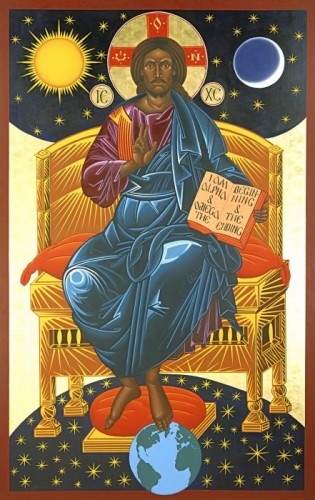
And it prays for God’s well-beloved Son to free us from this bondage and bring us together under his most gracious rule.  But when it says that he is King of Kings and Lord of Lords, we must be careful not to misunderstand.  This does not mean that he is of same ilk as the kings and presidents and party chairmen who rule the nations of the world, or that he makes a rival claim to their power.   It is saying that Christ has overcome the superior power that keeps them, and us, enslaved.  Because all earthly power, when you come right down to it, is a doomed effort to perpetuate itself, to defend its interests against those of an other.  But Christ’s power comes from the sovereign will of the almighty and everlasting God, whose purpose it is to reconcile all people, and restore all things.
Which sounds nice, but how it really works is not the least bit normal.  This is apparent when you consider that this power was decisively revealed on the cross.  In Luke’s telling of the story, the Jewish leaders scoff at Jesus as he is hanging on the cross, and say, “he saved others; let him save himself.”  And then the Roman soldiers mock him, saying, “If you are the King of the Jews, save yourself!”  Finally one of the men crucified along with Jesus, derides him, saying, “Are you not the Messiah?  Save yourself and us!”  To these people “save yourself,” is a taunt, a way of rubbing Jesus’ nose in his powerlessness, because preserving oneself is what power is for.   His inability or unwillingness to save himself is proof that he is no king, and no Messiah. 
But the other criminal is somehow able to see the real power of Jesus.  Crucifixion was a punishment reserved for rebellious slaves and others who took up arms against the state.  So here is someone who has tried and failed to overthrow domination with revolutionary violence.  He knows enough about Jesus to understand that this was not his way, and yet here Jesus is, suffering alongside him, condemned as if guilty of the man’s own crime.  And this fills his dying agony with insight about what is really happening here.  Jesus has not failed, because he never tried to win victory for one party over another, or to restore the greatness of one exceptional nation.  He is, in fact, freely giving his life to lead all humankind into a different world.  He is founding a new humanity, on the forgiveness of perpetrators and the witness of victims, on the vulnerability to lostness and sickness and sinfulness and death that we all have in common, and on our shared hope for the answering compassion of a loving God. 
And so the crucified revolutionary discovers the unconditional and sacrificial love of Jesus, which more than a religious sentiment; more than a social ethic; more than a political strategy.  In his willingness to forgo self-preservation in his confrontation with the power of sin, he is one with the self-emptying of God who created a universe free to rebel against their creator.  He is one with the compassion of God who refuses to abandon her creatures to their rebellion.  Jesus manifested this unity of human and divine will throughout public ministry, and his death and resurrection make it finally possible for all of us to perceive it, to believe in it, to understand how it works, and what it aims to do.  And when our eyes open to see the kingdom of the Son of God, it is not just an illumination of the mind, but a longing kindled the heart, a fire lit in the soul, a passion to offer our selves in service to its consummation.  The love that was in Christ becomes our own, not to form us into a new tribe called Christians, to wield the old, false power of domination over others, but to make us free agents of the reconciling, liberating love of God.        
The news this week contained a vivid demonstration of this love.  As the COP22 climate conference in Morocco was winding up on Friday, a group of 48 of the poorest countries in the world made an announcement.  They said that while it is true that they are the least responsible for adding greenhouses gases to the atmosphere, and have benefitted the least from fossil-fueled industrial development, and have the least capacity to address the problem of human-caused climate distruption, because they are suffering the most from the unfolding catastrophe they have decided to take the lead in saving humanity.  And so they are committing themselves to leaving behind the carbon economy as soon as possible.  They are revising their plans for national development so that their carbon emissions peak by 2020, and they will build resilient economies based on renewable energy, and be completely carbon-neutral by 2050.
I’m not sure what it says that while we squander our wealth on military dominance, and indulge our fantasies of nationalistic revival, the poorest people in the world are displaying the moral greatness that we lack.  Or that while we willfully prefer opinions of convenience to the facts threatening our children’s future, they are showing the capacity for altruistic sacrifice we seem largely to have lost.  Certainly it gives the lie to any claim we might make to be a Christian nation.  But “Christian nation” is an oxymoron anyway.  And if the murderer could gain paradise while hanging on a cross, surely it isn’t too late for us.  The Son of God still has the power to free us from the bondage of division and the slavery of sin, if we really want him to.  But, of course, we would have to give up being normal.   

Wednesday, September 16, 2015

Fear of faith


Psalm 19  


Later this morning we are going to gather in the parish hall for our “Homecoming” lunch, to mark that summer vacations are over and our whole community is coming together again in this, our spiritual home.  And after lunch we are going to have a sort of fair in celebration of the work that we are coming together again to do.  Leaders and representatives of the many working groups that are active in the congregation will be there so we can recognize each other and share information and generally rev our engines for another year of worship and learning and service.  It should be a lot of fun and the thing that is most exciting about it for me, personally, is not just that it gives us a chance to see how many different kinds of ministry are being done, with how many different leaders, but that all of us together form one ministry.
I was thinking about that this week as I was reading today’s lesson from the Gospel of Mark, and it struck me that this story gives us a way to describe what that one ministry is, the ministry of St. John’s Petaluma, and of the church in general.  It gives us one idea, to sum it up, which is “discipleship.”  Whatever formal shape our different ministries take, in the parish organization or outreach programs in the community, or simply attending worship and saying our prayers and putting something in the offering plate, all of us are called to be disciples of Jesus.  This story is, in some ways, the essential passage in all the gospels about what discipleship means, and Jesus begins his instruction on the subject with two questions: first he asks his disciples, "Who do people say that I am?" and then, after they have answered, “But who do you say that I am?”
Taken together, these questions imply that his disciples must know Jesus in a way other people don’t.  There are lots of opinions out there on the street about who he is, and that’s as true today as it ever was, but that’s different from the true knowledge that comes from intimate acquaintance.  So one way of understanding discipleship, and the ministry of the church, is that it is about telling the world something about Jesus that it doesn’t know.  That’s the approach that Peter takes, and he’s not the only one.  There are still a lot of people for whom discipleship means saying as loudly as possible that Jesus is the Messiah, the Son of God, Our Lord and Savior, and so on, in hopes of getting everyone to agree.  But as far as Jesus is concerned, what we say about him is not that important.  In fact, he sternly orders his disciples not to say anything.  What does matter is to trust him enough to do what he does, and to follow him on the way of life that is really worth living. 
And that means making a journey.  We have to go through something.  And the thing we have to go through, says Jesus, is the cross.  Now in this passage he talks about the cross in two different ways.  First, as a fact that is going to happen to him.  In this way he makes clear that whatever else we think we mean when we say that he is the Messiah, it has to include that he suffered, and was rejected by the people who were supposed to know about God, and was killed, and on the third day was raised.  And all that’s true, but if we only think of the cross in these terms it can become just another opinion about Jesus. 
So he also talks about the cross symbolically, and the thing about symbols is that, unlike facts, you have to do something with them.  You have to dialogue with them and make your own decisions about what they mean for you.  When Jesus talks about the cross this way it is no longer a fact we can consider from a distance.  If we want to be his disciples, we have to pick it up, and put it on our shoulders and start walking. 
I’ll be honest with you—as many times as I’ve heard this saying, it still makes me afraid.  It makes it sound like being a disciple of Jesus means signing up for pain.  And I’m afraid of pain.  One of my earliest memories is of screaming and crying at the doctor’s office when my mother took me in for my shots, not from the pain of the injections, but from fear of them before they ever happened.   But what if this teaching is not about gritting our teeth and psyching ourselves up for an extra big helping of pain, so that we might gain some reward from it later?  What if it is about transforming our relationship to our pain that is already here?   What if it is about accepting it, and really looking deeply into it, rather than trying to push it away or blame it on others?  What if it is about taking up the suffering we already have, simply because we are human, and carrying it to God?  
That makes me afraid, too, but with a different kind of fear—not the fear of pain per se, but the fear that the Hebrew wisdom tradition calls the fear of the Lord: the fear of laying aside my conventional assumptions about the purpose of life, and what makes for happiness; the fear of losing the image of myself that I have constructed with such great care so as to be accepted and admired by the people around me; the fear of losing the things I’ve acquired with that image—possessions, position, and esteem. It is the fear of looking squarely at the face I try to hide from others, the vulnerable, aging, needy, sometimes deeply sad, often conflicted and confused face of the person that I also am.  And it’s the fear of knowing all that and still having to make the decision that no one can make for me, the decision I have to make again every day, sometimes under the pressure of great doubt—the decision to have faith.
Jesus invites us to become his disciples, and to make that decision, as he has, and to choose a life centered on God.   But with that choice the illusions of the false self are sacrificed, the attachment to the un-life is broken.  The promise of Jesus is that this is not only a process of dying; it is also rebirth.  From acceptance of our own suffering we become sensitive to the suffering of others.  We also become aware of how much of it, theirs and ours, is needless.  There is that which is the inevitable consequence of life in a mortal body in a world of continual change.  But there is also the great mass of suffering that is due to the misuse of human freedom.  There are the self-inflicted wounds of self-destructive vice, of fruitless anxiety, of revolt against that which cannot be changed, and of clinging to what cannot remain the same.  And there is the suffering we inflict on each other, in personal acts of cruelty, coldness, and abuse, and in systems of collective violence, exploitation, and injustice.
The knowledge of needless suffering inflicts its own kind of pain.  Perhaps the sharpest wound it gives is the vision of liberation.  Because to see how much suffering is needless is to see how much better everything could be.  It is to awaken the deep yearning for a better world, the burning desire to do better, to be better than we have before.  And that is also a cross to bear.  To act on that desire requires effort, against our natural inclination to drift with the tide of time.  It brings us into conflict with powerful enemies, the inner demons and the outer tyrants who are fearful and resistant to healing and change.     
And it means living with failure, with constant reminders that our capacities are limited, that even with heroic sacrifice we will always accomplish less than we imagine we could and less than the world so badly needs.  But Jesus, the crucified and risen, has a message for his disciples, a message for them to administer to everyone.  It is that failure of this kind is nothing to be ashamed of.  This desire is for something better for the world is not naïve, this effort to realize it is not wasted, this suffering for its sake is not futile, because God is faithful in ways we cannot be.  And in Christ, God shares the desire, shares in the effort, even shares the suffering. 

Sunday, August 31, 2014

Who is welcome?


Last week our Bishop sent me to North Carolina to attend a conference that happens every two years in the Episcopal Church, a gathering of clergy and lay people from all over the country who are engaged in Latino ministry, or who want to be.   A fair number of the participants are first-generation Americans, with limited English, so a lot of the sermons and addresses and workshops, and almost all the songs, were in Spanish.  There was simultaneous translation available, but I chose not to use it.  There were two reasons for this.  The first was that I saw an opportunity to practice my Spanish.  There were some speakers, who, when they really got wound up, left me hopelessly in the dust, and a lot of jokes I didn’t get, but I was pleased with how much I was able to participate in Spanish, and I got better at it as the conference went on.

The second reason why I decided not to use the translation equipment was that I wanted to have an experience that is an everyday reality for many people, but almost never happens to me.  What with my sex, and the color of my eyes and skin, and my native language, socio-economic status, and level of education, and my degree of physical and mental ability, I have the privilege of access almost everywhere I go.  I feel like I belong.  And that is nowhere more true than in the church.  “The Episcopal Church Welcomes You” is a slogan that I know, without question, applies to me.  But sitting in the auditorium at that conference, where I was in the minority ethnic group, trying to sing a song I didn’t know, or get the gist of a speech in a language I didn’t completely understand, gave me just a little taste of what it is like to be a cultural outsider, an “other.”  

At the celebration of the Holy Eucharist on Wednesday afternoon I somehow ended up in the front row of the auditorium.  After the sermon it was announced that there would be laying on of hands and prayer for those with particular needs or concerns.  And sure enough, eight or so of the Latino and Latina priests in albs and stoles took positions up on the stage or in the space right in front of the first row of seats, and the people started lining up.  My immediate thought was that I didn’t have anything going on in my life that was serious enough to require special prayer.  I thought of the other people in that audience, and I imagined what they must deal with in terms of poverty, or separation from their families, doubtful immigration status, or serious disease, and I thought that they surely needed prayer more than I did. 

So I decided to sit and pray quietly to myself.  And I prayed for peace in the places in the world where there are wars and political turmoil.  And I prayed for people in this congregation and others that I know who are suffering or struggling in different ways.  But I also had a front row seat for the action that was going on around me, and my eyes kept straying upward to watch the people with their heads bowed, and the priests holding them in their hands and leaning in with their eyes closed, whispering their prayers, and I saw the hugs that sometimes followed after the prayers were said, and the tears.  After a few minutes I noticed that that, if there was some kind of expectation that you had to have really serious problems in order to go up for a prayer, people were either ignoring that requirement or else this was a group that was really hurting because the lines down the middle of the auditorium and in the side aisles were getting longer, not shorter.

 Well, I began to wonder whether maybe I should reconsider my decision not to join them, but I also started to worry about the time.  This Eucharist was supposed to end at 4:15 and I’d made plans to go for a run and a swim in the lake before dinner at 6:00 and some of these priests were really taking a long time with their prayers, and if I got into line, then everybody might as well do it and we’d never get out of there on time.  So I straightened up in my seat and closed my eyes and returned to my private prayer, and after a while I began to pray for members of my own family, for my crazy old uncle living by himself way up on the North Coast, and another uncle with cancer, and then I thought of my brother.  I started to pray for my brother who has a drug problem, and is unemployed, and has never really done much with his exceptional talents, but is just kind of stuck in a perpetual adolescence, and of all the shame and self-hatred I know he carries, and the sorrow and worry it causes my parents and I started to feel really, really sad, and I recognized that I did have something I needed prayer for.

But by then there were just a few people left in line, and the others had gone back to their seats, and the priests had started to turn and lay hands on each other, and I wasn’t sure which one to go to, and I didn’t want to be stupid and rude, like “hey, I know we’re almost finished, but I changed my mind.”  And I wasn’t sure that I wouldn’t start crying if I started talking to a priest  about my brother right then, and then I would have to walk back to my seat with everybody in the auditorium watching me.  And the thing was, that room was filled with a spirit of kindness and compassion in that moment and I’m sure that whatever I did no one was going to judge me, and it would have been okay. 

But I never did go up for a prayer, because I was afraid to be vulnerable.  I was so attached to the idea of being better off than those people that I couldn’t see my own need for healing, or that those “others” were offering it to me.  “The Episcopal Church Welcomes You,” is a slogan I can get behind as long as I’m the one doing the welcoming; but let me be the stranger in need of welcome, and I hesitate and am afraid, standing outside wondering if it’s safe to go in.

In today’s gospel reading Peter and Jesus have a fight, because Peter thinks that whatever it means that Jesus is the Messiah, the Son of God, it doesn’t involve being vulnerable.  But Jesus sees it differently.  He knows that the world that human beings have made is one where people quite easily and almost without thinking assume that some were meant to rule and others to be ruled, some to possess and other to be dispossessed, some to enjoy the blessings of prosperity and peace, and others to live and die in misery and violence, as if all of this were quite natural, even willed by God.  But Jesus sees God taking a place in this world with the poor, with those who mourn, those who hunger and thirst for justice, who suffer persecution for the cause of peace and for the truth.  So the Messiah will make the journey the holy city of Jerusalem as a vulnerable stranger, an outsider, one whose right to be there is in doubt, whose fate is in his enemies’ hands.

It wasn’t hard to predict what would happen to him there.  He would suffer and be killed, as prophets and martyrs have suffered and been killed again and again before Jesus and ever since.  What happened was business as usual, entirely ordinary except for one thing—on the third day Jesus rose from the dead, and his disciples were witnesses of it.  And that one thing is what makes all the difference.  It is what makes the cross not a place where God’s voice in the world is silenced once again, but where God’s truth speaks most clearly.  It is where we see the world as God sees it—where God dispels the illusions of human privilege and power, and drags hypocritical religion and rationalized barbarity out of the shadows.  The cross is where God lights up the whole of human life, even at its most treacherous and cruel, its most abused and degraded, with the eternal glory of the Son of Man—his compassion, his forgiveness, his wisdom and love. 

The cross is where we learn to follow Christ on a journey of healing and being healed, welcoming and being welcomed, that reaches across every barrier of culture, class, language, sex and sexual orientation, race and religion, to touch God in the hand of the other, and where we learn to say “ hermano”, “hermana”-- “brother”, “sister”.
  

About Me

My photo
Petaluma, California, United States
I am a priest in the Episcopal Church, and have been (among other things) an organic farmer and gardener, and a Zen monk. I have a lifelong interest in social and spiritual renewal on the basis of contemplative discipline, creative nonviolence, and ecological practice. In recent years my work has focused intensely on the responsibility of pastoral ministry in the humanistic, evangelical, and catholic branch of Christianity known as Anglicanism. I'm married with a daughter, and have three brothers and two parents.