Showing posts with label revolution. Show all posts

Monday, November 21, 2016

Not normal


A few weeks ago I was chatting with someone in the office at the church, and we were commiserating about the electoral campaign and the vulgarity and vitriol coming out of it.  And she said she couldn’t wait until November 9, when it would all be over and life could get back to normal.  Well, I had to tell her that I was sorry to say so, but that I didn’t think it would be over then, and that normal might never return.  Now, when I said that I was envisioning a different scenario from the one that played out in the end.  And you can call me a hypocrite if you like, but now the idea of returning to normal feels less like a promise to be wistful about, and more like a temptation to be resisted. 
My daughter came home upset the other night because a friend of hers at school, who had been as outraged as all the other kids during the campaign, had said of the President-elect, “well, he’s not that bad.”  Which was also the message that the sitting President put out after meeting for the first time with his soon-to-be successor.  And even I, in the days right after the election, when so many people I knew were freaking out, posted a statement on Facebook suggesting we give the man the benefit of the doubt.  I dared to suggest that the realization of his awesome responsibility, and some vaporous mystique of the office that he inhaled in corridors of the White House, might awaken a latent graciousness and magnanimity in his soul.     
But then he started filling posts in his administration: for National Security Advisor, he chose a man who likens Islam to cancer, and describes it as a political ideology disguised as a religion; for Attorney General, a Senator who was rejected for a federal judgeship because of his record of overt racism; for his senior advisor and chief political strategist, an internet publisher of white-nationalist, sexist, homophobic, and anti-Semitic propaganda.  The Ku Klux Klan, and the rest of the neo-Nazi and white supremacist wing of the President-elect’s movement is jubilant, anticipating an all-out attack on the rights and liberties of ethnic, and sexual, and religious minorities.  God help us if we come to see this as normal.
Of course, from a Christian point of view, there was never any “normal” to get back to.  The Collect for this last Sunday of the Christian year describes the peoples of the earth as under the sway of a hostile power.  It keeps us divided from each other, splintered into spurious identities of nation, and race, and religion.  Not only are we divided, but we are also enslaved.  We are imprisoned in the resentment and hate we nurse against those we consider “the other,” in the lies we tell to rationalize injustice and violence.  Even when we succeed in dominating the other, and enjoying the privilege of their subservience, we are not free.  We have only subjected ourselves, along with them, to a superior power.  And the name that the Collect gives for this power is “sin.”
And it prays for God’s well-beloved Son to free us from this bondage and bring us together under his most gracious rule.  But when it says that he is King of Kings and Lord of Lords, we must be careful not to misunderstand.  This does not mean that he is of same ilk as the kings and presidents and party chairmen who rule the nations of the world, or that he makes a rival claim to their power.   It is saying that Christ has overcome the superior power that keeps them, and us, enslaved.  Because all earthly power, when you come right down to it, is a doomed effort to perpetuate itself, to defend its interests against those of an other.  But Christ’s power comes from the sovereign will of the almighty and everlasting God, whose purpose it is to reconcile all people, and restore all things.
Which sounds nice, but how it really works is not the least bit normal.  This is apparent when you consider that this power was decisively revealed on the cross.  In Luke’s telling of the story, the Jewish leaders scoff at Jesus as he is hanging on the cross, and say, “he saved others; let him save himself.”  And then the Roman soldiers mock him, saying, “If you are the King of the Jews, save yourself!”  Finally one of the men crucified along with Jesus, derides him, saying, “Are you not the Messiah?  Save yourself and us!”  To these people “save yourself,” is a taunt, a way of rubbing Jesus’ nose in his powerlessness, because preserving oneself is what power is for.   His inability or unwillingness to save himself is proof that he is no king, and no Messiah. 
But the other criminal is somehow able to see the real power of Jesus.  Crucifixion was a punishment reserved for rebellious slaves and others who took up arms against the state.  So here is someone who has tried and failed to overthrow domination with revolutionary violence.  He knows enough about Jesus to understand that this was not his way, and yet here Jesus is, suffering alongside him, condemned as if guilty of the man’s own crime.  And this fills his dying agony with insight about what is really happening here.  Jesus has not failed, because he never tried to win victory for one party over another, or to restore the greatness of one exceptional nation.  He is, in fact, freely giving his life to lead all humankind into a different world.  He is founding a new humanity, on the forgiveness of perpetrators and the witness of victims, on the vulnerability to lostness and sickness and sinfulness and death that we all have in common, and on our shared hope for the answering compassion of a loving God. 
And so the crucified revolutionary discovers the unconditional and sacrificial love of Jesus, which more than a religious sentiment; more than a social ethic; more than a political strategy.  In his willingness to forgo self-preservation in his confrontation with the power of sin, he is one with the self-emptying of God who created a universe free to rebel against their creator.  He is one with the compassion of God who refuses to abandon her creatures to their rebellion.  Jesus manifested this unity of human and divine will throughout public ministry, and his death and resurrection make it finally possible for all of us to perceive it, to believe in it, to understand how it works, and what it aims to do.  And when our eyes open to see the kingdom of the Son of God, it is not just an illumination of the mind, but a longing kindled the heart, a fire lit in the soul, a passion to offer our selves in service to its consummation.  The love that was in Christ becomes our own, not to form us into a new tribe called Christians, to wield the old, false power of domination over others, but to make us free agents of the reconciling, liberating love of God.        
The news this week contained a vivid demonstration of this love.  As the COP22 climate conference in Morocco was winding up on Friday, a group of 48 of the poorest countries in the world made an announcement.  They said that while it is true that they are the least responsible for adding greenhouses gases to the atmosphere, and have benefitted the least from fossil-fueled industrial development, and have the least capacity to address the problem of human-caused climate distruption, because they are suffering the most from the unfolding catastrophe they have decided to take the lead in saving humanity.  And so they are committing themselves to leaving behind the carbon economy as soon as possible.  They are revising their plans for national development so that their carbon emissions peak by 2020, and they will build resilient economies based on renewable energy, and be completely carbon-neutral by 2050.
I’m not sure what it says that while we squander our wealth on military dominance, and indulge our fantasies of nationalistic revival, the poorest people in the world are displaying the moral greatness that we lack.  Or that while we willfully prefer opinions of convenience to the facts threatening our children’s future, they are showing the capacity for altruistic sacrifice we seem largely to have lost.  Certainly it gives the lie to any claim we might make to be a Christian nation.  But “Christian nation” is an oxymoron anyway.  And if the murderer could gain paradise while hanging on a cross, surely it isn’t too late for us.  The Son of God still has the power to free us from the bondage of division and the slavery of sin, if we really want him to.  But, of course, we would have to give up being normal.   

Wednesday, November 26, 2014

Revolution of compassion


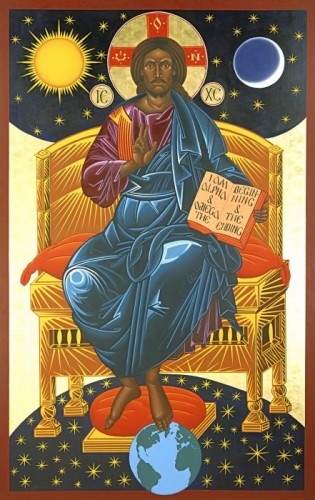
Some of us here at St. John’s have been meeting since September to study a book about Jesus.  Not Jesus as the author supposes he might have been, but Jesus as people have imagined him, in every era of Christian civilization: Jesus as they have honored and adored him; Jesus, who one way or another has held the key for them to know who God is, and what is good, and beautiful, and true. 


Reimagining Jesus is what Christians have always done.  It’s a process that was already well under way when the four Gospels were written, as you can easily see by comparing them.  Each one presents a different picture of what he said and did, how he died, and what happened to him after that, because each of them arose in a different community.  These little groups that became the church took the traditions that had been handed down to them about him and shaped them to speak to their hopes and fears, their needs, their experiences of the Spirit of Christ, and the signs he showed them of God’s kingdom.   Of course, those differences only serve to make the main character of the stories that much more compelling.  So while we find four distinctive images of Jesus in Matthew, Mark, Luke, and John, we have no doubt that they are all about the same person.

Jews, Muslims, and Buddhists, even atheists and agnostics, are curious about the person who inspired those stories.  Many admire his teachings and try to understand him better by making comparisons with other prophets, saints, and sages.  But what animates Christian faith is something more than curiosity and admiration.  It is more than the search for an accurate portrait of a historical figure.  It is something more even than the willingness to believe certain things about Jesus.  The heart of Christian faith in Jesus is the desire to know him as he is.  It is living and creative, because it is love infused with hope for oneself and for the world.   

In the great chapter on Christian love in First Corinthians, Saint Paul writes “For now we see in a mirror dimly, but then [we will see] face to face; now I know in part, but then I will know fully just as I also have been fully known.”  Our desire to know Jesus is one with our hope of knowing ourselves and others as we truly are, as we are known and loved by God.  And when we look at those men and women who have cultivated that desire, and have committed more and more of themselves to the fulfillment of that hope, what we see is transformation. 


There is a story, perhaps apocryphal, that on his deathbed Lenin made this confession to a childhood friend who was a priest:
“I have made a mistake. No doubt . . . many people who were oppressed had to be freed, but our method let loose new forms of oppression and murder. You know it, and it is my deadly nightmare to feel smothered in this ocean of blood of innumerable victims. What was needed to save Russia—but now it is too late—was a dozen like Francis of Assisi.”

Whether or not this story is historically accurate, it rings true.  Because it says that no movement to transform the world will ever truly succeed unless it awakens in human beings the hope that they themselves can fundamentally change, and the power to do it.

The hope of taking revenge on their oppressors is not enough; the hope of taking control of the factory, or of the land, or even the simple hope of having enough to eat, are not enough.  These motivations will carry a revolution for a while.  But if it does not have at its heart a persuasive image of the ultimate purpose of being human, the movement will falter and lose its way.  It will be another promise broken, another dream that turned into a nightmare.   On the other hand, I know of one revolutionary movement that has kept going for two thousand years.  In spite of all its sad and shameful history of selling out and settling for less, of complacency and outright crime, it is still able, with regularity, to turn ordinary people into Francis or Clare of Assisi, into Oscar Romero, or Martin Luther King, Jr.  It can do this because it still carries within it, as its source and reason for being, the living image of Jesus and the desire to know and be known by him.

We have this image because of communities like the one that created the Gospel of Matthew, who saw in Jesus Christ what they most wanted to become, and found in him the power to transform the world.  The irony is that they had nothing of what we would account as power.  They were members of a marginal and vilified ethnic group, the Jews, who had fought and lost disastrously a war to free their nation from the tyranny of Rome.  And this particular little congregation was doubly marginalized.   Because their proclamation that the crucified Jesus of Nazareth was the resurrected Messiah of Israel, and their practice of including Gentiles among them as equals, were scandalous to their fellow Jews.  And though the Gospel never explicitly says so, it leaves clues in the text that they had been thrown out of the synagogue. 

But these painful events did not make them discouraged; they actually strengthened and amplified their hope.  They only confirmed that the things that Jesus had said were true, and that he had said those things for them.  The stories said Jesus promised to return in the glory and power of God, though about that day or hour no one could know.  But they also said that he would be with them where ever two or three were gathered in his Name, and that he would be with them until the end of the age. 

And the stories told them another thing about how Jesus would be present, a promise that was also a warning.  Because they were going to have to live for the time being in a mixed up world, a world like a field of wheat with weeds growing in it.  And they were always going to be tempted to take sides in that world’s arguments.  They were going to hear that there were nations of sheep and nations of goats, people who were favored, and entitled to kill to get what they wanted, and people who were cursed, and deserved whatever they got.  But Jesus told them that the whole human race was mixed up, that every nation was sheep and goats mixed together, and no one could sort them out until the very end, and, by the way, it would be up to him to do the sorting. 

But so they wouldn’t lose hope for the world, and become passive and turn inward, he gave them an image of himself, so they could pick him out in the crowd.  Jesus left us with an image of the ultimate purpose of being human, the same image that God showed him.  And it was not a self-image.  It was an image of God’s beloved, the key to the transformation of the world, and it was not a charismatic healer, a sinless savior, a spiritually enlightened being in a white robe and sandals.  Before he gave himself up to death on the cross, Jesus told us to seek him in the old man in the nursing home whom nobody comes to visit, to desire him in the pierced and tattooed girl on the
sidewalk with her placard and her dog, to love him in the ISIS fighter shaking his rifle and shouting “Death to the Infidels”, to care for him in the Guatemalan child on the bus to the immigrant detention center.

The violence of Matthew’s language of judgment disturbs us, but its purpose is to warn us.  Having lived through the horrors of total war, and the pain of religious schism, Matthew’s community knew well what also need to know—that any vision of our future based on the might of the strong, the wisdom of the intelligent, the purity of the self-righteous, or the prosperity of the rich, will sooner or later prove to be demonic.  And I hope that this threat of darkness won’t keep us from also seeing the light—the light of judgment that Jesus and Francis of Assisi and so many others saw and were transformed by—that when we stand with the weak, the hated, the powerless and destitute and share their hope, we take the part of God in the world.


Thursday, August 14, 2014

To the other side


It’s not easy to see why Jesus would send his disciples away at nightfall to start rowing across a lake, but there might be a clue in the larger order of events in the gospel.  You see, the story the feeding of the multitude comes right after the sordid episode where Herod, the ruler of Galilee, has John the Baptist beheaded at a dinner party.  Word then comes to Herod about this new fellow, Jesus of Nazareth, and he declares that this must be John, come back from the dead.  News of this comes to Jesus, and that is the point at which he leaves town and heads out into the bush.  A great crowd goes after him—with John dead, Jesus is the only prophet they have left, the only one who can challenge the violence and corruption of their rulers in the name of God’s justice and truth. 
It’s not clear whether Jesus set out to have the great world-changing career that he did.  It seems to me that a lot of what he did was spontaneous and personal.  He had a profound personal experience of God’s love for everyone, and he related to everyone he met on that basis.  But because of his historical circumstances, every little thing he said and did to relieve people’s suffering, to satisfy their basic needs, to lift their spirits and bring them together, had revolutionary impact, and this is the point in the gospel story where that starts to be clear.  Jesus had to know that news of miraculously feeding a multitude would travel fast, and that the reaction might be swift and brutal.  Maybe he sent his disciples out in the boat that night because he feared for their lives, and decided they should slip away under cover of darkness. 
From the evidence we can piece together, Matthew’s gospel came out of a community that was crossing over from their ancestral home in the world of Judaism to the strange new reality called the Church.  It was a journey that put them in a boat with other people they would never have given the time of day before, and now they were all depending on each other for their very lives.  They were running into unaccountable hostility from their fellow Jews, who rejected and denounced and even persecuted them for preaching and praying and gathering in the name of Jesus. 
Yet it was a community that had experienced the fulfillment of what it means to be human.  In their gatherings they had received gifts of the Holy Spirit in baptism and the Eucharist.  They had died with Christ and been reborn in his resurrection to a new life of imperishable glory.  They had tasted the heavenly banquet of God’s justice and love, where all pain and grief are at an end and evil and suffering are no more.  But somehow they still found themselves on this side of things, in the world where children die of hunger and nations are laid waste in war.  Or more precisely, they found themselves in a small boat in the dark, rowing against the wind and against the waves, trying to cross over to the other side.  
The image of Jesus coming to the disciples over the sea, calming the storm, and their fears along with it, must have been a great comfort to these people.  Less comforting is the little story that Matthew works in at this point about Peter.  The troubling part is where Jesus says to Peter, "You of little faith, why did you doubt?"  It has always struck me as an accusation that if Peter really had faith, he should be able to do like Jesus.  But that just doesn’t seem fair, to Peter, or, for that matter, to us.  If walking on water is the minimum standard of faith, we’re all in trouble. 
But reading the story this time around, I realized that walking on water isn’t the only thing Peter has doubts about.   Before that even happens, Jesus calls out to the terrified disciples, "Take heart, it is I; do not be afraid." But Peter doesn’t calm down and wait in the boat for Jesus to come and rescue them.  He doubts that it is really Jesus, and he demands proof.  He wants Jesus’ power, for himself and nobody else, so he can take matters in his own hands.  “Go ahead, knock yourself out,” says Jesus, and Peter leaves his brothers behind and steps out of the boat. 
I don’t imagine Jesus was surprised when Peter started sinking.  Peter’s faith wasn’t big enough to believe that Jesus was a living man, and not a ghost.  It wasn’t big enough to just sit tight in the boat with everybody else.  So it sure as anything wasn’t big enough to walk on water.   Now just a little faith is enough, as long as it is faith in Jesus and solidarity with the others in the boat.  But it seems like there were some in the early Christian community who weren’t content with that.  They began to doubt that faith was sufficient to their historical situation. They wanted some kind of supernatural escape plan, to leave the whole soggy mess behind and walk away over the waves.
In May I was with a bunch of priests and deacons from our diocese, when Sally Hubbell, from St. Paul’s church in Healdsburg, asked the group if we knew anyone who might be able to do a service in Spanish.  St. Paul’s has a small but lively Spanish-language congregation and one of the girls from the was going to celebrate her quinceañera on August 9.  Sally would be away on vacation and neither of the priests who usually substitute for her on such occasions were going to be able to do it either.  With a certain amount of trepidation I raised my hand and said, “I can.” 
For the past six years all the time and money that I get allotted for Continuing Education has gone to learning Spanish.  I have a weekly lesson via an internet video call with a man in Guatemala, and I spend three or four hours of my free time every week doing written exercises.  Progress has been painfully slow at times, but I’ve stuck with it.  So yesterday I preached in Spanish for the first time.  The same goes for celebrating the Eucharist.   For that matter, it was the first quinceañera I’d ever been to.  When I first agreed to do it, I was excited about the chance to show off my skills.  But by the time it came around it was all I could do to get through it. 
Friday night I hardly slept a wink, and I got up yesterday morning feeling like death warmed over.  It didn’t help that I was coming down with a cold.  I made it through okay, though, with a lot of help.  I used my Spanish lesson on Thursday to go over my homily with my teacher, and he helped me polish up my grammar and use more popular idioms.  I got a lot of help from a lady named Gretta, who is a kind of bridge person between St. Paul’s Anglo and Latino congregations.  Her Spanish is way better than mine, and she was the emcee for the event.  The family had hired a fabulous trio of musicians who had a huge repertoire of Mexican folk music.  Whenever I decided I needed a little music, I’d just give them a nod, and away they’d go. 
But the biggest help of all was having someone there who was, if anything, even more scared than I was.  I mean, of course, fifteen year old Jessica Castañeda.  She was sitting in her tiara and purple dress and high heeled shoes, in the center aisle right in front of the altar, so we were physically close and looking at each other throughout the service.   We traded off being the center of attention, and had to take a lot of cues from each other.  And I think the fact that both of us were coming out in public, in different ways, at the same time, that both of us were thrilled to be there and at the same time just getting by on a wing and prayer, enabled us to help each other, to keep rowing against the wind and waves.
One year-old Ave Marie Boazman is having a coming-out part of her own this morning, at her baptism.  We can’t know how historical circumstances are going to shape her life.  I’d like to be able to say it’s will be smooth sailing, but a quick glance at the headlines, or even the weather report, suggests otherwise.  Lucky for Ava she has parents who recognize that she’s not going to get very far walking across the water.  She needs a boat, and a Lord who can still the wind and the waves.  She needs people who will stay in the boat with her, no matter what happens.  And so do we, so we are glad to welcome Ava aboard.

About Me

My photo
Petaluma, California, United States
I am a priest in the Episcopal Church, and have been (among other things) an organic farmer and gardener, and a Zen monk. I have a lifelong interest in social and spiritual renewal on the basis of contemplative discipline, creative nonviolence, and ecological practice. In recent years my work has focused intensely on the responsibility of pastoral ministry in the humanistic, evangelical, and catholic branch of Christianity known as Anglicanism. I'm married with a daughter, and have three brothers and two parents.