Showing posts with label repentance. Show all posts

Monday, November 21, 2016

Not normal


A few weeks ago I was chatting with someone in the office at the church, and we were commiserating about the electoral campaign and the vulgarity and vitriol coming out of it.  And she said she couldn’t wait until November 9, when it would all be over and life could get back to normal.  Well, I had to tell her that I was sorry to say so, but that I didn’t think it would be over then, and that normal might never return.  Now, when I said that I was envisioning a different scenario from the one that played out in the end.  And you can call me a hypocrite if you like, but now the idea of returning to normal feels less like a promise to be wistful about, and more like a temptation to be resisted. 
My daughter came home upset the other night because a friend of hers at school, who had been as outraged as all the other kids during the campaign, had said of the President-elect, “well, he’s not that bad.”  Which was also the message that the sitting President put out after meeting for the first time with his soon-to-be successor.  And even I, in the days right after the election, when so many people I knew were freaking out, posted a statement on Facebook suggesting we give the man the benefit of the doubt.  I dared to suggest that the realization of his awesome responsibility, and some vaporous mystique of the office that he inhaled in corridors of the White House, might awaken a latent graciousness and magnanimity in his soul.     
But then he started filling posts in his administration: for National Security Advisor, he chose a man who likens Islam to cancer, and describes it as a political ideology disguised as a religion; for Attorney General, a Senator who was rejected for a federal judgeship because of his record of overt racism; for his senior advisor and chief political strategist, an internet publisher of white-nationalist, sexist, homophobic, and anti-Semitic propaganda.  The Ku Klux Klan, and the rest of the neo-Nazi and white supremacist wing of the President-elect’s movement is jubilant, anticipating an all-out attack on the rights and liberties of ethnic, and sexual, and religious minorities.  God help us if we come to see this as normal.
Of course, from a Christian point of view, there was never any “normal” to get back to.  The Collect for this last Sunday of the Christian year describes the peoples of the earth as under the sway of a hostile power.  It keeps us divided from each other, splintered into spurious identities of nation, and race, and religion.  Not only are we divided, but we are also enslaved.  We are imprisoned in the resentment and hate we nurse against those we consider “the other,” in the lies we tell to rationalize injustice and violence.  Even when we succeed in dominating the other, and enjoying the privilege of their subservience, we are not free.  We have only subjected ourselves, along with them, to a superior power.  And the name that the Collect gives for this power is “sin.”
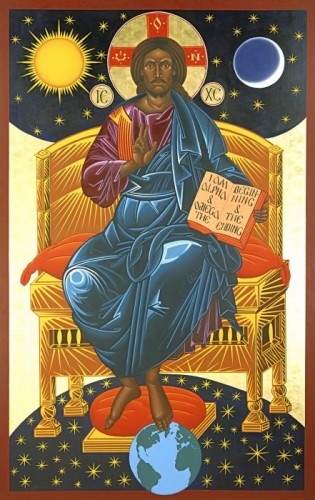
And it prays for God’s well-beloved Son to free us from this bondage and bring us together under his most gracious rule.  But when it says that he is King of Kings and Lord of Lords, we must be careful not to misunderstand.  This does not mean that he is of same ilk as the kings and presidents and party chairmen who rule the nations of the world, or that he makes a rival claim to their power.   It is saying that Christ has overcome the superior power that keeps them, and us, enslaved.  Because all earthly power, when you come right down to it, is a doomed effort to perpetuate itself, to defend its interests against those of an other.  But Christ’s power comes from the sovereign will of the almighty and everlasting God, whose purpose it is to reconcile all people, and restore all things.
Which sounds nice, but how it really works is not the least bit normal.  This is apparent when you consider that this power was decisively revealed on the cross.  In Luke’s telling of the story, the Jewish leaders scoff at Jesus as he is hanging on the cross, and say, “he saved others; let him save himself.”  And then the Roman soldiers mock him, saying, “If you are the King of the Jews, save yourself!”  Finally one of the men crucified along with Jesus, derides him, saying, “Are you not the Messiah?  Save yourself and us!”  To these people “save yourself,” is a taunt, a way of rubbing Jesus’ nose in his powerlessness, because preserving oneself is what power is for.   His inability or unwillingness to save himself is proof that he is no king, and no Messiah. 
But the other criminal is somehow able to see the real power of Jesus.  Crucifixion was a punishment reserved for rebellious slaves and others who took up arms against the state.  So here is someone who has tried and failed to overthrow domination with revolutionary violence.  He knows enough about Jesus to understand that this was not his way, and yet here Jesus is, suffering alongside him, condemned as if guilty of the man’s own crime.  And this fills his dying agony with insight about what is really happening here.  Jesus has not failed, because he never tried to win victory for one party over another, or to restore the greatness of one exceptional nation.  He is, in fact, freely giving his life to lead all humankind into a different world.  He is founding a new humanity, on the forgiveness of perpetrators and the witness of victims, on the vulnerability to lostness and sickness and sinfulness and death that we all have in common, and on our shared hope for the answering compassion of a loving God. 
And so the crucified revolutionary discovers the unconditional and sacrificial love of Jesus, which more than a religious sentiment; more than a social ethic; more than a political strategy.  In his willingness to forgo self-preservation in his confrontation with the power of sin, he is one with the self-emptying of God who created a universe free to rebel against their creator.  He is one with the compassion of God who refuses to abandon her creatures to their rebellion.  Jesus manifested this unity of human and divine will throughout public ministry, and his death and resurrection make it finally possible for all of us to perceive it, to believe in it, to understand how it works, and what it aims to do.  And when our eyes open to see the kingdom of the Son of God, it is not just an illumination of the mind, but a longing kindled the heart, a fire lit in the soul, a passion to offer our selves in service to its consummation.  The love that was in Christ becomes our own, not to form us into a new tribe called Christians, to wield the old, false power of domination over others, but to make us free agents of the reconciling, liberating love of God.        
The news this week contained a vivid demonstration of this love.  As the COP22 climate conference in Morocco was winding up on Friday, a group of 48 of the poorest countries in the world made an announcement.  They said that while it is true that they are the least responsible for adding greenhouses gases to the atmosphere, and have benefitted the least from fossil-fueled industrial development, and have the least capacity to address the problem of human-caused climate distruption, because they are suffering the most from the unfolding catastrophe they have decided to take the lead in saving humanity.  And so they are committing themselves to leaving behind the carbon economy as soon as possible.  They are revising their plans for national development so that their carbon emissions peak by 2020, and they will build resilient economies based on renewable energy, and be completely carbon-neutral by 2050.
I’m not sure what it says that while we squander our wealth on military dominance, and indulge our fantasies of nationalistic revival, the poorest people in the world are displaying the moral greatness that we lack.  Or that while we willfully prefer opinions of convenience to the facts threatening our children’s future, they are showing the capacity for altruistic sacrifice we seem largely to have lost.  Certainly it gives the lie to any claim we might make to be a Christian nation.  But “Christian nation” is an oxymoron anyway.  And if the murderer could gain paradise while hanging on a cross, surely it isn’t too late for us.  The Son of God still has the power to free us from the bondage of division and the slavery of sin, if we really want him to.  But, of course, we would have to give up being normal.   

Tuesday, February 23, 2016

The fox and the hen


When I was a child we lived on a couple of acres outside of town in an old farmhouse.  There was a barn next to the house, and some smaller sheds and outbuildings, and although we didn’t have pigs or cows or chickens or geese, we did have dogs and cats.  At any given time we might have a couple of dogs and half a dozen cats, which worked fine because the animals were usually outside.  We didn’t worry about fencing or leashing the dogs because the house was well back from the road, and the neighboring houses were few and a good distance away.  The cats also came and went as they pleased, and some of them spent more time in and around the house, and others preferred the outbuildings and the fields.
The top part of the barn was a haymow, which you climbed up into on a ladder fixed to the wall, and at the base of the ladder was a small windowless room.   I guess it had been used to store a smaller amount of hay so the farmer didn’t have to climb up into the haymow and throw some down every time he wanted to feed his horses and cows.  And there was still hay on the floor of this little room, about a foot deep, and at least a couple of times that I remember, one of our animals decided that this would be a good place to give birth to her young.   I know it happened at least once with puppies, and there’s a story about that which will have to wait for another day.  And it happened at least once with kittens, because I remember the morning my brother Gordon got up early and went out to the barn to visit a litter of kittens, and came running back into the house, calling for us in alarm to come and see.  And we ran to the barn to find that every one of the kittens was dead, their little bodies scattered here and there, their necks torn and broken.
There is no way to know what kind of animal it was that did this, but my money is on a fox.  Foxes typically kill their prey by gripping it by the neck and shaking.  They also kill more than they need, when the opportunity arises, and bury the leftovers for later.  Perhaps the mother cat had been gone and returned, or one of our dogs heard a noise from the barn and went to investigate, and surprised the hunter before it could carry its prizes away.  And I’m going to say it was a fox, because that’s what Jesus calls Herod in today’s reading from the Gospel of Luke.  Some Pharisees have come to warn him that Herod, the ruler of Galilee, the one who threw John the Baptist in prison and executed him, now is out to kill Jesus so he should move along from there.  And Jesus says, “Go and tell that fox that I have work to do, healing the people who need healing, and I will not leave here ‘til I’m done.” 
I don’t think Jesus calls Herod a fox because he’s a sly trickster, or a charming rogue like the foxes in the children’s songs and folk tales that we know.  He calls him a fox because he is an opportunistic killer like the one who came prowling around our barn.  I take Jesus’ saying that way because he goes on to say more to the Pharisees about the work he has come to do.   He tells them that when he’s finished there, he will move on from Galilee, but not because he’s afraid of Herod—but because he has a further mission to carry out with respect to the people of Jerusalem.   And Jesus uses an image to describe his intentions toward Jerusalem and her children, which could not contrast more sharply with the intentions of men like Herod—they are like foxes who prey on the people whom God loves, but he is like a mother hen, who wants only to gather them underneath her wings, and keep them together and keep them safe.
Jesus is going to Jerusalem because he has to, because he is a Jew and Jerusalem is the place toward which all the desire of his people is bent.   All their hopes for justice and peace, for unity with one another, for the vindication of their people and their peculiar religion against the nations that oppress them, are focused Jerusalem.  Because that is where sacred revelation says that God has chosen to make his name and his glory dwell.   This invests that place with an extraordinary sacred power.  This results in giving the people who possess that place, and control access to it, political and economic power.  And one could be forgiven for assuming that Jesus’ purpose in going to Jerusalem is to confront those people and challenge their power.  Certainly it appears that the chief priests and scribes who controlled the temple in Jerusalem looked at him that way.  I think we can suppose that a great many of the people who followed him from Galilee had the same idea.
But this passage in Luke seems to say that Jesus’ business in Jerusalem is not with her rulers, or at least not with them alone.  He is not going there to overthrow them, or reform their institutions, or take the reins of their power.  Jesus goes to Jerusalem not as one who is seeking to get anything, power least of all; he goes as the prophets before him went, as one who is sent.  It is power that sends him, the power of the Holy Spirit of God.  In response to the desire of the children of Jerusalem, their longing for the presence of God, Jesus is coming with the power of an answering desire.  It is the same desire that came to Abram with the invitation to a covenant relationship, and the promise of children as numerous as the stars.  It is the desire for a people, who will live together in the land that the Lord will give, in unity and justice, and holiness and peace.  It is the desire of a mother to gather her children under the shelter of her wings. 
Jesus already knows from his experience in Galilee that God’s offer through him of forgiveness and love, of the healing medicine that breaks down walls of fear and exclusion and creates a beloved community, is perceived by lots of people as a threat.  He is astute enough to understand that the people of Jerusalem probably won’t care to hear about it; they prefer their little privileges over their less fortunate neighbors, or their resentments over their more fortunate ones, their fantasies of violent revolution, and party quarrels, and winner-take-all struggles for political and economic power.  And yet he is going anyway, even though he knows he is likely to suffer the fate that always seems to wait for prophets like him.  Because the desire of God will not be denied.  It must make its appeal, even though its only weapons are words of truth, and the love that never gives up hoping for an answering response from the beloved.  
It is a presidential election year in our country, and the candidates are abroad, appealing to the people.  And their message is strikingly similar, whichever party they seek to represent:  “Put me in the White House,” they say, “and I will seize power from your enemies and give it back to you.”  They may have differences of opinion about who the enemy is.  For some it is the billionaires, the Wall Street bankers and corporate CEOs.  For some it is the socialists and government bureaucrats.  But all are agreed on one thing, which is the greatness of the people, who are the innocent virtuous victims of some predatory class.  It is hard to deny the appeal of this message.  Wouldn’t it be nice if all we had to do to get out of the mess we’re in was to change the people in control of the levers of power?  Wouldn’t it be grand if we didn’t have to change the way we think or the way we live in any fundamental way?
Prophets like Jesus confront us with the emptiness of this dream.  That’s why we tend to kill them—because we don’t want hear about our own responsibility for the violence and injustice and waste that goes on in the world.  And we don’t want to know that God has a different dream, a dream of safety for all of us, and unity beneath the cover of her sheltering wings.  Most of all we don’t want to know that we have the power to turn in the direction of that dream, and that our turning is the turning of the world.  But God’s desire will not be denied.  The one who comes in the name of the Lord holds that power in trust for us, and offers it with unconditional love and absolute humility.  And he asks nothing from us but acceptance of his gift.    

Sunday, January 10, 2016

Responsibility and Freedom


I spent the last couple of days in Auburn, where the Sierra foothills start to rise out of the Central Valley, east of Sacramento.   I was at a retreat center run by the Roman Catholic Sisters of Mercy, but, while the event I was attending was called a retreat, it’s purpose wasn’t prayer or meditation.  It was a “retreat” more or less in the sense that corporations or large non-profits use the term—which is to say it was more like a three-day meeting.  Actually, it was two meetings.  From Thursday afternoon through Friday afternoon I met with the Bishop, and his assisting priest, whose formal title in Episcopalese is Canon to the Ordinary, and five of the six other regional deans in our Diocese.  Then, the members of the Diocesan Board of Trustees arrived, and we had more meetings on Friday evening, and yesterday morning.  They were still at it when I left yesterday after lunch, and in fact, they are meeting again this morning as we speak.
I won’t try to tell you much what those meetings were about, not because we talked about anything secret, or things you wouldn’t understand, but because I kind of assume you wouldn’t be all that interested.  There were moments over the past couple of days when I wasn’t interested myself, but not actually that many.  I came away tired, because I didn’t sleep very well, and there wasn’t much time for exercise, and because, as an introvert, there’s only so much time in meetings I can take.  But I also came away feeling lifted up by the experience of being with people I have come to love and respect, with whom I can speak and hear about questions that really matter in the work that I do. 
This hasn’t always been the case when I’ve come away from Diocesan meetings.  There was a time in the past when I would have said that the work of governance and oversight in the church is tedious, and alienating, and dull.  When I try to understand what has changed between then and now, I could certainly relate it to the people I get to work with now, from the Bishop on down.  But, to be honest, I think what has changed most of all is me.  I used to go to those meetings and feel like an outsider, like someone who wasn’t really part of the tribe, but now I feel like I belong.  I have a defined and significant role to play.  People want to hear what I have to say—they respect it and take it seriously, and as a result I can say what I’m really thinking.
Like it or not, we human beings exist in community.  And like it or not, that means meetings.  It means governance, and decision-making, working through conflict, settling questions of authority.  It means politics.  “Politics” has come to be almost a dirty word in our vocabulary, a word we say with a mixture of cynicism, wariness, and contempt.  But I’m convinced that this is only because we are alienated from the process.  Politics becomes tedious, and ugly, and draining, and frustrating, when we don’t feel like we belong, when we feel like no one is listening.  It is sad to see this happen in any context, but it is especially hard to see it happen in the church.  Because at least part of what brings people to church is the need and desire to belong. 
And our responsibility is to show them that they do.  Not by telling them the rules and behaviors they have to adopt, or the things they have to say they believe, or by spelling out for them what are the steps to formal membership in our organization.  The church is truly itself when it shows people with actions that speak for themselves that they belong here, in the broadest possible sense.  They belong here in the church, but more than that they belong here in this world.  They have a place and a purpose, and a voice, and a name that is theirs because the God who made them and loves them gave it to them.
Our identity as Christians, and this thing called “church,” is something we belong to, not something that belongs to us.   And one of the basic teachings of our faith is that we belong only by the grace of God.  The teachings of the New Covenant tell us that, although we are Gentiles, it was God’s will that in Jesus Christ we should be made fellow-heirs of the promises of God.  We are, In other words, honorary Jews.  So when the Hebrew scriptures say that we are a people created by God for his glory, that it is God who formed us and called us by name, for we are God’s sons and daughters, those words are for us.  But the whole history of prophecy in Israel is a warning to us that this gift is never fixed into a final form.  Who we are, as people who are precious in the sight of God, is an identity that has to be continually renewed by the creating spirit of God, if it is not to become an idol of our own making. 
The story of John the Baptist sums up that prophetic warning in a powerful way.  The baptism that John offered at the Jordan wasn’t just an individual act of contrition, it was a collective act of repentance for Israel’s sins, and her helplessness to renew her own identity as the people of God.  What used to work isn’t working any more.  Things that used to make sense have become absurd, even deadly, because the conditions have changed.  Something new is needed, and we can’t begin to know what it is unless we first admit that we are at a dead end, we are stuck and don’t know how to move forward.   We need new insight, new energy, new inspiration, so that together we can find a new way to live.  And if that is to be true renewal, and not just the unconscious repetition of patterns from the past, it has to come from God—it has to be not simply renewal, but re-creation.
We can’t forget that this is where Jesus stepped onto the stage of history.  This is where his public ministry began.  Jesus, who had no sins of his own to repent, nevertheless went to receive John’s baptism of repentance.  He did it, not out of a sense of personal guilt, but because he identifies himself completely with his people, with their suffering and desperation and longing for a complete and radical renovation.   He joins in with their collective plea for forgiveness by being baptized in the Jordan, showing he is right there with them, stuck, at a dead end, sharing their need for the new beginning that only God can give.
And that is where our own Christian ministry begins.  People often express outrage or at the least confusion over the idea that their perfect little babies need cleansing from their sins.  That’s completely reasonable, but is based on a misunderstanding of the identity that we are baptized into.  Because the starting point of the Christian life is not a sinful individual made perfect.  It is participation in Jesus’ act of identifying himself with the sin and suffering of the whole human race.   This participation is not a private and personal experience of grace; it is a public act of incorporation into a body.  And this body does not belong to itself, as a world apart.  It belongs to the world that God has also created, which God also loves, which is also full of God’s glory.
In his baptism Jesus immersed himself in the collective predicament of his people, but that is not the whole story.  He got out of the water, Luke says, and as he was praying, heaven opened and the Holy Spirit descended upon him in bodily form, like a dove.  And a voice came from heaven saying, “You are my Son, the Beloved; with you I am well pleased.”  This baptism of the Holy Spirit is the gift, not of a collective identity, but of a personal mission.  Belonging to the church does not only mean belong collectively to the world, it also means belonging personally to God.  It means putting on Christ, which is a new kind of personhood.  It means being completely and compassionately grounded in the real, concrete forms of belonging that makes us human, belonging to a mortal body, to a place, to a people and their history; and at the same time being utterly open to ongoing re-creation by the spirit of God. 
So let’s keep this in mind when we invite people to church, and when we come here ourselves.   We are not coming here to parcel out what belongs to us, but to pray for a gift.   And this gift is deadly serious, but more than that it is child’s play.  It is the greatest, most universal sense of human responsibility—complete identification with the suffering of the whole world.  And at the same time it is an invitation to try anything you like to address that suffering, and to do so fearlessly, because you have complete permission to fail.  Belonging to Christ is ultimate freedom, the freedom to grow and to learn and to change, to become what God is eternally creating you to be.  It means sharing the freedom of the children of God.

About Me

My photo
Petaluma, California, United States
I am a priest in the Episcopal Church, and have been (among other things) an organic farmer and gardener, and a Zen monk. I have a lifelong interest in social and spiritual renewal on the basis of contemplative discipline, creative nonviolence, and ecological practice. In recent years my work has focused intensely on the responsibility of pastoral ministry in the humanistic, evangelical, and catholic branch of Christianity known as Anglicanism. I'm married with a daughter, and have three brothers and two parents.