Showing posts with label Spanish. Show all posts

Saturday, June 17, 2017

Thick accents of love


Last weekend I was a special guest at the annual convention of the Episcopal Diocese of Honduras, and all during the long flight down there, and the journey by pickup truck from the airport to the diocesan camp and conference center out on the Caribbean coast, I kept thinking about what I was going to say to the convention when the time came for me to speak.  Because I had a pretty good idea that I would be given the opportunity, not for a lengthy speech, but for a couple of minutes to make some courteous remarks appropriate to the occasion: greetings from Bishop Beisner and all of us in the Diocese of Northern California; gratitude to Bishop Allen of Honduras and everyone there for their warmth and hospitality; hope that the companion relationship between our dioceses would continue and grow stronger in the future—you know, that sort of thing. 
And sure enough, on Friday night after dinner, Bishop Allen asked me if I wanted to get up and say a few words during his address to the convention the following morning.   The opportunity came pretty much exactly as I had expected, so you might wonder why I had wasted so much time worrying about what I was going to say.  Well, because I had decided to give my remarks in Spanish.  Some of you know that I started studying Spanish seriously about eight years ago.  Which is one of the reasons why Bishop Beisner asked me to go and represent him at the diocesan convention in Honduras.  Moreover, I’d already made plans to go there during my sabbatical later this summer, partly to improve on my Spanish, and partly to learn more about the work Episcopal diocese there.   So I jumped at the chance to make this brief initial trip, to get a little bit of the lay of the land, and make some acquaintances.    
It was out of that desire to open doors that I decided that if I did get the chance to speak to the convention, I was going do it in Spanish.  And I wouldn’t write my remarks out ahead of time, but would deliver them in an impromptu conversational style.  That was why I spent so much time beforehand going over in my mind what I would say, and how I was going to say it.  But it turned out, of course, I really need not have worried.  Not because I ended up giving a flawless performance.  There were things I had meant to say but forgot about in the heat of the moment; and there were other things I did say, only awkwardly, after fumbling for the right word, or the correct grammar.  Still, when I was done Bishop Allen thanked me for what I’d said, and for taking the risk of saying it in what obviously not, as he put it, my “mother tongue.” 
The twelve apostles take the same risk in the story of Pentecost.  I think we often assume that because the power to speak in different languages came from the Holy Spirit, they must have spoken them perfectly.  And yet the story says that the people in the crowd that gathered were doubly amazed, because the apostles both spoke to them in their various native tongues, and did so with Galilean accents.    And it seems that their syntax was a little jumbled, and their pronunciations a little slurred, because some of the bystanders got the impression that they were drunk.  All of which says something important about the way the Holy Spirit works.  It gave the apostles the power to communicate with strangers from many foreign lands, but in using that gift they remained the persons they always were—those rough and rude, poorly-educated, fishermen from Galilee.
Which is precisely the point of the passage from the prophets that Peter quotes to explain to the crowd what is happening—that before that great and glorious day when God makes his power and judgment unmistakably manifest on earth, the spirit of prophecy will come on all kinds of people.  Young men will see visions and old men will dream dreams; your sons and daughters, even your slaves, both male and female, will be filled with the prophetic Spirit, and speak the truth that comes from God.  And it is this great outbreak of divine communication with humanity, this democratization of the power to see and know and speak and hear and understand the hidden things of God, that is the real miracle of Pentecost.   
I was able to connect more effectively with the Episcopalians in Honduras, not just because I spoke in Spanish, but also because my Spanish was not all that good.    This broke down to some degree the unspoken dynamics of inequality built into our relationship by the legacy of colonialism, so we could see eye-to-eye, heart-to-heart, as sisters and brothers.  In a similar way, the coming of the Holy Spirit upon the apostles, does not transform them into higher beings of perfection and light.  It does not turn them into flawlessly fluent speakers of Parthian, but uses these ordinary and imperfect channels to open the crowd in Jerusalem to receive its message.
And even though each of them heard it in a different tongue, the Holy Spirit’s message was the same to all.  It did not require an extensive vocabulary of subtle theological terms, or a grammatically complex sequence of logical proofs.  This message was a new communication that would revolutionize the world, of who God is and how God acts, and yet it came upon the crowd that day with so much spiritual power precisely because it was so simple.  It was as deceptively simple as a really good story.  And that’s what it was—a story; a story of God’s love for us.  It told how God communicated that love by taking the risk of speaking our language, becoming one of us, to meet us face-to-face, heart-to-heart, in the person of Jesus of Nazareth. 
The Holy Spirit’s message told how Jesus did not set himself above us, but came as one who shared the disappointment of the poor, the loneliness of the outcast, the sorrows of the bereaved, and the suffering of the oppressed.  He struggled against the religious, economic, and political powers of his day, with no weapon but the truth of God, and the faith of the little ones who believed in him.  He carried out that struggle to the death, to his own ignominious death on the cross.  Through it all Jesus never ceased to love God, never stopped offering himself to be an instrument of God’s will, never gave up hope that God would be faithful to his promises.  And God was faithful.  For Jesus’ sake, God broke the chains of death that hold us all in bondage, and raised this same Jesus to the life of a new and glorious body, exalting him to heaven where even now he sits enthroned as the gracious and merciful Lord and judge of the world. 
The miracle of Pentecost is that the fishermen told this story—in different languages, with poor pronunciation, awkward syntax, and thick Galilean accents—and many of the people in that crowd knew that it was true.  The truth of it poured into them, like water sinking into cracked and thirsty ground.  And to their amazement they felt an answering response within; the welling up deep inside them of something that they had almost forgotten was there, as if a heavy lid had been removed from an ever-flowing spring.  The Gospel of John says that the Holy Spirit will flow like rivers of living water from those who believe in Jesus. 
But our translation is a bit misleading when it says this water will come out of our hearts.  Because the original Greek literally says that rivers of living water will flow out of our wombs.  The Holy Spirit is a fire, burning away all illusions and ignorance that blind us to God’s truth.  But it is also water, dissolving hardness of heart, eroding the dam that obstructs the flow of God’s love.  We who drink in the story of Jesus discover a God who loves us with the compassion of a mother for her child.  This God, the Holy Spirit, not only pours over us, as compassion for our suffering, our fears and weaknesses and limitations; it flows out of us as life-giving rivers of compassion toward all who, like us, are mortal and sorrowful, lonely and afraid.  And there can be no mistaking what is meant by this symbol of water bursting forth from our wombs—it is this Holy Spirit, that we know in the self-giving love and compassion of Jesus, that will give birth to a new world.       
 ,

Sunday, August 31, 2014

Who is welcome?


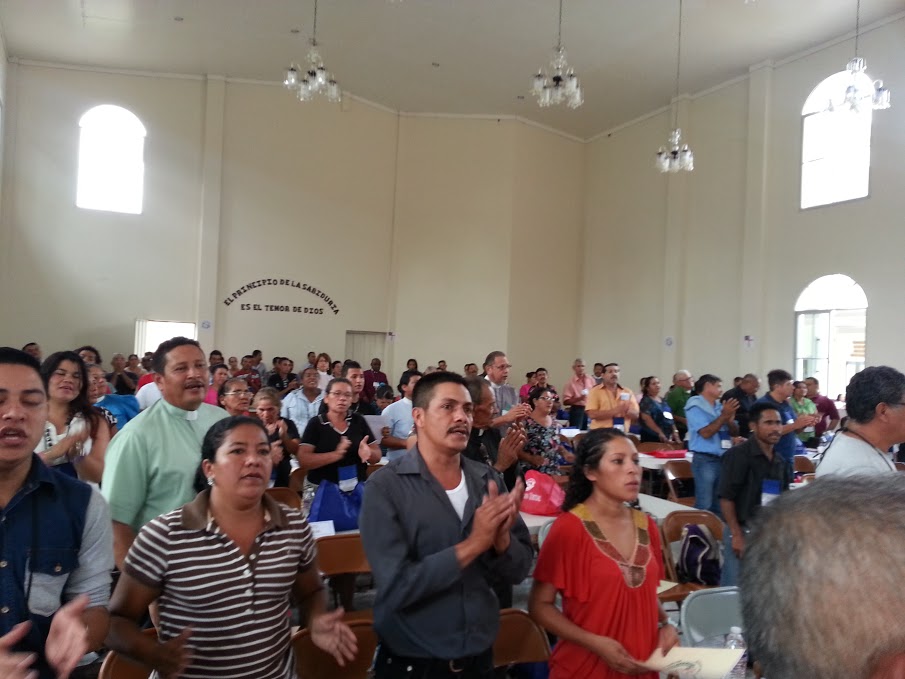
Last week our Bishop sent me to North Carolina to attend a conference that happens every two years in the Episcopal Church, a gathering of clergy and lay people from all over the country who are engaged in Latino ministry, or who want to be.   A fair number of the participants are first-generation Americans, with limited English, so a lot of the sermons and addresses and workshops, and almost all the songs, were in Spanish.  There was simultaneous translation available, but I chose not to use it.  There were two reasons for this.  The first was that I saw an opportunity to practice my Spanish.  There were some speakers, who, when they really got wound up, left me hopelessly in the dust, and a lot of jokes I didn’t get, but I was pleased with how much I was able to participate in Spanish, and I got better at it as the conference went on.

The second reason why I decided not to use the translation equipment was that I wanted to have an experience that is an everyday reality for many people, but almost never happens to me.  What with my sex, and the color of my eyes and skin, and my native language, socio-economic status, and level of education, and my degree of physical and mental ability, I have the privilege of access almost everywhere I go.  I feel like I belong.  And that is nowhere more true than in the church.  “The Episcopal Church Welcomes You” is a slogan that I know, without question, applies to me.  But sitting in the auditorium at that conference, where I was in the minority ethnic group, trying to sing a song I didn’t know, or get the gist of a speech in a language I didn’t completely understand, gave me just a little taste of what it is like to be a cultural outsider, an “other.”  

At the celebration of the Holy Eucharist on Wednesday afternoon I somehow ended up in the front row of the auditorium.  After the sermon it was announced that there would be laying on of hands and prayer for those with particular needs or concerns.  And sure enough, eight or so of the Latino and Latina priests in albs and stoles took positions up on the stage or in the space right in front of the first row of seats, and the people started lining up.  My immediate thought was that I didn’t have anything going on in my life that was serious enough to require special prayer.  I thought of the other people in that audience, and I imagined what they must deal with in terms of poverty, or separation from their families, doubtful immigration status, or serious disease, and I thought that they surely needed prayer more than I did. 

So I decided to sit and pray quietly to myself.  And I prayed for peace in the places in the world where there are wars and political turmoil.  And I prayed for people in this congregation and others that I know who are suffering or struggling in different ways.  But I also had a front row seat for the action that was going on around me, and my eyes kept straying upward to watch the people with their heads bowed, and the priests holding them in their hands and leaning in with their eyes closed, whispering their prayers, and I saw the hugs that sometimes followed after the prayers were said, and the tears.  After a few minutes I noticed that that, if there was some kind of expectation that you had to have really serious problems in order to go up for a prayer, people were either ignoring that requirement or else this was a group that was really hurting because the lines down the middle of the auditorium and in the side aisles were getting longer, not shorter.

 Well, I began to wonder whether maybe I should reconsider my decision not to join them, but I also started to worry about the time.  This Eucharist was supposed to end at 4:15 and I’d made plans to go for a run and a swim in the lake before dinner at 6:00 and some of these priests were really taking a long time with their prayers, and if I got into line, then everybody might as well do it and we’d never get out of there on time.  So I straightened up in my seat and closed my eyes and returned to my private prayer, and after a while I began to pray for members of my own family, for my crazy old uncle living by himself way up on the North Coast, and another uncle with cancer, and then I thought of my brother.  I started to pray for my brother who has a drug problem, and is unemployed, and has never really done much with his exceptional talents, but is just kind of stuck in a perpetual adolescence, and of all the shame and self-hatred I know he carries, and the sorrow and worry it causes my parents and I started to feel really, really sad, and I recognized that I did have something I needed prayer for.

But by then there were just a few people left in line, and the others had gone back to their seats, and the priests had started to turn and lay hands on each other, and I wasn’t sure which one to go to, and I didn’t want to be stupid and rude, like “hey, I know we’re almost finished, but I changed my mind.”  And I wasn’t sure that I wouldn’t start crying if I started talking to a priest  about my brother right then, and then I would have to walk back to my seat with everybody in the auditorium watching me.  And the thing was, that room was filled with a spirit of kindness and compassion in that moment and I’m sure that whatever I did no one was going to judge me, and it would have been okay. 

But I never did go up for a prayer, because I was afraid to be vulnerable.  I was so attached to the idea of being better off than those people that I couldn’t see my own need for healing, or that those “others” were offering it to me.  “The Episcopal Church Welcomes You,” is a slogan I can get behind as long as I’m the one doing the welcoming; but let me be the stranger in need of welcome, and I hesitate and am afraid, standing outside wondering if it’s safe to go in.

In today’s gospel reading Peter and Jesus have a fight, because Peter thinks that whatever it means that Jesus is the Messiah, the Son of God, it doesn’t involve being vulnerable.  But Jesus sees it differently.  He knows that the world that human beings have made is one where people quite easily and almost without thinking assume that some were meant to rule and others to be ruled, some to possess and other to be dispossessed, some to enjoy the blessings of prosperity and peace, and others to live and die in misery and violence, as if all of this were quite natural, even willed by God.  But Jesus sees God taking a place in this world with the poor, with those who mourn, those who hunger and thirst for justice, who suffer persecution for the cause of peace and for the truth.  So the Messiah will make the journey the holy city of Jerusalem as a vulnerable stranger, an outsider, one whose right to be there is in doubt, whose fate is in his enemies’ hands.

It wasn’t hard to predict what would happen to him there.  He would suffer and be killed, as prophets and martyrs have suffered and been killed again and again before Jesus and ever since.  What happened was business as usual, entirely ordinary except for one thing—on the third day Jesus rose from the dead, and his disciples were witnesses of it.  And that one thing is what makes all the difference.  It is what makes the cross not a place where God’s voice in the world is silenced once again, but where God’s truth speaks most clearly.  It is where we see the world as God sees it—where God dispels the illusions of human privilege and power, and drags hypocritical religion and rationalized barbarity out of the shadows.  The cross is where God lights up the whole of human life, even at its most treacherous and cruel, its most abused and degraded, with the eternal glory of the Son of Man—his compassion, his forgiveness, his wisdom and love. 

The cross is where we learn to follow Christ on a journey of healing and being healed, welcoming and being welcomed, that reaches across every barrier of culture, class, language, sex and sexual orientation, race and religion, to touch God in the hand of the other, and where we learn to say “ hermano”, “hermana”-- “brother”, “sister”.
  

Thursday, August 14, 2014

To the other side


It’s not easy to see why Jesus would send his disciples away at nightfall to start rowing across a lake, but there might be a clue in the larger order of events in the gospel.  You see, the story the feeding of the multitude comes right after the sordid episode where Herod, the ruler of Galilee, has John the Baptist beheaded at a dinner party.  Word then comes to Herod about this new fellow, Jesus of Nazareth, and he declares that this must be John, come back from the dead.  News of this comes to Jesus, and that is the point at which he leaves town and heads out into the bush.  A great crowd goes after him—with John dead, Jesus is the only prophet they have left, the only one who can challenge the violence and corruption of their rulers in the name of God’s justice and truth. 
It’s not clear whether Jesus set out to have the great world-changing career that he did.  It seems to me that a lot of what he did was spontaneous and personal.  He had a profound personal experience of God’s love for everyone, and he related to everyone he met on that basis.  But because of his historical circumstances, every little thing he said and did to relieve people’s suffering, to satisfy their basic needs, to lift their spirits and bring them together, had revolutionary impact, and this is the point in the gospel story where that starts to be clear.  Jesus had to know that news of miraculously feeding a multitude would travel fast, and that the reaction might be swift and brutal.  Maybe he sent his disciples out in the boat that night because he feared for their lives, and decided they should slip away under cover of darkness. 
From the evidence we can piece together, Matthew’s gospel came out of a community that was crossing over from their ancestral home in the world of Judaism to the strange new reality called the Church.  It was a journey that put them in a boat with other people they would never have given the time of day before, and now they were all depending on each other for their very lives.  They were running into unaccountable hostility from their fellow Jews, who rejected and denounced and even persecuted them for preaching and praying and gathering in the name of Jesus. 
Yet it was a community that had experienced the fulfillment of what it means to be human.  In their gatherings they had received gifts of the Holy Spirit in baptism and the Eucharist.  They had died with Christ and been reborn in his resurrection to a new life of imperishable glory.  They had tasted the heavenly banquet of God’s justice and love, where all pain and grief are at an end and evil and suffering are no more.  But somehow they still found themselves on this side of things, in the world where children die of hunger and nations are laid waste in war.  Or more precisely, they found themselves in a small boat in the dark, rowing against the wind and against the waves, trying to cross over to the other side.  
The image of Jesus coming to the disciples over the sea, calming the storm, and their fears along with it, must have been a great comfort to these people.  Less comforting is the little story that Matthew works in at this point about Peter.  The troubling part is where Jesus says to Peter, "You of little faith, why did you doubt?"  It has always struck me as an accusation that if Peter really had faith, he should be able to do like Jesus.  But that just doesn’t seem fair, to Peter, or, for that matter, to us.  If walking on water is the minimum standard of faith, we’re all in trouble. 
But reading the story this time around, I realized that walking on water isn’t the only thing Peter has doubts about.   Before that even happens, Jesus calls out to the terrified disciples, "Take heart, it is I; do not be afraid." But Peter doesn’t calm down and wait in the boat for Jesus to come and rescue them.  He doubts that it is really Jesus, and he demands proof.  He wants Jesus’ power, for himself and nobody else, so he can take matters in his own hands.  “Go ahead, knock yourself out,” says Jesus, and Peter leaves his brothers behind and steps out of the boat. 
I don’t imagine Jesus was surprised when Peter started sinking.  Peter’s faith wasn’t big enough to believe that Jesus was a living man, and not a ghost.  It wasn’t big enough to just sit tight in the boat with everybody else.  So it sure as anything wasn’t big enough to walk on water.   Now just a little faith is enough, as long as it is faith in Jesus and solidarity with the others in the boat.  But it seems like there were some in the early Christian community who weren’t content with that.  They began to doubt that faith was sufficient to their historical situation. They wanted some kind of supernatural escape plan, to leave the whole soggy mess behind and walk away over the waves.
In May I was with a bunch of priests and deacons from our diocese, when Sally Hubbell, from St. Paul’s church in Healdsburg, asked the group if we knew anyone who might be able to do a service in Spanish.  St. Paul’s has a small but lively Spanish-language congregation and one of the girls from the was going to celebrate her quinceañera on August 9.  Sally would be away on vacation and neither of the priests who usually substitute for her on such occasions were going to be able to do it either.  With a certain amount of trepidation I raised my hand and said, “I can.” 
For the past six years all the time and money that I get allotted for Continuing Education has gone to learning Spanish.  I have a weekly lesson via an internet video call with a man in Guatemala, and I spend three or four hours of my free time every week doing written exercises.  Progress has been painfully slow at times, but I’ve stuck with it.  So yesterday I preached in Spanish for the first time.  The same goes for celebrating the Eucharist.   For that matter, it was the first quinceañera I’d ever been to.  When I first agreed to do it, I was excited about the chance to show off my skills.  But by the time it came around it was all I could do to get through it. 
Friday night I hardly slept a wink, and I got up yesterday morning feeling like death warmed over.  It didn’t help that I was coming down with a cold.  I made it through okay, though, with a lot of help.  I used my Spanish lesson on Thursday to go over my homily with my teacher, and he helped me polish up my grammar and use more popular idioms.  I got a lot of help from a lady named Gretta, who is a kind of bridge person between St. Paul’s Anglo and Latino congregations.  Her Spanish is way better than mine, and she was the emcee for the event.  The family had hired a fabulous trio of musicians who had a huge repertoire of Mexican folk music.  Whenever I decided I needed a little music, I’d just give them a nod, and away they’d go. 
But the biggest help of all was having someone there who was, if anything, even more scared than I was.  I mean, of course, fifteen year old Jessica Castañeda.  She was sitting in her tiara and purple dress and high heeled shoes, in the center aisle right in front of the altar, so we were physically close and looking at each other throughout the service.   We traded off being the center of attention, and had to take a lot of cues from each other.  And I think the fact that both of us were coming out in public, in different ways, at the same time, that both of us were thrilled to be there and at the same time just getting by on a wing and prayer, enabled us to help each other, to keep rowing against the wind and waves.
One year-old Ave Marie Boazman is having a coming-out part of her own this morning, at her baptism.  We can’t know how historical circumstances are going to shape her life.  I’d like to be able to say it’s will be smooth sailing, but a quick glance at the headlines, or even the weather report, suggests otherwise.  Lucky for Ava she has parents who recognize that she’s not going to get very far walking across the water.  She needs a boat, and a Lord who can still the wind and the waves.  She needs people who will stay in the boat with her, no matter what happens.  And so do we, so we are glad to welcome Ava aboard.

About Me

My photo
Petaluma, California, United States
I am a priest in the Episcopal Church, and have been (among other things) an organic farmer and gardener, and a Zen monk. I have a lifelong interest in social and spiritual renewal on the basis of contemplative discipline, creative nonviolence, and ecological practice. In recent years my work has focused intensely on the responsibility of pastoral ministry in the humanistic, evangelical, and catholic branch of Christianity known as Anglicanism. I'm married with a daughter, and have three brothers and two parents.