Showing posts with label discipleship. Show all posts

Sunday, November 13, 2016

Excluded by wealth


I got grants and loans to help my parents pay for the elite private college I went to.  But I had to earn the money for my personal expenses by working at a campus job.  In the public schools I’d attended in Indiana and Vermont, my family’s income was somewhere in the upper half of the broad tier of those of us who knew we weren’t poor, but weren’t rich, either.  Which included almost everyone I knew.   But when I got to college I grasped for the first time that there are some people who are rich.  Not rich like we are all in this country relative to peasants in the underdeveloped world, but really rich.  Like, children of middle-eastern despots or Wall Street hedge-fund managers kind of rich.   And I found being in the same world as them to be intimidating.  I was lucky, in that I was spared the humiliation of wearing a hairnet and slinging hash in the dining hall.  My job was in the library, re-shelving books.  And it’s funny to me now to think back on the embarrassment I felt wheeling my book cart past my fellow-students as if there were something shameful about being on a scholarship. 
But one Saturday evening in my sophomore year, a friend invited me to party with a friend of his in the next dorm over from mine.  This friend of a friend was someone every on our small campus recognized, because his last name was on, not one building on campus, but an entire quadrangle of science classrooms, and laboratories, and faculty offices.  And after I’d been hanging out for a while, feeling kind of awkward, I asked our host if I could play a record from his collection.  (Side note here--I’ll never forget how Bob Marley’s Babylon by Bus album sounded on his unbelievably awesome stereo).   And in his eager response to my request, I perceived something that had not occurred to me before.  Which was that he was deeply lonely and almost pitiably eager to be liked.  In that moment I saw that his privilege was an isolation cell, keeping him from ever knowing the freedom of being just an ordinary guy.  
The fellow named Zacchaeus who features in today’s Gospel lesson is not the only one in Jericho eager to see Jesus.  The crowd that lines the road through the town is so dense that a little guy like Zacchaeus can’t see over it.  The people in the crowd know who Zacchaeus is—everyone does—and if he had any friends among them, they might have moved aside a little and let him push his way through to the front.  But they all detest him, this rich tax collector, who hardly needs another privilege granted him.  So they stand, shoulder-to-shoulder, with their backs to Zacchaeus, while he jumps behind them, trying to get a glimpse of the man everyone’s talking about. 
But Zacchaeus is nothing if not resourceful.  He runs through the back alleys, to get ahead of the parade, and clambers up a sycamore tree to get an obstructed view.  And when Jesus gets there he looks up and greets Zacchaeus as if seeing an old friend.  “Hurry down from there, Zacchaeus.  I need to stay at your house tonight.”  And with touching eagerness, Zacchaeus scrambles down from his perch, and welcomes Jesus to be his guest.
Now where the point in the story where we learn that Zacchaeus is driven to try to see Jesus by something more than idle curiosity.  And maybe this is only just dawning on Zacchaeus, too.  But when Jesus recognizes him and calls him down out of the sycamore tree, and tells him he is worthy to take Jesus under his roof and be his host, Zacchaeus suddenly understands what he was really looking for— to put things right in his life.  He sees what he has to do to be restored to wholeness, and he finds the resolve to do it.  “I will give half my possessions to the poor, Lord, and if I have defrauded anyone of anything, I will pay it back four times over.” 
Now Jesus confirms that Zacchaeus has got it right.  He says it there, in the street of Jericho, in front of the whole crowd, so everyone can understand, that no matter what kind of person Zacchaeus has been in the past, no matter how his wealth, and his manner of getting it, have alienated him from them, today Zacchaeus belongs again to the community.  He is once again truly what he has always been in his essence, a member of the family of Abraham.   Because today he sets out on a new path, the path that Jesus call everyone to follow, no matter their history, or station in life, the path of integrity, and generosity, and compassion.         
This is the story of the call of a disciple, the final such story in the Gospel of Luke, and Luke’s is the only Gospel that includes it.  Mark and Matthew tell of a different encounter that Jesus had in Jericho, which also turned into a call to discipleship.  And Luke tells that story, too, right before the one about Zacchaeus.  It is the story of a fellow who also wants to see Jesus but can’t, not because he is short, but because he is blind.  Like Zacchaeus, he is marginalized, kept at the back of the crowd because he cannot see.  But he cries out “Jesus, Son of David, have mercy on me!” and the more those in front of him tell him to shut up, the more he shouts it out.  And as with Zacchaeus, Jesus stops, for the one that others tried to exclude; he asks the blind man “What do you want me to do for you?” and he asks to receive his sight.  Jesus tells that his faith has saved him, and immediately he is able to see, and goes after Jesus, praising God.
In one sense the rich tax collector could not be more different from the blind beggar by the roadside.  But by adding in the Zacchaeus story, Luke sets up a parallel which seems to suggest that they are really much the same.   They share the same determination to make a connection with Jesus in spite of the disapproval of the crowd.  In both cases, Jesus takes notice of them, and initiates a conversation.  In both cases, the result is healing and transformation.  And yet the differences are also significant.  The beggar asks for and receives a gift from Jesus, the physical restoration of his sight.   While for Zacchaeus the restoration is social and moral, and it begins with giving Jesus what he asked for—the hospitality of his house.  The one man goes off to follow Jesus, on the final miles of the journey to Jerusalem, but Zacchaeus is to stay put and set things right with the folks in Jericho.  
It might help us understand what Luke was trying to say here if we consider that this is not the only place in his gospel where wealth is a wedge dividing people from each other—think of the rich man who feasts while Lazarus lies starves at his gate, or the younger brother who squanders his inheritance, and is too ashamed to go home.  The strange parable of the dishonest steward is a story, only found in Luke, in which ill-gotten wealth, like that of Zacchaeus, becomes a means of reconciliation.  All of which suggests that Luke was wrestling with a problem that wasn’t much of an issue for Matthew and Mark, namely how to bring people of unequal economic status together in the same community. 
Luke’s says nothing to soften the warnings we hear in the other Gospels against making an idol of wealth.  And, if anything, he makes an even stronger case for what modern theologians have called God’s “preferential option for the poor.”  But when Jesus calls Zacchaeus to come down from his high place, and join the rest of us, he adds nuance to this picture, a nuance sometimes missing from our contemporary debates about inequality.  We see a growing awareness nowadays of how destructive our grossly unequal distribution of wealth is to the poor, and even to the endangered middle-class, how it is corrupting our public institutions, and eroding social solidarity.   But the gospel reminds that it hurts the rich, too, who in their own way are excluded from the unity God wants us to share.  Like people marginalized by disability or poverty, or ethnic or sexual prejudice, they need a way to be reconciled and restored to communion.  They are called to a path of discipleship.  And the example of Zacchaeus provides it, a path that, like the struggle of the oppressed for liberation, requires courage and sacrifice.  It begins with redistribution and reparations.

Sunday, September 11, 2016

Actions that hurt--and heal


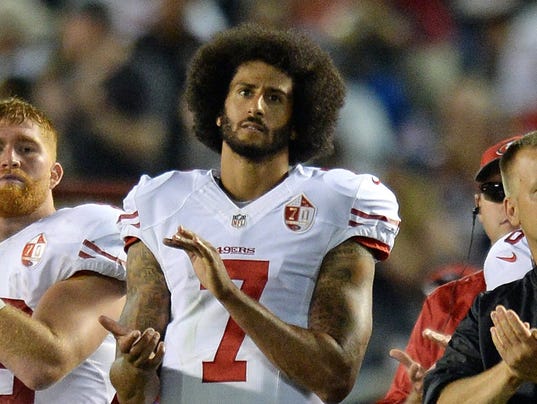
I spent most of last Monday digging up an old, leaky irrigation system in the front yard, and I brought a portable radio outside with me, to listen to while I worked.  After a couple of hours of informative programming on a listener-sponsored community station, I decided I’d had enough of that for the day and turned to one of my guilty pleasures—sports talk radio.  And in that world the news was all about a quarterback for the San Francisco 49ers named Colin Kaepernick, who has been remaining seated during the national anthem before the team’s pre-season football games.  The first time he did it, no one noticed, but at last Sunday’s game in Green Bay, Wisconsin, a reporter saw him, and asked him about it in a locker-room interview after the game, at which point Kaepernick declared that he was sitting in protest of the oppression of African-Americans and other people of color in the United States. 
The hosts of my radio talk show felt compelled to weigh in with their opinions about what Kaepernick had done, and then they opened the phone lines and took calls from listeners who expressed their wide-ranging and contradictory views.  As the week went on, this controversy spread across the media landscape, with everyone from Kaepernick’s former coach, Jim Harbaugh, and 49ers legend Jerry Rice, to the Republican Party’s nominee for President publicly expressing their disapproval.  Meanwhile, some current and former members of the armed services, not wanting to let others took offense on their behalf, “tweeted” messages of support at #VeteransForKaepernick.  At the 49ers final exhibition game on Thursday, at “Salute to the Military Night” in San Diego, Kaepernick and teammate Eric Reid knelt on one knee during the anthem, in what they intended as a gesture of mingled defiance and respect, and tens of thousands of fans in the stadium got to contribute their voices to the conversation by booing Kaepernick lustily every time he was on the field. 
Clearly, Colin Kaepernick has touched a nerve by taking this stand, or rather, this seat or this knee.  He has aroused countless people to want to have their views be heard on what they think of his actions, and whether his taking them is justified, whether he is personally qualified to be making this protest, and whether the way he has gone about it is appropriate or offensive.  And I personally am not immune to this reaction.  But I’m going to spare you my opinions, because I think today’s scripture readings point us in a different direction.  They are asking us to think, not about what Colin Kaepernick’s protest means to us or to others, but about what it is actually like for Colin Kaepernick.  When all his teammates and coaches, and the owner of the team, and every one of the fifty-thousand other people in the stadium who were physically able to do so rise to their feet in a ritual of unity and love for our country, a ritual you yourself have proudly participated in hundreds of times before in your high school, college, and professional careers, what is it like to sit, alone, on the bench? 
Jesus says that this kind of loneliness, this alienation from other people, is what we can expect when we join his movement.   We can expect to have moments when we are estranged from the groups we thought we wanted to belong to, and even from the person we thought we would be to be loved and accepted by them.  It is an estrangement that can turn us into enemies in the eyes of our nation, our church, even our family: "Whoever comes to me and does not hate father and mother, wife and children, brothers and sisters, yes, and even life itself, cannot be my disciple.” This is a hard saying, and it’s natural to think, “Jesus can’t really mean that—he must be overstating the case.” And in a sense he is, but the purpose of the exaggeration is to underscore his essential point: that following him means sharing his commitment to doing the will of God whatever the cost.  We have to be ready for those moments when we know what we must do to be faithful to the truth of our lives, when even though it is certain we will be misunderstood and hurt people we care about, and in those moments we have to be willing to act. 
If we’re lucky we are never called to do this at the cost of our health, our freedom, or our lives.  But the point is that we are never truly free unless we give God the freedom to tell us what to do and how far to go.  We are never fully alive if we are not willing to lay our lives on the line in response to the Spirit’s stirring of our conscience.  And if we are fortunate enough to live in a society where Christians are the majority, where social deviance and political dissent are widely tolerated, it shouldn’t serve as an excuse to take fewer risks with our freedom, or stands on our conscience, but as a license to take more.   This doesn’t necessarily mean that we have to go out looking for courageous stands to take; the naturally-unfolding circumstances of our lives give us ample opportunities to take difficult and unpopular actions.  Even those actions we recognize as especially heroic often turn on a fairly straightforward personal choice.  Rosa Parks had no idea, when she refused to give up her seat in 1955, that she would catalyze the Montgomery Bus Boycott and the Civil Rights movement.  She was simply, she would later say, “tired of giving in.”  Yet as this example shows us, it is actions, even modest personal ones, that really count.  They have far-reaching effects that words do not. 
Actions create stories, and symbols, with the power to move other people.  In July LeBron James and three other professional basketball superstars stood together and made speeches, at a nationally-televised awards ceremony, about racial division, systemic failure, and violence both by and against the police.  It received a polite murmur in response, whose tone was generally appreciative.  But those speeches were a blip on the meter compared to the volume and intensity of the reaction that Colin Kaepernick got, by sitting alone, saying nothing.  His action transformed an obligatory ritual that rarely gets a second thought, into a highly charged symbol of our country’s congenital wound of racist oppression and violence, a wound that has never healed, and continues to tear us apart.  And in the days since, as people have passionately argued with each other about their interpretations of what he did, that disunity has been visible for everyone to see.  Whatever you make of Kaepernick’s action, it is hard to dispute its effectiveness.   
Of course, there is no greater example of the power of an act to transform a symbol than the one given us in the gospel.  Jesus’ teachings about the forgiveness of sins and the blessedness of the poor, about loving one’s enemies, and the subversive, hidden nearness of the Kingdom of God, would surely have been forgotten centuries ago if he had not been willing to die on a cross.   In doing so, Jesus changed that cross from a sign of terror and despair at the ruthless power of the Roman state, into a symbol of unconquerable freedom of conscience, and faithfulness to the will of God.  And God’s act of raising Christ from the dead completed the transformation, so that now the cross is a symbol of the truth of all that Jesus taught, of justice, forgiveness and reconciliation, of abundant life’s victory over death, a sign of promise even to those without a hope in the world, that their suffering itself is eloquent, and God is listening. 
And for those of us who have something left to give the world, and come to Jesus to take up his cross, it is the sign of our freedom and our mandate, in gestures of protest and works of mercy, to act like him.  The importance of these actions is not measured in how much they shift the balance of political power, or even lessen the suffering in the world.  In those respects, they often seem to be so much spitting in the wind.  But they are also important as signs of resistance and hope.  They create symbols and stories that inspire and provoke, encourage and infuriate, chasten and embolden, others to act.

Tuesday, August 23, 2016

On the move, at the door.


Friday afternoon at 3:30 I had a rendezvous here at the church with two older guys from Indiana named Ron and Dan.  They drove a twenty-foot box van full of sleeping bags and duffels and bicycle repair equipment into the parking lot behind Cram Hall, and they wore matching t-shirts with a logo that said DeCycles West Coast 2016.  According to the email I got in April requesting to stay overnight at our church, DeCycles (like “disciples”—get it?) is an ecumenical Christian youth program, sponsored by churches, businesses, service organizations and individuals in Indiana, that has been taking teenagers on summer bicycle trips since 1969, and giving them the opportunity to practice kindness, caring, service, and other principles of a Christ-centered life.   This year’s group is riding down the coast from Seattle to Los Angeles and Ron and Dan were the advance men, who go to the overnight site ahead of the pack of riders, to get the lay of the land. 
I showed them the parish hall, the library and the nursery as potential sleeping areas, the kitchen and the bathrooms, the courtyard and the supply closet, and we discussed the deployment of chairs and tables, and dining arrangements, and where to lock up seventy-five bicycles.  They asked me for the passcode for the wireless network, assuring me that only selected adults would be using it.  While I was at it, I gave them my cell phone number, in case anything came up after I left.  We finished the tour, and they’d asked me all the questions they could think of, and no one else had arrived so I invited them to see the church. 
Needless to say, they were greatly impressed, especially with the front door and the stained-glass windows, and Dan kept lamenting that the craft of making such beautiful things seems to be passing away.  We were just coming out, when another, smaller truck pulled up, with the DeCycles logo on the side of the cargo box.  Ron directed the driver to parking lot, and another smiling older man got out, and a woman named Liz with a charming accent I soon found out was Welsh.  This truck was loaded with cooking gear and food.  Liz was in charge of meals, and I led her inside to the kitchen, and when she saw our refrigerator, she practically squealed with delight. 
It was just about this time that the first wave of what would eventually be 60 bicycle riders, aged 13 to 20, and 15 adult staff, all in matching black and white DeCycles West Coast 2016 jerseys, rounded the corner from 5th street onto C, looking for their vans.  And for the next hour or so I stood around, answering questions, giving directions, solving problems, and watching with amusement as order gradually emerged from chaos.  Kids rolled the serving carts from kitchen down the wheelchair ramp to the food van and brought them back, piled with ice chests.  Someone else found the fans in the chair storage closet and set them up at either end of the hall.  Bowls of trail mix appeared on the coffee hour food table, and on the other table where we serve the drinks, I piled the letters and care packages that the mailman had been dropping off in my office all week. 
At one point Ron had to ask me where the supply closet was again—in all the confusion, he’d forgotten where that was.  One young man asked me if there was Wi-Fi available, and I told him there was, but that only the adults would be using it.  “That’s cool,” he said, as if both the question and the answer were of complete indifference to him.  “It’s like a three-ring circus,” Liz cracked to me at one point, “with no ringmaster,” and I laughed, because she had it about right.   Still, by the time two-thirds or so of the kids pedaled off again to the Petaluma Swim Center for the showers and the pool, and the others rolled out their sleeping bags and lay down for a rest, they’d sorted out who was sleeping where, and how they would lock up the bikes for the night, and what would be for dinner.  And when I dropped by the church yesterday afternoon, there was a window open in the men’s bathroom, and a garbage barrel that is usually in the kitchen in the parish hall—but other than that, there was no sign that they’d ever been here.
Matthew, Mark, and Luke all tell the story of how Jesus sent his twelve disciples out, to heal and cast out demons, and announce the Kingdom of God.  But only Luke tells about a “second wave” of 70 or 72 (the ancient manuscripts differ) whom Jesus sends out later on the same kind of mission.  Luke is also the only one who says that Jesus sent them on ahead, like Ron and Dan, to the places where he himself was about to go.  Luke gives other details about the ministry of Jesus as he makes his way through Galilee and Samaria and Judea that are not found in the other gospels.  A few weeks ago, for instance, we heard about the women, like Mary Magdalene, who went along with the other disciples, and provided for their material needs.  And, unlike Mark and Matthew, Luke ties his episodes loosely together into a single story of continuous and purposeful movement.  They are encounters and teachings that happen on the road to Jerusalem.
Luke’s version also describes a movement in another sense of the word.  All the gospels speak about the twelve men who form the inner circle around Jesus, who are his conversation partners, and foils for his teachings, who do what he tells them, and follow where he goes.  They also speak of a much larger group of followers, known only as “the crowd.”  The size and composition of this group is left undefined, but one has the impression that the crowd shrinks and swells as new people are drawn to Jesus by need or curiosity, and others decide they’ve seen enough, or have better things to do, and drift away.  But only Luke describes a second, larger circle of committed disciples, like the women I referred to a moment ago, or the seventy-two Rons and Dans Jesus sends out in advance of his journey.  If we believe Luke, Jesus was not just drifting, with his little company of twelve, from one random encounter to another, but was methodically and purposefully building a movement.      
This fits with Luke’s over-arching purpose as an evangelist.  He (or she) is also the author of the book of Acts, which tells how this movement continued and spread and became The Church.  When we say “the church” we think of something firmly established, with deep foundations of doctrine and tradition that change only slowly, if they ever change at all.  But experiences like my encounter with the DeCycles, and stories like the one from Luke today, remind us that at its heart the church is less an institution than what it was at the beginning—a movement.  The new Presiding Bishop of the Episcopal Church, The Most Reverend Michael Curry, is fond of point out this fact, calling us to membership in the “Jesus Movement” as the defining core of who we are. 
Luke says this movement signals the beginning of the end for the powers of evil and death, and the beginning of the new creation of the kingdom of God.  But the movement is not itself the kingdom; rather, it exists to point to it, to spread the news that it is coming near.  This communication cannot take place in a casual encounter on the road—the gospel doesn’t fit on a bumper-sticker or a tri-fold brochure.  Neither does it spread by armies on the march or demonstrations in the streets.  It moves, instead, by the formation of new relationships that begin with a greeting at the door.  The news of the kingdom travels through the world through countless risky overtures of peace, and equally vulnerable responses of hospitality.  Everyone in this room today, from the person who is here for the very first time to the one who’s been here for sixty years, had at one point to walk up to that big arched door that impressed Ron from Indiana so much, and come in, hoping to find the desire for Christ’s peace she carried in her heart in some way reciprocated.  And I hope it was, and is, and will be, because that’s how we know we’re still part of the Jesus movement.


About Me

My photo
Petaluma, California, United States
I am a priest in the Episcopal Church, and have been (among other things) an organic farmer and gardener, and a Zen monk. I have a lifelong interest in social and spiritual renewal on the basis of contemplative discipline, creative nonviolence, and ecological practice. In recent years my work has focused intensely on the responsibility of pastoral ministry in the humanistic, evangelical, and catholic branch of Christianity known as Anglicanism. I'm married with a daughter, and have three brothers and two parents.