Showing posts with label sacrifice. Show all posts

Monday, November 21, 2016

Not normal


A few weeks ago I was chatting with someone in the office at the church, and we were commiserating about the electoral campaign and the vulgarity and vitriol coming out of it.  And she said she couldn’t wait until November 9, when it would all be over and life could get back to normal.  Well, I had to tell her that I was sorry to say so, but that I didn’t think it would be over then, and that normal might never return.  Now, when I said that I was envisioning a different scenario from the one that played out in the end.  And you can call me a hypocrite if you like, but now the idea of returning to normal feels less like a promise to be wistful about, and more like a temptation to be resisted. 
My daughter came home upset the other night because a friend of hers at school, who had been as outraged as all the other kids during the campaign, had said of the President-elect, “well, he’s not that bad.”  Which was also the message that the sitting President put out after meeting for the first time with his soon-to-be successor.  And even I, in the days right after the election, when so many people I knew were freaking out, posted a statement on Facebook suggesting we give the man the benefit of the doubt.  I dared to suggest that the realization of his awesome responsibility, and some vaporous mystique of the office that he inhaled in corridors of the White House, might awaken a latent graciousness and magnanimity in his soul.     
But then he started filling posts in his administration: for National Security Advisor, he chose a man who likens Islam to cancer, and describes it as a political ideology disguised as a religion; for Attorney General, a Senator who was rejected for a federal judgeship because of his record of overt racism; for his senior advisor and chief political strategist, an internet publisher of white-nationalist, sexist, homophobic, and anti-Semitic propaganda.  The Ku Klux Klan, and the rest of the neo-Nazi and white supremacist wing of the President-elect’s movement is jubilant, anticipating an all-out attack on the rights and liberties of ethnic, and sexual, and religious minorities.  God help us if we come to see this as normal.
Of course, from a Christian point of view, there was never any “normal” to get back to.  The Collect for this last Sunday of the Christian year describes the peoples of the earth as under the sway of a hostile power.  It keeps us divided from each other, splintered into spurious identities of nation, and race, and religion.  Not only are we divided, but we are also enslaved.  We are imprisoned in the resentment and hate we nurse against those we consider “the other,” in the lies we tell to rationalize injustice and violence.  Even when we succeed in dominating the other, and enjoying the privilege of their subservience, we are not free.  We have only subjected ourselves, along with them, to a superior power.  And the name that the Collect gives for this power is “sin.”
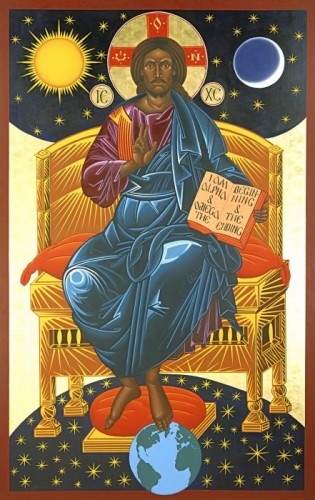
And it prays for God’s well-beloved Son to free us from this bondage and bring us together under his most gracious rule.  But when it says that he is King of Kings and Lord of Lords, we must be careful not to misunderstand.  This does not mean that he is of same ilk as the kings and presidents and party chairmen who rule the nations of the world, or that he makes a rival claim to their power.   It is saying that Christ has overcome the superior power that keeps them, and us, enslaved.  Because all earthly power, when you come right down to it, is a doomed effort to perpetuate itself, to defend its interests against those of an other.  But Christ’s power comes from the sovereign will of the almighty and everlasting God, whose purpose it is to reconcile all people, and restore all things.
Which sounds nice, but how it really works is not the least bit normal.  This is apparent when you consider that this power was decisively revealed on the cross.  In Luke’s telling of the story, the Jewish leaders scoff at Jesus as he is hanging on the cross, and say, “he saved others; let him save himself.”  And then the Roman soldiers mock him, saying, “If you are the King of the Jews, save yourself!”  Finally one of the men crucified along with Jesus, derides him, saying, “Are you not the Messiah?  Save yourself and us!”  To these people “save yourself,” is a taunt, a way of rubbing Jesus’ nose in his powerlessness, because preserving oneself is what power is for.   His inability or unwillingness to save himself is proof that he is no king, and no Messiah. 
But the other criminal is somehow able to see the real power of Jesus.  Crucifixion was a punishment reserved for rebellious slaves and others who took up arms against the state.  So here is someone who has tried and failed to overthrow domination with revolutionary violence.  He knows enough about Jesus to understand that this was not his way, and yet here Jesus is, suffering alongside him, condemned as if guilty of the man’s own crime.  And this fills his dying agony with insight about what is really happening here.  Jesus has not failed, because he never tried to win victory for one party over another, or to restore the greatness of one exceptional nation.  He is, in fact, freely giving his life to lead all humankind into a different world.  He is founding a new humanity, on the forgiveness of perpetrators and the witness of victims, on the vulnerability to lostness and sickness and sinfulness and death that we all have in common, and on our shared hope for the answering compassion of a loving God. 
And so the crucified revolutionary discovers the unconditional and sacrificial love of Jesus, which more than a religious sentiment; more than a social ethic; more than a political strategy.  In his willingness to forgo self-preservation in his confrontation with the power of sin, he is one with the self-emptying of God who created a universe free to rebel against their creator.  He is one with the compassion of God who refuses to abandon her creatures to their rebellion.  Jesus manifested this unity of human and divine will throughout public ministry, and his death and resurrection make it finally possible for all of us to perceive it, to believe in it, to understand how it works, and what it aims to do.  And when our eyes open to see the kingdom of the Son of God, it is not just an illumination of the mind, but a longing kindled the heart, a fire lit in the soul, a passion to offer our selves in service to its consummation.  The love that was in Christ becomes our own, not to form us into a new tribe called Christians, to wield the old, false power of domination over others, but to make us free agents of the reconciling, liberating love of God.        
The news this week contained a vivid demonstration of this love.  As the COP22 climate conference in Morocco was winding up on Friday, a group of 48 of the poorest countries in the world made an announcement.  They said that while it is true that they are the least responsible for adding greenhouses gases to the atmosphere, and have benefitted the least from fossil-fueled industrial development, and have the least capacity to address the problem of human-caused climate distruption, because they are suffering the most from the unfolding catastrophe they have decided to take the lead in saving humanity.  And so they are committing themselves to leaving behind the carbon economy as soon as possible.  They are revising their plans for national development so that their carbon emissions peak by 2020, and they will build resilient economies based on renewable energy, and be completely carbon-neutral by 2050.
I’m not sure what it says that while we squander our wealth on military dominance, and indulge our fantasies of nationalistic revival, the poorest people in the world are displaying the moral greatness that we lack.  Or that while we willfully prefer opinions of convenience to the facts threatening our children’s future, they are showing the capacity for altruistic sacrifice we seem largely to have lost.  Certainly it gives the lie to any claim we might make to be a Christian nation.  But “Christian nation” is an oxymoron anyway.  And if the murderer could gain paradise while hanging on a cross, surely it isn’t too late for us.  The Son of God still has the power to free us from the bondage of division and the slavery of sin, if we really want him to.  But, of course, we would have to give up being normal.   

Tuesday, October 20, 2015

Living sacrifice


The character of Job in the Bible is a good man.  He does what is right and reveres God.  But in spite of this, or rather because of it, he is crushed; afflicted with terrible suffering.  His livestock and his servants are killed or carried off by marauders, his children perish, and he contracts an agonizing skin disease.  And all this God allows Satan to do to him, to see whether Job will reject God.  Job’s three friends come to comfort him, or at least that’s how they see it, although what they mostly try to do is to convince him that he must have done something to deserve his terrible fate. 
But Job insists that he will not confess his wrongdoing, because he has none.  He will not plead for forgiveness, because he’s done nothing that requires it.  The more his friends tell him that he is a stubborn fool, that he must have done something to anger God, the more Job insists on his innocence.  And he demands his day in court, to stand face to face with God, and to plead his case to the almighty Judge.  In the end he gets what he wants—sort of.  In the passage that we read this morning, God breaks his silence, and speaks to Job out of the heart of a storm.
But God doesn’t talk to Job about his innocence or guilt.  He doesn’t address the question of whether Job deserves what he got, or why he should suffer so much if he doesn’t.   Instead, God cross-examines him.  “What do you know,” God asks Job, “of the creation of the world, of the mysteries of its intricate order, or the sources of its power?  Who do you suppose is the master of its elements, who sustains the lives of its creatures?”  And God isn’t really expecting an answer because he knows that Job has nothing to say.  In contemplating the creation, Job can only stand in awe and admit how puny his knowledge is.  In the face of the immensity of the world, who is he to question its creator and source?  What does he know of the ways of God, or of God’s justice, that he accuses God?
In the modern period, many people came to think that the argument in the Book of Job had lost its power.  We are no longer in awe of the forces of nature, they said, because science has discovered how they work.  We may not have been there at the foundation of the world, but we might as well have been, because now we know what happened.  With each piece we add to our knowledge, the thinking went, a little more of the “mystery of existence” is shown to be no mystery at all, and the less room there is in the world for God.  We don’t need an answer from God, like Job did, about suffering, because we can remove the causes of suffering with our technological prowess.  We don’t need justice from God, like Job did, because our political parties and nation states with their laws and ideologies, their education and welfare systems, will eliminate injustice.
But, though many still refuse to admit it, that project has long been unraveling.  100 years ago last month, on one battlefield in France, the wondrous new techniques of poison gas and aerial bombing made their first appearance on the world stage.   A young poet named Robert Graves was in that battle, and the memoir he wrote about it is as good an epitaph as one could want for the supreme self-satisfaction of the Victorian age—Goodbye to All That.   
By now, in 2015, we have to ask whether the quintessential modern achievement is lasting peace or never-ending war, shared prosperity or extreme inequality, universal enlightenment or total surveillance.  Is it a cornucopia of abundance, or a world made barren, so exhausted and polluted that the survival of civilization is in doubt?  The expansion of human knowledge of the material workings of the universe has only brought into sharper relief our ignorance about what holds it all together, and how to be in it as servants and celebrants of life, rather than captives of death.   
Some people still try to make the case that our modern scientific knowledge puts us on a different plane from people of the past, such as the ones who wrote the Book of Job.  They do this by making a distinction between the knowledge itself and the uses to which it is put.  But the Bible would answer that the human being is one.  We are one creature, and our knowledge is one.  A mind splintered into fragments is mentally ill, and what we know is not separate from what we feel, or what we suffer, what we love or what we hope, what we will or what we do.  So if we use our science to create a world of illusion, or to despoil, pollute, and kill, it is proof that our science is incomplete.  For all its impressive achievements, we still don’t really know who, or where, or how we are.
Thankfully, we have another source of knowledge, the revelation of the glory of God.  That revelation says that God’s glory fills heaven and earth, so it must be possible to investigate the world, as science does, and to use that knowledge to alter it, but to do so with humility, in a spirit of reverence and prayer.  It is very common nowadays to hear people say that the beauty and grandeur of nature is where they have their most powerful experience of God.   As far as I’m concerned, those people are not wrong.   But here again we have to ask if we are looking with a splintered mind, because to contemplate the whole of nature in today’s world is to witness a vast and deepening tragedy.  It is to worship in a temple that we are destroying.  If we are going to do more than just think that nature is holy—if we are going to act like it—we have to find our way back to encounters with God like the ones recorded in the Bible.  We need experiences of God that change the way we live.    
And for that, we need a revelation of the glory of God in human life; not only in the transcendent power of the thunderstorm and the singing of the morning stars, but in human persons, in human community.  We need an experience of God that unites what our knowledge has splintered: to seek the true glory of woman and man, not only in the rulers and great men, but in the powerless and poor.  We need to find glory not only in achieving our goals and satisfying our desires, but also in grief, in failure and disappointment.  We need to know glory not only in the people we love, but also in the people we hate, and the people who hate us.  And to have this kind of experience we need to learn to see the God’s glory not only on the outside, but also on the inside, even in the ignorance and waywardness of our own hearts.        
The New Testament says that God has revealed this glory in Jesus Christ.  His is the fullness of the Glory of God, because in him God’s glory fills even what we consider empty—of meaning and beauty and grace.  There is a word that means to take what is profane and make it sacred by offering it to God.  That word is “sacrifice.”  And what Jesus sacrifices is his life.  Every aspect of his human life, from humble birth to ignominious death, is sacred, because he offers it to God, in thanksgiving to the giver of the gift. 
Sacrifice is the work of priests, and God raised Jesus’ human life from death and gave it to us, so that we might share in his priesthood, and reveal the glory of God in our lives of sacrifice.  We are priests of the new covenant in Jesus when we take what is profane, what is ordinary and earthly and human—bread and wine, flesh and blood, time and money, and offer it to God in thankfulness, in unity with Christ.  And God makes it holy— we don’t know how. 
We call our offering “stewardship,” because the things we are offer are gifts we have received.  But we are stewards, the Bible says, of mysteries.  We come to church to sacrifice our lives, to offer them to God so God can make them holy, and use them for the new creation of the world.  But how this happens is a mystery.  In church we see Christ, but only in part, in symbols of word and sacrament that hint at the all-encompassing glory that fills even the darkest corners of our lives.  Here the Holy Spirit gives us just a little taste of what we will know and who we will be when we see him face to face.     

About Me

My photo
Petaluma, California, United States
I am a priest in the Episcopal Church, and have been (among other things) an organic farmer and gardener, and a Zen monk. I have a lifelong interest in social and spiritual renewal on the basis of contemplative discipline, creative nonviolence, and ecological practice. In recent years my work has focused intensely on the responsibility of pastoral ministry in the humanistic, evangelical, and catholic branch of Christianity known as Anglicanism. I'm married with a daughter, and have three brothers and two parents.