Showing posts with label communication. Show all posts

Saturday, June 17, 2017

Thick accents of love


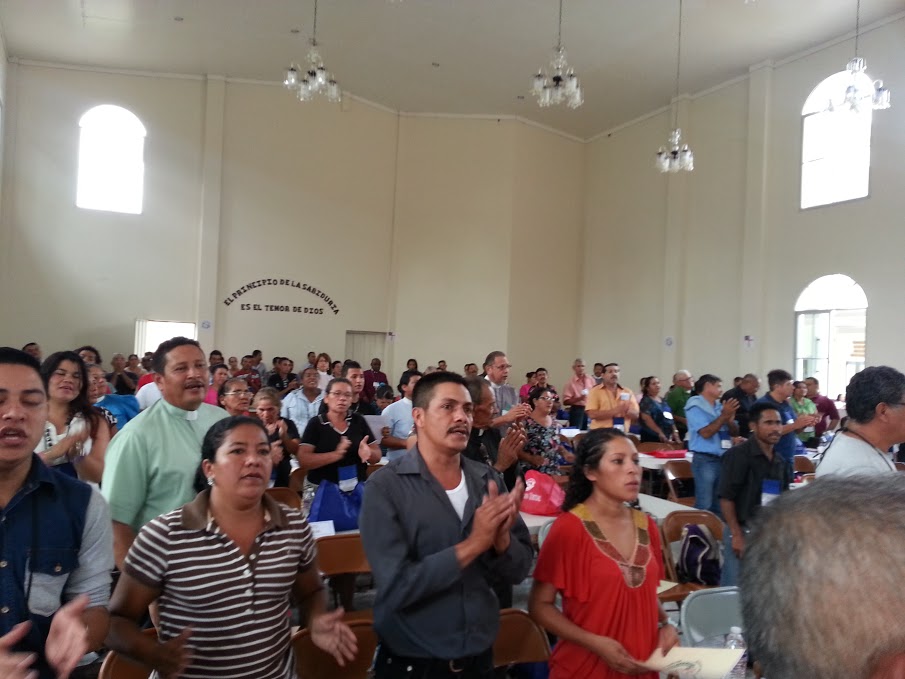
Last weekend I was a special guest at the annual convention of the Episcopal Diocese of Honduras, and all during the long flight down there, and the journey by pickup truck from the airport to the diocesan camp and conference center out on the Caribbean coast, I kept thinking about what I was going to say to the convention when the time came for me to speak.  Because I had a pretty good idea that I would be given the opportunity, not for a lengthy speech, but for a couple of minutes to make some courteous remarks appropriate to the occasion: greetings from Bishop Beisner and all of us in the Diocese of Northern California; gratitude to Bishop Allen of Honduras and everyone there for their warmth and hospitality; hope that the companion relationship between our dioceses would continue and grow stronger in the future—you know, that sort of thing. 
And sure enough, on Friday night after dinner, Bishop Allen asked me if I wanted to get up and say a few words during his address to the convention the following morning.   The opportunity came pretty much exactly as I had expected, so you might wonder why I had wasted so much time worrying about what I was going to say.  Well, because I had decided to give my remarks in Spanish.  Some of you know that I started studying Spanish seriously about eight years ago.  Which is one of the reasons why Bishop Beisner asked me to go and represent him at the diocesan convention in Honduras.  Moreover, I’d already made plans to go there during my sabbatical later this summer, partly to improve on my Spanish, and partly to learn more about the work Episcopal diocese there.   So I jumped at the chance to make this brief initial trip, to get a little bit of the lay of the land, and make some acquaintances.    
It was out of that desire to open doors that I decided that if I did get the chance to speak to the convention, I was going do it in Spanish.  And I wouldn’t write my remarks out ahead of time, but would deliver them in an impromptu conversational style.  That was why I spent so much time beforehand going over in my mind what I would say, and how I was going to say it.  But it turned out, of course, I really need not have worried.  Not because I ended up giving a flawless performance.  There were things I had meant to say but forgot about in the heat of the moment; and there were other things I did say, only awkwardly, after fumbling for the right word, or the correct grammar.  Still, when I was done Bishop Allen thanked me for what I’d said, and for taking the risk of saying it in what obviously not, as he put it, my “mother tongue.” 
The twelve apostles take the same risk in the story of Pentecost.  I think we often assume that because the power to speak in different languages came from the Holy Spirit, they must have spoken them perfectly.  And yet the story says that the people in the crowd that gathered were doubly amazed, because the apostles both spoke to them in their various native tongues, and did so with Galilean accents.    And it seems that their syntax was a little jumbled, and their pronunciations a little slurred, because some of the bystanders got the impression that they were drunk.  All of which says something important about the way the Holy Spirit works.  It gave the apostles the power to communicate with strangers from many foreign lands, but in using that gift they remained the persons they always were—those rough and rude, poorly-educated, fishermen from Galilee.
Which is precisely the point of the passage from the prophets that Peter quotes to explain to the crowd what is happening—that before that great and glorious day when God makes his power and judgment unmistakably manifest on earth, the spirit of prophecy will come on all kinds of people.  Young men will see visions and old men will dream dreams; your sons and daughters, even your slaves, both male and female, will be filled with the prophetic Spirit, and speak the truth that comes from God.  And it is this great outbreak of divine communication with humanity, this democratization of the power to see and know and speak and hear and understand the hidden things of God, that is the real miracle of Pentecost.   
I was able to connect more effectively with the Episcopalians in Honduras, not just because I spoke in Spanish, but also because my Spanish was not all that good.    This broke down to some degree the unspoken dynamics of inequality built into our relationship by the legacy of colonialism, so we could see eye-to-eye, heart-to-heart, as sisters and brothers.  In a similar way, the coming of the Holy Spirit upon the apostles, does not transform them into higher beings of perfection and light.  It does not turn them into flawlessly fluent speakers of Parthian, but uses these ordinary and imperfect channels to open the crowd in Jerusalem to receive its message.
And even though each of them heard it in a different tongue, the Holy Spirit’s message was the same to all.  It did not require an extensive vocabulary of subtle theological terms, or a grammatically complex sequence of logical proofs.  This message was a new communication that would revolutionize the world, of who God is and how God acts, and yet it came upon the crowd that day with so much spiritual power precisely because it was so simple.  It was as deceptively simple as a really good story.  And that’s what it was—a story; a story of God’s love for us.  It told how God communicated that love by taking the risk of speaking our language, becoming one of us, to meet us face-to-face, heart-to-heart, in the person of Jesus of Nazareth. 
The Holy Spirit’s message told how Jesus did not set himself above us, but came as one who shared the disappointment of the poor, the loneliness of the outcast, the sorrows of the bereaved, and the suffering of the oppressed.  He struggled against the religious, economic, and political powers of his day, with no weapon but the truth of God, and the faith of the little ones who believed in him.  He carried out that struggle to the death, to his own ignominious death on the cross.  Through it all Jesus never ceased to love God, never stopped offering himself to be an instrument of God’s will, never gave up hope that God would be faithful to his promises.  And God was faithful.  For Jesus’ sake, God broke the chains of death that hold us all in bondage, and raised this same Jesus to the life of a new and glorious body, exalting him to heaven where even now he sits enthroned as the gracious and merciful Lord and judge of the world. 
The miracle of Pentecost is that the fishermen told this story—in different languages, with poor pronunciation, awkward syntax, and thick Galilean accents—and many of the people in that crowd knew that it was true.  The truth of it poured into them, like water sinking into cracked and thirsty ground.  And to their amazement they felt an answering response within; the welling up deep inside them of something that they had almost forgotten was there, as if a heavy lid had been removed from an ever-flowing spring.  The Gospel of John says that the Holy Spirit will flow like rivers of living water from those who believe in Jesus. 
But our translation is a bit misleading when it says this water will come out of our hearts.  Because the original Greek literally says that rivers of living water will flow out of our wombs.  The Holy Spirit is a fire, burning away all illusions and ignorance that blind us to God’s truth.  But it is also water, dissolving hardness of heart, eroding the dam that obstructs the flow of God’s love.  We who drink in the story of Jesus discover a God who loves us with the compassion of a mother for her child.  This God, the Holy Spirit, not only pours over us, as compassion for our suffering, our fears and weaknesses and limitations; it flows out of us as life-giving rivers of compassion toward all who, like us, are mortal and sorrowful, lonely and afraid.  And there can be no mistaking what is meant by this symbol of water bursting forth from our wombs—it is this Holy Spirit, that we know in the self-giving love and compassion of Jesus, that will give birth to a new world.       
 ,

Sunday, March 24, 2013

Asking the hard questions


The Liturgy of the Palms
Luke 19:28-40
Psalm 118:1-2, 19-29
The Liturgy of the Word
Isaiah 50:4-9a
Psalm 31:9-16
Philippians 2:5-11
Luke 22:14-23:56

I don’t know about you, but I have questions about the stories we just heard.  I have questions about Jesus riding into Jerusalem and the crowd that waved their branches and laid their cloaks down in the road ahead of him, shouting “Blessed is the King who comes in the name of the Lord!”  And I have questions about the other story, the one about the crowd that dragged him before Pontius Pilate shouting “Crucify him!  Crucify him!”  I don’t know what Jesus was expecting to happen after coming into Jerusalem like that.  If we can believe the gospel accounts, he knew things were going to play out just the way they did.  But, if he knew he was going to be killed, why did he go?
The centuries have produced a variety of answers to that question.  Mostly they are theological interpretations of his death.   Jesus went to Jerusalem, the theologians say, in order to die.  And they offer explanations of what it was that his death accomplished, and why it was only in dying that he could finish the work God sent him to do.    These theories of The Atonement—about how Jesus paid the penalty for our sin, or how in dying he overthrew the powers of death, or how he gave for all time a perfect example of self-sacrificing love—these theories are meant as answers, but they only raise more questions— important questions, worthy of careful study and reflection, but that can also seem kind of remote from you and me and the decisions that we have to make every day about how to live our lives.
But there is something about the way we tell the stories this morning, how we act them out, or put them on, if you will, that suggests that they are meant to relate to us.  They ask questions that we are supposed to answer.  And some of these questions are hard.  But I think that on the human and historical level that’s what Jesus rode into Jerusalem to do—to ask hard questions.  The first thing he does when he gets there is to go into the temple and make a scene, driving out those who are selling there, and calling the place a “den of robbers.”  It is a confrontation, the action of someone who means to be reckoned with.  But it is not the first strike in a battle to take control; it is the opening statement in a conversation.  Jesus isn’t there to fight, he’s there to talk, and it seems like what he most wants to talk about is the temple, and the people who are in charge of it. 
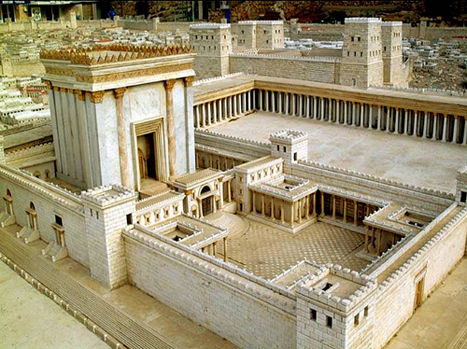
The temple in Jerusalem was like the Vatican, Washington, D.C., and the New York Stock Exchange all rolled into one.   It was the institution that dominated Jesus’ world, the center around which the political, economic, social, and religious map of the life of every Jew was drawn.  And as Jesus went around in Galilee, driving out evil spirits, healing the sick, preaching good news to the poor, ministering with compassion to people who were like sheep without a shepherd, he ran into the local representatives of the temple.  They challenged his authority to do the things he did and they questioned the way that he did them.  And he confronted them about their hypocrisy, and their failure to practice what they preached, and challenged them to renew the essential spirit of their religion.  But this conflict was a stalemate, and it only intensified, until it was inevitable that Jesus would carry the argument to its source.
Jesus didn’t go to the temple to seize power—he went there to talk.  But he wanted to talk about the things that the elite at the temple didn’t want to talk about.  It’s true that they came to him with questions, which he answered with questions of his own, and after one or two of Jesus’ questions they shut their mouths and went away.  And that was because they weren’t really interested in dialogue.  When the chief priests and the scribes sent their spies, as he is teaching in the temple, to ask him “Is it lawful for us to give tribute to Caesar, or not?” they weren’t actually interested in having a conversation about the economic arrangements in an imperialistic world system.  They weren’t asking to talk about the relation between the sovereignty of the Emperor and the sovereignty of God, and which is more deserving of our allegiance.  They were simply bandying words, trying to get him to incriminate himself, and when he tried to lead them into a real exploration of the truth, they had nothing to say.
By the time that Jesus was standing before the high priest himself, he had nothing more to say, either, because it was clear by then that there was no hope of having a real conversation.  Maybe the gospel writers are right, and he knew all along that this was how things were going to go.  Maybe he had no expectation that the temple elite were going to listen to what he had to say.  Maybe he knew perfectly well that they would never open their lives, to an honest examination, let alone consider going in a different direction.  But that’s the thing about knowing the truth—about being committed to the God whose Spirit is truth.  You can’t just sit idly by while the nation you love is poisoned with a never-ending diet of lies.  You have to speak up; you have to ask questions about what is really going on.
On this Passion Sunday, Jesus challenges us again to make our churches places where the hard questions are asked, and where real conversations can happen.   It’s interesting how many of the gospel stories about Jesus’ arguments with his enemies take place while he is worshipping with them in the synagogue, or in their houses having dinner.  If Christian churches can’t hold open a space where people can talk about the hard questions without the stridency of entrenched ideological positions, where else will we find that space?  Can this church be a place where we talk to each other about the things that matter without asking ourselves “is this person a Liberal or a Conservative?” but rather, “What are her values and concerns?  What beliefs and experiences have shaped her understanding of the world?  What can she teach me?”
Jesus rode to certain death because he trusted that love is the truth, and truth only becomes truth when it is communicated.  The truth is something that lives between us, in the space where we touch each other.  Jesus learned about this from God, and so he trusted that God would use him for the truth, even if the only way he could tell it was to die.  So one of the benefits of his death and passion is that we, too, can risk the truth.  We can venture into the space between us where no one is completely guilty, because no one is entirely innocent.  We can sustain a conversation about the hard questions, because Jesus showed us that if we can’t talk honestly about power, our justice is a lie, and if we can’t talk openly about war, our peace is a lie, and if we are afraid to talk about evil, our goodness is a lie. 
And to live a lie is to die every day, a slow, painful, meaningless death.  But as he is dying, Jesus turns to the repentant thief, the one who in the agony of crucifixion finally admits the truth about himself, and he says “today you will be with me in Paradise.”

Wednesday, May 30, 2012

You didn't have to be there


Of the 50 to 60 million inhabitants of the Roman Empire, a tiny elite, perhaps one-half of one percent, owned some 80 percent of the wealth.  Nearly every scrap of writing that remains to us from those days, the novels, the poetry, the plays, the works of history and philosophy and rhetoric, was written by members of that elite.  It was written for members of that elite.  It speaks from their worldview.  It addresses their concerns.  We have a pretty good idea from the surviving literature about how the one-half of one percent lived, what they ate, how they spent their time.   We know many of their names. 
Contrast this with the peasants, the small shopkeepers, the artisans and laborers, the miners and sailors and soldiers and slaves who made up the remaining ninety-nine and one-half percent of the Empire’s population.  They didn’t write books, and the people who did write them were not really interested in their lives.  Their names aren’t carved on stones in the ruins of ancient cities.  We know next to nothing about them, so that when a distinguished historian recently published a book describing what we can say about them from the available evidence, he gave it the title Invisible Romans.
But there is one work of ancient literature  that is by members of the ninety-nine and one-half percent.  This book, really a collection of books, is about ordinary people.  Thanks to these writings we know some of their names, some details about how they lived, and what they cared about.  We know about them because certain experiences that they had were so significant that they decided everyone should know about them.  They organized themselves into resilient and mobile little groups, dedicated to giving testimony to what they had witnessed.  Eventually these testimonies were written down, so that they could be carried from place to place and passed down through the years in something like their original form.  Stories by ordinary people, about ordinary people, intended, by and large, for ordinary people, that by one of history’s great miracles have come down to us.
I am talking, of course, about the New Testament.  And today, on this day of Pentecost, we whose very existence as a people called “Christians” is owed to those ordinary people, celebrate the miracle that gave us birth.  This miracle has two parts.  The first part is the way in which Jesus’ disciples discovered that they were now responsible for his mission.  Not only responsible, but willing and able and empowered by God to carry it out.  That is the transformation that we celebrate in the fifty days after Easter—that this little  group of ordinary, invisible people made the journey from running away in fear on the night of Jesus’ arrest to bravely carrying on the work that he started. 
The second part of the miracle is that when these people stood up to talk about God’s mighty acts of liberation, redeeming the whole world through the life and death and resurrection of Jesus Christ, people actually listened.  Some of them actually got it—as improbable as this message was, as unlikely as the messengers were, it got through to them in a completely surprising way. 
You’ve probably had the experience where you are trying to tell your spouse or a friend about something that happened to you earlier in the day that was particularly affecting, or hilariously funny, something that for whatever reason you really want to share with another person.  So you try to describe it with all the significant details, and then you get to the climax, the moment that had the real emotional impact, and the person you’re talking to just kind of looks at you with a blank expression.  Maybe they force a little laugh just to be nice, and say something like “wow—sounds pretty funny,” or “that must have been really cool,” but you know that they just didn’t “get it” in the way that you hoped you would.  So you say “I guess you had to be there.”   
Well the miraculous thing about Pentecost is that these ordinary people, Simon Peter, for instance, Son of Jonah, started talking about extraordinary things, amazing, mysterious, mystical experiences of what they had learned from Jesus and how he came to them after he died, and breathed his peace into them and sent them out on a mission of healing and forgiveness to the whole world; and you know, it turned out that you didn’t have to be there.  You didn’t have to be there to believe that what these people were saying about Jesus was true.  You didn’t have to be there to feel like this was the best news you’d heard in a long time, maybe ever, and that it was meant for you. 
You didn’t have to be there to feel like someone was speaking to what you’d always secretly suspected about God and about yourself, but never dared to let yourself believe— that God loves you and everyone else in this world like a Father or a Mother, and that you aren’t an invisible person at all, but are heaven’s messenger, gifted with a high and noble purpose.  And just because you hadn’t been there didn’t mean you were left out of that purpose—it was not too late to join, and everyone was welcome, no matter if you were an important person or not, no matter what background you came from, there was a place for you in the brother- and sister-hood of the Messiah Jesus.
The apostles looked at these miracles, the way they had come to accept the mission of Jesus for their own, and the way all different kinds of people were actually taken with their message, and they knew that only God could do this.   That’s what God the Holy Spirit does, she communicates.  She connects.  She enters into the space between people and removes the barriers to love and trust and truth.  That’s why we invoke the Holy Spirit whenever we perform a sacramental act.   We know that only God can make the bread and wine really communicate the living body of the Lord to us.  Only God can really make the baptismal water go all the way in, and cleanse us inside and out for new life in Christ.  Only God can really make two people married, one flesh as Christ and the church are one.  So we ask God the Holy Spirit to come, and the message of Pentecost that she is not ashamed to be here, no matter how ordinary the company.  The church was created and is most alive today when it includes all kinds of people, and embraces all kinds of differences among them.

Take Brandon and Briana, and their baby Dallas, who are being baptized here today.  They are ordinary people.  Briana’s nineteen, and Brandon just graduated from High School last week.  They are not married.  It is not certain whether they ever will be.  And yet they come here today, as they have been coming for the last year or so, seeking God’s blessing for their family and their lives.  They could go a lot of places to hear people tell them where they’ve gone wrong or what they should be doing differently, but in the grace of the Holy Spirit we say to them here, “What an adorable baby!”  They could go a lot of places to hear that they’d be welcome just as soon as they got married.   In the grace of the H0ly Spirit we say, “You have to make your own decisions, but remember—with God nothing is impossible. What can we do to help?” 
Mainly we’re just grateful that they’ve decided to throw their lot in with Jesus.  They are exactly the kind of people he chose carry on his mission in the world.  Just look at us!  You didn’t have to be there.  You don’t have to have it all together.  You don’t have to be one of the one-half of one percent.  You just need faith in the Holy Spirit within you, who called you into this work and is giving you the gifts to carry it out.  And you need faith in the Holy Spirit outside you who is hidden in the world, ready, waiting, eager to respond to what you have to say.  

About Me

My photo
Petaluma, California, United States
I am a priest in the Episcopal Church, and have been (among other things) an organic farmer and gardener, and a Zen monk. I have a lifelong interest in social and spiritual renewal on the basis of contemplative discipline, creative nonviolence, and ecological practice. In recent years my work has focused intensely on the responsibility of pastoral ministry in the humanistic, evangelical, and catholic branch of Christianity known as Anglicanism. I'm married with a daughter, and have three brothers and two parents.