Showing posts with label love. Show all posts

Saturday, June 17, 2017

Thick accents of love


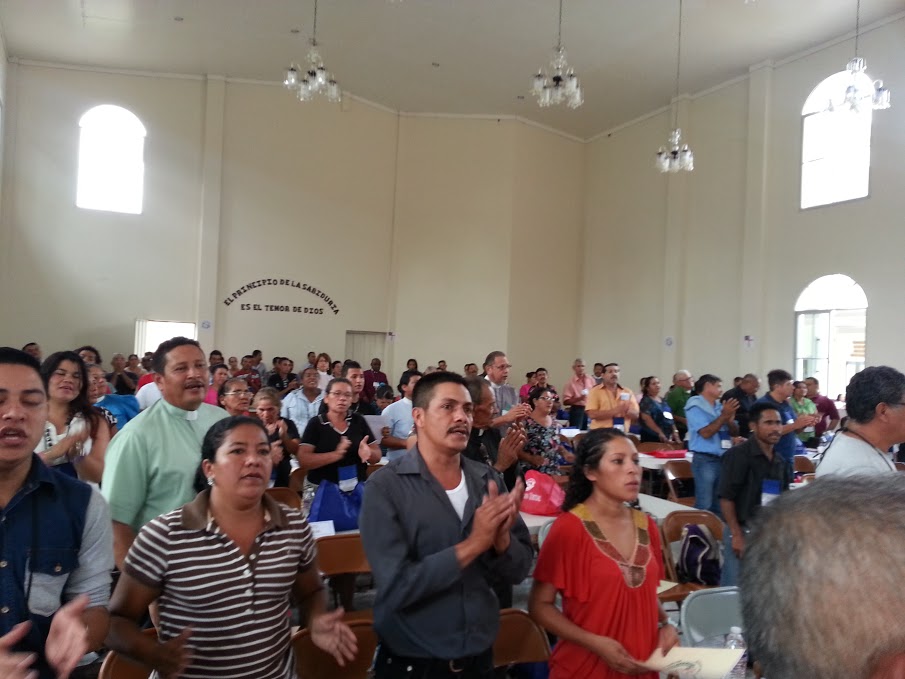
Last weekend I was a special guest at the annual convention of the Episcopal Diocese of Honduras, and all during the long flight down there, and the journey by pickup truck from the airport to the diocesan camp and conference center out on the Caribbean coast, I kept thinking about what I was going to say to the convention when the time came for me to speak.  Because I had a pretty good idea that I would be given the opportunity, not for a lengthy speech, but for a couple of minutes to make some courteous remarks appropriate to the occasion: greetings from Bishop Beisner and all of us in the Diocese of Northern California; gratitude to Bishop Allen of Honduras and everyone there for their warmth and hospitality; hope that the companion relationship between our dioceses would continue and grow stronger in the future—you know, that sort of thing. 
And sure enough, on Friday night after dinner, Bishop Allen asked me if I wanted to get up and say a few words during his address to the convention the following morning.   The opportunity came pretty much exactly as I had expected, so you might wonder why I had wasted so much time worrying about what I was going to say.  Well, because I had decided to give my remarks in Spanish.  Some of you know that I started studying Spanish seriously about eight years ago.  Which is one of the reasons why Bishop Beisner asked me to go and represent him at the diocesan convention in Honduras.  Moreover, I’d already made plans to go there during my sabbatical later this summer, partly to improve on my Spanish, and partly to learn more about the work Episcopal diocese there.   So I jumped at the chance to make this brief initial trip, to get a little bit of the lay of the land, and make some acquaintances.    
It was out of that desire to open doors that I decided that if I did get the chance to speak to the convention, I was going do it in Spanish.  And I wouldn’t write my remarks out ahead of time, but would deliver them in an impromptu conversational style.  That was why I spent so much time beforehand going over in my mind what I would say, and how I was going to say it.  But it turned out, of course, I really need not have worried.  Not because I ended up giving a flawless performance.  There were things I had meant to say but forgot about in the heat of the moment; and there were other things I did say, only awkwardly, after fumbling for the right word, or the correct grammar.  Still, when I was done Bishop Allen thanked me for what I’d said, and for taking the risk of saying it in what obviously not, as he put it, my “mother tongue.” 
The twelve apostles take the same risk in the story of Pentecost.  I think we often assume that because the power to speak in different languages came from the Holy Spirit, they must have spoken them perfectly.  And yet the story says that the people in the crowd that gathered were doubly amazed, because the apostles both spoke to them in their various native tongues, and did so with Galilean accents.    And it seems that their syntax was a little jumbled, and their pronunciations a little slurred, because some of the bystanders got the impression that they were drunk.  All of which says something important about the way the Holy Spirit works.  It gave the apostles the power to communicate with strangers from many foreign lands, but in using that gift they remained the persons they always were—those rough and rude, poorly-educated, fishermen from Galilee.
Which is precisely the point of the passage from the prophets that Peter quotes to explain to the crowd what is happening—that before that great and glorious day when God makes his power and judgment unmistakably manifest on earth, the spirit of prophecy will come on all kinds of people.  Young men will see visions and old men will dream dreams; your sons and daughters, even your slaves, both male and female, will be filled with the prophetic Spirit, and speak the truth that comes from God.  And it is this great outbreak of divine communication with humanity, this democratization of the power to see and know and speak and hear and understand the hidden things of God, that is the real miracle of Pentecost.   
I was able to connect more effectively with the Episcopalians in Honduras, not just because I spoke in Spanish, but also because my Spanish was not all that good.    This broke down to some degree the unspoken dynamics of inequality built into our relationship by the legacy of colonialism, so we could see eye-to-eye, heart-to-heart, as sisters and brothers.  In a similar way, the coming of the Holy Spirit upon the apostles, does not transform them into higher beings of perfection and light.  It does not turn them into flawlessly fluent speakers of Parthian, but uses these ordinary and imperfect channels to open the crowd in Jerusalem to receive its message.
And even though each of them heard it in a different tongue, the Holy Spirit’s message was the same to all.  It did not require an extensive vocabulary of subtle theological terms, or a grammatically complex sequence of logical proofs.  This message was a new communication that would revolutionize the world, of who God is and how God acts, and yet it came upon the crowd that day with so much spiritual power precisely because it was so simple.  It was as deceptively simple as a really good story.  And that’s what it was—a story; a story of God’s love for us.  It told how God communicated that love by taking the risk of speaking our language, becoming one of us, to meet us face-to-face, heart-to-heart, in the person of Jesus of Nazareth. 
The Holy Spirit’s message told how Jesus did not set himself above us, but came as one who shared the disappointment of the poor, the loneliness of the outcast, the sorrows of the bereaved, and the suffering of the oppressed.  He struggled against the religious, economic, and political powers of his day, with no weapon but the truth of God, and the faith of the little ones who believed in him.  He carried out that struggle to the death, to his own ignominious death on the cross.  Through it all Jesus never ceased to love God, never stopped offering himself to be an instrument of God’s will, never gave up hope that God would be faithful to his promises.  And God was faithful.  For Jesus’ sake, God broke the chains of death that hold us all in bondage, and raised this same Jesus to the life of a new and glorious body, exalting him to heaven where even now he sits enthroned as the gracious and merciful Lord and judge of the world. 
The miracle of Pentecost is that the fishermen told this story—in different languages, with poor pronunciation, awkward syntax, and thick Galilean accents—and many of the people in that crowd knew that it was true.  The truth of it poured into them, like water sinking into cracked and thirsty ground.  And to their amazement they felt an answering response within; the welling up deep inside them of something that they had almost forgotten was there, as if a heavy lid had been removed from an ever-flowing spring.  The Gospel of John says that the Holy Spirit will flow like rivers of living water from those who believe in Jesus. 
But our translation is a bit misleading when it says this water will come out of our hearts.  Because the original Greek literally says that rivers of living water will flow out of our wombs.  The Holy Spirit is a fire, burning away all illusions and ignorance that blind us to God’s truth.  But it is also water, dissolving hardness of heart, eroding the dam that obstructs the flow of God’s love.  We who drink in the story of Jesus discover a God who loves us with the compassion of a mother for her child.  This God, the Holy Spirit, not only pours over us, as compassion for our suffering, our fears and weaknesses and limitations; it flows out of us as life-giving rivers of compassion toward all who, like us, are mortal and sorrowful, lonely and afraid.  And there can be no mistaking what is meant by this symbol of water bursting forth from our wombs—it is this Holy Spirit, that we know in the self-giving love and compassion of Jesus, that will give birth to a new world.       
 ,

Sunday, November 13, 2016

Mercy and Truth


From time to time, one of my sermons makes someone mad.  As you might expect, it happens when I wade into the troubled waters of race relations, or climate change, or some such hot-button topic taken from the headlines.  And it’s not like I don’t know that I’m stirring the pot.  I labor over those sermons more than the others, and often have a hard time sleeping the night before I give them.  To the extent that the issue has been politicized, I try not to take sides.  My intention is to find in the scriptures a perspective that reveals a spiritual dimension to the real problems of the world.  But even as I do this I have to deal with the limits of my experience, and my own inherent biases, some of which are firm convictions, and some of which are assumptions of which I am not even conscious.   So there’s always the danger that the perspective I present as “biblical” and “spiritual” truth is really just a clever way to justify my own opinion. 
And other people have their inherent biases, and limited experience, their passionate convictions, and unconscious assumptions, as well.  So I am not surprised when someone takes offense, but when it actually happens it is always painful.  It reminds me that, among the world’s many problems, none is greater than our human inability to see them in the same way.  Maybe I’d be on firmer ground if I stuck to questions of personal faith and morality, and the work of spiritual growth, to talking about salvation, and Jesus, and heaven, and God.  These are the common interests, after all, of almost everyone who comes to church—including me.   But, then, I come to church with a responsibility that other people don’t.  I’m supposed to preach, and I’m accountable in what I say, not just to what I think is important, or what I imagine you want to hear; I’m accountable to God as God is revealed in the Bible. 
This is a responsibility I took on at the time of my ordination, when I made a solemn public declaration that I “believe the Holy Scriptures of the Old and New Testaments to be the Word of God, and to contain all things necessary to salvation.”   Now, there is probably no end to the theological discussions we could have about what that means.  But it has clear practical implications for the everyday work of a preacher.   What it means for me is that at the beginning of each week I sit down with the scriptures that the church appoints for the coming Sunday and read them.  I read them out loud, slowly, several times.  I read the Gospel, at least, in its original language.  And as I read them I listen for the word or the phrase, the verse or the verses, that speak to me in a voice that is not my own.  I wait for the word that moves my heart and my mind, out of their unthinking circular grooves and into wonder, into an openness and attentiveness to meaning I take to be a little closer to the truth.
And for the rest of the week, with those scriptures in my mind, I listen to my life.   I watch for the correspondences between the active story or the image in the book, and the things that go on in my world.  Because, the God of the Bible is infinitely beyond our knowing, but has also revealed himself, as intimately acquainted, and concerned, with every aspect of our lives—from our most intimate thoughts, feelings, and relationships, to the social and political conflicts, and historic events, that shape the destinies of nations.   If I am going to preach to others to believe in that revelation, not as some abstract, impersonal truth somewhere out there, but as the light and the life of the world, I have to open my own life, my own world to the scrutiny, and interpretation, and critique that comes from the scriptures.   And like life itself, that sometimes that pushes me into places I would really rather not go. 
So it’s not like I sit down at my desk and think, “what can I say this time that will really piss people off.”   But lately, the lectionary has given us a lot of Jeremiah.  And maybe it is because of this year’s election campaign, and the general air of anxiety and crisis floating around, but Jeremiah has captured my imagination recently more than he ever has before.   The word of Jeremiah summons the whole house of Israel to look at some very hard truths, to look at their idolatry and self-deception, and their injustice to the poor, to contemplate the true nature of war, and to face a historical reckoning with the consequences of breaking faith with God.   And maybe it’s just me, but it feels like this is a moment when you and I are also being called—individually, yes, but especially collectively—to look at hard truths.  Anyway, for good or ill, I have felt compelled to give more thought than usual to Jeremiah, and I have asked you to do the same.
Now, I’m well aware that there is an aspect of my personality that gets off on this stuff, a part that is grandiose and angry, judgmental and self-righteousness, which is exactly why I’ve always wary of preaching in that vein.  And as a sinner, everything I do has mixed motives.  But, for what it’s worth, the best intention of my prophetic preaching, if you want to call it that, is love.  It is an invitation to intimacy, to move beyond the easy friendliness that we maintain by keeping silence about the things that really make us angry, or sad, or afraid.  It is offered in the hope that there is great reward in making the journey together into the heartbreak of the world, including the heartbreak of failing to see exactly eye-to-eye, and our reward is the faith that God’s word speaks even there.   
Today the Hebrew Bible shows us not the angry Jeremiah, the judgmental, accusatory Jeremiah, the prophet of doom, but Jeremiah the heartbroken.  It shows us Jeremiah who longs for the capacity to express even more fully the pain he feels over the sufferings of Israel: “For the hurt of my poor people I am hurt; I mourn, and dismay has taken hold of me…O that my head were a spring of water, and my eyes a fountain of tears.”  The word of God that can be a sharp arrow of truth, piercing ignorance and denial, or an iron rod, sternly correcting pride and vice, can also be a human heart breaking, a voice wailing for the sufferings of her children.  It is in that sharing of the cup of our suffering that the Word seems most human, most true to our world and our experience.  A God who speaks when we are lost and overwhelmed by personal tragedy or national calamity, in a human voice stricken with grief, is a source of true hope and consolation.       
Even in the midst of an unjust and conflicted world, the mercy of God invites us to have faith in a higher perspective.  That is how the author of 1st Timothy can urge that prayers be made for all people, even though only a small handful have embraced what he teaches.  Because the source of a godly, dignified, and peaceable life in a messed up world is faith in the God who desires that all people be saved.  Christians are to pray for kings and those who are in high places, even when those kings demand sacrifice and worship as if they were gods, and put Christians to death who refuse to do it.  If we defy such people in the name of the only God who really is God, how can we harbor ill-will against them whom God desires to save?  If Jesus gave himself as a ransom for all, who are we to decide who is worthy of our prayers of concern? 
Of course, 1st Timothy also says that God desires that everyone will come to the knowledge of the truth.  And in this mercy that moves us all toward the truth we see the dual nature of the word of God.  It is not always easy for us to hold both parts together.  We tend to splinter off into those who worship the God of certain revelation, of stern judgment and unchanging truth, on the one hand, or those who preach the God of mercy and forgiveness, long-suffering kindness, and reconciling love, on the other.  But the salvation of God, as the Psalmist says, is when “mercy and truth are met together: righteousness and peace have kissed each other.”  This is the salvation embodied in Christ, who holds our double-standards, our wishful-thinking, hypocrisy and lack of faith, up to the brightest, most revealing light possible —the radiant sun of his forgiveness and love.  
  

Sunday, March 20, 2016

The place we call home


On Thursday I went to the home of a neighbor here in Petaluma, where I’d been invited for lunch.  A smiling woman met me at the door and showed me into her beautiful home which was painted in warm primary colors and decorated with Mexican folk art.  There were two other people already there, and two soon more soon arrived.  They were a couple of young community organizers from Santa Rosa, and a fellow I’d met before from the Unitarian Universalists, a folks from St. Vincent’s Catholic parish, and me, and we ate squash soup and bread and salad, and talked about the critical shortage of affordable housing in Petaluma, and what our faith communities might come together to do. 
You don’t have to look outside of this room to find persons of low- or moderate-income who are at the mercy of rising rents and vacancy rates that are vanishingly low.  Several of our members have already had to move, some of them out of Petaluma, because a home was sold out from under them and the new owner jacked up the rent, or because they wanted to buy a house and found that they could not afford to do so in their home town.  And I get regular calls in the parish office from people asking for help, who’d been just scraping by until a lay-off, or an illness, or a car crash, brought them to the brink of homelessness. 
So this is a problem that concerns me professionally and pastorally, but also personally.  It wounds my conscience.  So much insecurity about something as basic as having a home can’t be what God intends for her people, and something needs to be done.  And yet I didn’t go to that meeting on Thursday feeling certain that I know what that “something” is.   Which I found to be a great relief.  So often in my daily work I feel like I’m the one who’s expected to know what we’re all supposed to do.  But at this meeting I could sit back and listen to the conversation and learn about who these people were, and what they’re passionate about, and what they see happening in Petaluma, and what they’d like to see.
Which was kind of the same thing we were talking about doing in the meeting, only on a wider scale.  As I understand it, what was being proposed was to select a couple of precincts in town where there are a high density of renters, and voter turnout is low.  And the participating churches would divide up those neighborhoods and send out volunteers in pairs, each with at least one Spanish and English bilingual member, to go door to door.  And affordable housing might be a good place to start a conversation, one that might come around in time to the upcoming election and whether folks were eligible and planning to vote.  But the focus wouldn’t be to convince them to adopt an opinion, or to promote a candidate or political party.  It would be to ask questions and to listen, to what is on the minds of our neighbors.  It would be to build relationships of common interest and concern.
But when we got to the end of our meeting on Thursday, and it came time to plan the next one, I had to say that I couldn’t commit to being there.  With everything else I’m already engaged, the Russian River Deanery, and the College for Congregational Development, the Living Legacy Storytelling Events, the Interfaith Sustainable Food Collaborative and the Interfaith Springtime Fellowship gathering that’s coming up on Trinity Sunday, I just don’t have the “bandwidth”, as they say, to be out in front of an effort like this, so if St. John’s is going to get involved it will depend on other folks in the congregation.  If you’re interested, speak to me later.
Of course it’s likely you don’t have the extra time and energy either.  We still have our hands full developing our capacities in basic areas of congregational life, like liturgy and music, and inviting and welcoming newcomers, and stewardship of our buildings and grounds, and teaching our tradition to the children.  But I like the idea of doing this voter engagement.  I’m intrigued by the possibility of receiving training from experienced community organizers, and joining in the effort with other congregations in a discrete project with a set timeline and a modest goal.  I like to think that within with this supportive context some of us could take a step toward acquiring new skills and confidence in the art of engaging strangers in conversation, and listening for common ground, of building relationships across the barriers of culture and language, and religion and class. 
And it’s fun to imagine that one day I’ll the time for this kind of thing.  It’s not that what we’re already doing isn’t worthwhile.  As I left that meeting on Thursday, our host told me that she’d attended labyrinth walks at our church and said how much she loves what we’re doing at St. John’s.  But as I drove away I reflected on how good it had been to have a brief break from doing the work of the church, to be able to break out briefly of my ceaseless thinking and working and praying only about what I can do to strengthen this congregation, and care for its members, to spend an hour as one citizen among other citizens talking about the welfare of the place where we all live—it was refreshing, and it made me wish for more.
Because even as we are making a mighty effort to rebuild the internal fabric of this church community, powerful economic, technological, and ideological forces are tearing the wider community around us apart.  Our national politics display, to a frightening degree, the breakdown of civility and mutual respect, or any pretense of concern for the common good; but the same thing is happening on the local scale as well.  The eviction of elderly renters is a symptom of the same progressive, potentially terminal disease.  And it is not only the poor and marginal who are suffering.  As Mother Teresa of Kolkata said, forty years ago, in a famous interview:
“You, in the West, have millions of people who suffer such terrible loneliness and emptiness. They feel unloved and unwanted. These people are not hungry in the physical sense, but they are in another way. They know they need something more than money, yet they don't know what it is.  What they are missing, really, is a living relationship with God.”
And I think we all know that when we are estranged from each other, when we are trapped in structures of social interaction that pit us against each other and make us vie competitively for our own narrow self-interest or that of our group, we aren’t really free in relation to God.  When Mary of Bethany takes a pound of perfume worth a working man’s pay for a year and anoints Jesus with it, she is acknowledging the supreme value of that living relationship.  Judas complains about the waste and indulgence, but Jesus affirms the gesture that Mary has made.  When he says, “you always have the poor with you, but you do not always have me,” he is not saying to be indifferent to the plight of the less fortunate, or fatalistic about their prospects for relief.  He is pointing to the essential work that he has come to do, of breaking down the barriers we put between ourselves and each other, which are really barriers to God.  He is saying that without this work, we are all in poverty, a poverty that is absolute.
The energy of Jesus’ work is reconciling love.  Without it, we are like Judas, whose appeal on behalf of the poor is just another self-serving scheme.   With it, we dare hope that God can open every prison of separation that keeps us bound, even the prison of death.  Mary of Bethany has seen Jesus free her brother Lazarus from that prison, for love of her family, and she repays him her own extravagant gesture of love.  The fragrance of her outpouring fills whole house.
But she is, as Jesus says, anointing him for his burial.  She pours her perfume on his feet, the feet that will carry him away from her and the intimate circle of her family home, away to complete the work he came to do.  They will carry him into the city, to the temple in the midst of the Passover crowds.  They will carry him to the place of public execution, and there the soldiers will drive a spike through the feet that Mary caressed with her hair.  Because the reconciling love of God isn’t for Jesus’ particular friends.  It isn’t for the rich, and it isn’t for the poor, for sinners or for the righteous.  It’s for us all.  

About Me

My photo
Petaluma, California, United States
I am a priest in the Episcopal Church, and have been (among other things) an organic farmer and gardener, and a Zen monk. I have a lifelong interest in social and spiritual renewal on the basis of contemplative discipline, creative nonviolence, and ecological practice. In recent years my work has focused intensely on the responsibility of pastoral ministry in the humanistic, evangelical, and catholic branch of Christianity known as Anglicanism. I'm married with a daughter, and have three brothers and two parents.