Showing posts with label freedom. Show all posts

Sunday, November 13, 2016

The way to freedom


On the morning of Wednesday, November 5, 1980, I met with a half-dozen of my friends outside our high school before first-period band.  We passed around black strips of cloth and safety pins and helped each other fasten them around our upper arms, as signs of mourning and protest.   Because the night before our hopes had been dashed, our hopes to come of age in a world moving toward peace, equality, and justice.  A right-wing extremist had been elected President of the United States.   
Over the next several months, I wrote a paper for my honors U.S. History course about the prospects for dictatorship in our country.  The first part was a summary of a classic work on the rise of Fascism, Escape from Freedom, by Erich Fromm.  Fromm, a psychoanalyst, was not interested in political history so much as in social psychology.  He proposed that human beings have an innate and existential need for freedom, a kind of spontaneous solidarity with others in love and work, not on the basis of primal ties of family and race and tradition, but as creative individuals.  But, Fromm argued, modern social and economic conditions sometimes frustrate and prevent individuality from developing in this way.  At the same time, these conditions tear apart the primal bonds that used to make us psychologically secure.  Hanging suspended in the void, between stunted individuality and the loss of primal ties, people find freedom too much to bear.  So they give it away to an authoritarian figure.  Relieved of the burden of freedom, they experience it vicariously through the strongman, the one who alone is magnificently free to say the unthinkable, and do the unspeakable.

My paper continued with a historical account of populist demagogues in the United States during the period of the Great Depression, and then went on to a survey of contemporary society.  I described economic decline and the resulting alienation and resentment, in the small towns and the industrial working-class.  I noted the resurgence of nationalism and militarism, the manipulation of public opinion through misinformation and propaganda, and the rise of a reactionary political movement.  And I concluded my paper, not with a prediction, but with a warning, of a situation taking shape that could lead to the end of our democracy. 
After last Tuesday night more people than ever are feeling that this is a real possibility.  And it is not hard to see why.  Even as he calls for national unity, the President-elect has yet to pledge explicitly that he will defend the constitutional rights of the vulnerable groups he threatened and bullied during his campaign.  He has not even condemned the wave of celebratory hate crimes that has followed his election.   But as troubling as this is, I would urge us not to misunderstand.  The majority of voters, who cast ballots for Trump did not do so because they are more racist or misogynistic than the rest of us.  They are not longing for a Fascist dictatorship.  They disliked the same aspects of his message and his personality as others did. 
But they were willing to hold their noses and vote for him because they are desperate for social and economic change.  They have feel humiliated and afraid because of the long, relentless withering of their future prospects and their communities while, as Americans, they believe it is their birthright to be free.  Theirs was not a partisan decision--millions of them would have been happier to vote for Bernie Sanders.  But, given the choice they had, Trump was the more revolutionary option.  For all the symbolic significance of her sex, Clinton was the candidate of more of the same.  And here we have to be completely honest.  Under the leadership of the Clintons and Obama some of the most troubling signs of our country’s drift toward totalitarian rule—the fusion of government and corporate power, the expansion of state secrecy and mass surveillance, the continuation of a state of endless war, the concentration of wealth in the hands of the few, the militarization of the police, and the criminalization of the poor—became the policy of the Democratic Party.
Of course, they are Republican policy too, and this is where Trump’s less rabid supporters are deceived.  The new President will quickly learn the limits our Constitution places on his power.  And even if he truly desires, which I suppose he might, to somehow turn back the clock on neoliberal globalization, the leaders of his party in the Congress do not.  Unlike him, they have a legislative record, which shows how slavishly they do the bidding of the corporate elite.  And this raises the prospect of a truly precarious moment that is still to come—now that Sanders and Trump have raised the flag of revolution, what happens in the vast sections of our country sinking into the red, when folks realize that they’ve been fooled again? 

Jesus of Nazareth lived in a time of seething popular unrest, of repeated cycles of revolutionary violence, and even more violent reprisals and repression.  And he wasn’t especially optimistic about the future of his nation.  As he presciently said, “the days will come when not a stone will be left upon a stone.”  But under these conditions, for a brief time, Jesus carried out a public campaign; a campaign to show the world for all time what it looks like when the Spirit of God has set someone completely free.   And because Jesus was free--of hate and fear, of greed and self-pity, of the desire to dominate or submit, free of misgivings about the goodness and compassion and wisdom of God, and free of illusions about human beings, he was the most dangerous man alive. 
Jesus was hated and feared by the authorities.  And for good reason, because the people who became Jesus’ disciples, who believed what he said and followed him to hear more, began to see that they also could be free.  They also could come alive with the Spirit of God, and become new people, free and spontaneous individual agents of God’s new creation of the world.   It wasn’t going to be easy.  It’s never easy to let go of old identities, old ties to family and tribe, and old religious certainties.  It’s not easy to give up on social climbing, on grasping after wealth and prestige, and the other things that make us feel superior to others.  It’s not easy to write off the debts we think that we are owed.   
It is not easy to have faith that we are sons and daughters of God, who provides for our every need, and will not allow one hair of our head to perish.  It is not easy to trust that we are brothers and sisters, meant to live together in repentance, forgiveness, and mutual love.  It’s not easy to share all things in common, and to give equal respect, and equal value, to our very different talents, and backgrounds, and needs.  No wonder so many people didn’t get it.  No wonder they preferred to think that following Jesus meant championing a strongman who would make Israel great again. 

But instead Jesus died.  He died to pay the cost of freedom for others, which is what the word “redemption” means.  He rose again and sent his disciples in his Spirit, to continue his public campaign of demonstrating what freedom is.  As the decades went on, and the political violence went from bad to worse, the Jesus movement refused to take sides in it, and for that they were despised by everyone.  They rejected the demand to honor earthly rulers in the place of God, and for this they were hunted.  But it’s not like they didn’t have political power—in a strange and unprecedented way, they did.   It came from a promise that Jesus had made to his disciples not long before he died: the promise that, even surrounded by enemies, even standing, accused, before kings and governors, they would not be alone: “I will give you words,” said Jesus, “and a wisdom that none of your opponents will be able to withstand or contradict.”  They might be in chains on their way to execution, but speaking Christ’s words, they would have power.  They would be free.  

I wish you all could have been with me in Sacramento last weekend at our church Convention when the youth of our Diocese got up to speak.   Their adult and college-age leaders went first, but then, one after the other, the fourteen and fifteen-year olds came up to the mike.  They were hesitant at first, but seemed to draw confidence from each other, as they gave their testimony.  They had gone on pilgrimage last summer, some to South Africa, others to Tule Lake here in Northern California, and in a vast hall, in front of hundreds of their elders, they spoke passionately and persuasively of what they had seen and heard and learned. 
They bore witness to the scars left on bodies and communities, and on the land, by violence and injustice.  They testified to the persistence of pain, and the suffocation of denial, and of the truth-telling and acknowledgment of wrong that is the first step toward forgiveness.  They spoke of the new life that flows from reconciliation.  They spoke of being changed, of wanting to change, of wanting to make change happen.  And believe it or not, they spoke of the church--of how much it meant to them to be encouraged by their church to explore and discover the Gospel as the healing power of the Spirit in the world, the power to create community, and to be free.  
. 

Sunday, September 11, 2016

Actions that hurt--and heal


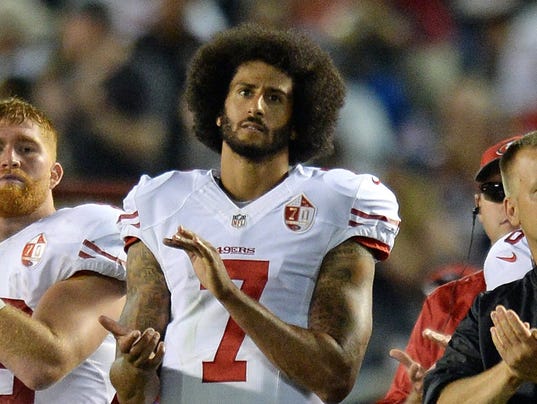
I spent most of last Monday digging up an old, leaky irrigation system in the front yard, and I brought a portable radio outside with me, to listen to while I worked.  After a couple of hours of informative programming on a listener-sponsored community station, I decided I’d had enough of that for the day and turned to one of my guilty pleasures—sports talk radio.  And in that world the news was all about a quarterback for the San Francisco 49ers named Colin Kaepernick, who has been remaining seated during the national anthem before the team’s pre-season football games.  The first time he did it, no one noticed, but at last Sunday’s game in Green Bay, Wisconsin, a reporter saw him, and asked him about it in a locker-room interview after the game, at which point Kaepernick declared that he was sitting in protest of the oppression of African-Americans and other people of color in the United States. 
The hosts of my radio talk show felt compelled to weigh in with their opinions about what Kaepernick had done, and then they opened the phone lines and took calls from listeners who expressed their wide-ranging and contradictory views.  As the week went on, this controversy spread across the media landscape, with everyone from Kaepernick’s former coach, Jim Harbaugh, and 49ers legend Jerry Rice, to the Republican Party’s nominee for President publicly expressing their disapproval.  Meanwhile, some current and former members of the armed services, not wanting to let others took offense on their behalf, “tweeted” messages of support at #VeteransForKaepernick.  At the 49ers final exhibition game on Thursday, at “Salute to the Military Night” in San Diego, Kaepernick and teammate Eric Reid knelt on one knee during the anthem, in what they intended as a gesture of mingled defiance and respect, and tens of thousands of fans in the stadium got to contribute their voices to the conversation by booing Kaepernick lustily every time he was on the field. 
Clearly, Colin Kaepernick has touched a nerve by taking this stand, or rather, this seat or this knee.  He has aroused countless people to want to have their views be heard on what they think of his actions, and whether his taking them is justified, whether he is personally qualified to be making this protest, and whether the way he has gone about it is appropriate or offensive.  And I personally am not immune to this reaction.  But I’m going to spare you my opinions, because I think today’s scripture readings point us in a different direction.  They are asking us to think, not about what Colin Kaepernick’s protest means to us or to others, but about what it is actually like for Colin Kaepernick.  When all his teammates and coaches, and the owner of the team, and every one of the fifty-thousand other people in the stadium who were physically able to do so rise to their feet in a ritual of unity and love for our country, a ritual you yourself have proudly participated in hundreds of times before in your high school, college, and professional careers, what is it like to sit, alone, on the bench? 
Jesus says that this kind of loneliness, this alienation from other people, is what we can expect when we join his movement.   We can expect to have moments when we are estranged from the groups we thought we wanted to belong to, and even from the person we thought we would be to be loved and accepted by them.  It is an estrangement that can turn us into enemies in the eyes of our nation, our church, even our family: "Whoever comes to me and does not hate father and mother, wife and children, brothers and sisters, yes, and even life itself, cannot be my disciple.” This is a hard saying, and it’s natural to think, “Jesus can’t really mean that—he must be overstating the case.” And in a sense he is, but the purpose of the exaggeration is to underscore his essential point: that following him means sharing his commitment to doing the will of God whatever the cost.  We have to be ready for those moments when we know what we must do to be faithful to the truth of our lives, when even though it is certain we will be misunderstood and hurt people we care about, and in those moments we have to be willing to act. 
If we’re lucky we are never called to do this at the cost of our health, our freedom, or our lives.  But the point is that we are never truly free unless we give God the freedom to tell us what to do and how far to go.  We are never fully alive if we are not willing to lay our lives on the line in response to the Spirit’s stirring of our conscience.  And if we are fortunate enough to live in a society where Christians are the majority, where social deviance and political dissent are widely tolerated, it shouldn’t serve as an excuse to take fewer risks with our freedom, or stands on our conscience, but as a license to take more.   This doesn’t necessarily mean that we have to go out looking for courageous stands to take; the naturally-unfolding circumstances of our lives give us ample opportunities to take difficult and unpopular actions.  Even those actions we recognize as especially heroic often turn on a fairly straightforward personal choice.  Rosa Parks had no idea, when she refused to give up her seat in 1955, that she would catalyze the Montgomery Bus Boycott and the Civil Rights movement.  She was simply, she would later say, “tired of giving in.”  Yet as this example shows us, it is actions, even modest personal ones, that really count.  They have far-reaching effects that words do not. 
Actions create stories, and symbols, with the power to move other people.  In July LeBron James and three other professional basketball superstars stood together and made speeches, at a nationally-televised awards ceremony, about racial division, systemic failure, and violence both by and against the police.  It received a polite murmur in response, whose tone was generally appreciative.  But those speeches were a blip on the meter compared to the volume and intensity of the reaction that Colin Kaepernick got, by sitting alone, saying nothing.  His action transformed an obligatory ritual that rarely gets a second thought, into a highly charged symbol of our country’s congenital wound of racist oppression and violence, a wound that has never healed, and continues to tear us apart.  And in the days since, as people have passionately argued with each other about their interpretations of what he did, that disunity has been visible for everyone to see.  Whatever you make of Kaepernick’s action, it is hard to dispute its effectiveness.   
Of course, there is no greater example of the power of an act to transform a symbol than the one given us in the gospel.  Jesus’ teachings about the forgiveness of sins and the blessedness of the poor, about loving one’s enemies, and the subversive, hidden nearness of the Kingdom of God, would surely have been forgotten centuries ago if he had not been willing to die on a cross.   In doing so, Jesus changed that cross from a sign of terror and despair at the ruthless power of the Roman state, into a symbol of unconquerable freedom of conscience, and faithfulness to the will of God.  And God’s act of raising Christ from the dead completed the transformation, so that now the cross is a symbol of the truth of all that Jesus taught, of justice, forgiveness and reconciliation, of abundant life’s victory over death, a sign of promise even to those without a hope in the world, that their suffering itself is eloquent, and God is listening. 
And for those of us who have something left to give the world, and come to Jesus to take up his cross, it is the sign of our freedom and our mandate, in gestures of protest and works of mercy, to act like him.  The importance of these actions is not measured in how much they shift the balance of political power, or even lessen the suffering in the world.  In those respects, they often seem to be so much spitting in the wind.  But they are also important as signs of resistance and hope.  They create symbols and stories that inspire and provoke, encourage and infuriate, chasten and embolden, others to act.

Letting freedom flow


Sometime last year I decided to do more to conserve water at my house.  I’d already stopped irrigating my lawn a year or two before, but with the severity of the ongoing drought here in California I considered what further measures I might take.  I’ve never been a big one for washing my car, or taking long showers, or letting the tap run while I brush my teeth or shave my whiskers, so I didn’t see much room for improvement in those areas.  But there are the toilets.  We have two of them, and as far as I know they might very well date from when our house was built in 1972, because they have those big old tanks that probably use five gallons every time they are flushed.   So, when I was at the hardware store one day getting something else and spotted a product on the shelves that seemed to offer at least a partial solution, I took a closer look. 
It was a fancy replacement for the old flapper valve, and instead of a handle like a little lever it has a couple of push-buttons, one of which will measure out a smaller flush when less water is required.   And, though I was skeptical that the thing would really work, it was inexpensive and I figured “what have I got to lose?”  I only bought one, to begin with, and installed it in the bathroom off the hall, which gets the most use, and for a while it worked as advertised.   But after a while the valve started getting stuck the majority of the times you use it.  You can release it, if you wait a second or two after flushing, and then do this thing where you push the bottom button in and then release it rapidly a couple of times until you hear the little “click” of the valve snapping shut. 
Which would only be a minor inconvenience if we remembered to do that every time.  But human nature being what it is, we don’t.  And of course the times we forget are, often enough, when we’re rushing out of the house to go somewhere, and there has been more than one occasion when I’ve returned home to find the toilet running and I know that no one has been in the house for hours.  So it’s hard to say at this point whether the contraption has saved more water than it’s wasted, and I’m grudgingly coming to accept that it’s time to bite the bullet and buy a couple of new, high-efficiency toilets. 
It hurts to know that my plumbing wastes water, but I have been able to live with the pain of it longer than I otherwise might, because there is a layer of abstraction that distances me from the problem and softens the blow.  It costs me money, of course, but lots of things cost money, and many of them cost more.  And there’s the emotional cost of feeling guilt about it, and ashamed of myself for procrastinating, because I know that we are in a drought and I am wasting a precious resource, but my actual lived experience is that there is plenty of water and however much I use, I can always get more.  That is because my toilets are hooked up to the pipelines and pumping stations of a modern municipal water system.  And that system has access to the reservoirs and the aquifers of the Russian River watershed, which not shown any signs, even in this historically-bad drought, of running dry. 
It would be far different if I lived in Judea in the 6th century BCE, which also had a summer-dry Mediterranean climate like ours, and if my household water system was a cistern containing what I’d been able to catch of last winter’s rain.  If that cistern leaked, it would soon be empty of water, and there would be no way to get more.  It is to people in a dry land, who were acutely aware of the precious and tenuous supply of water on which their lives depended, that the prophet Jeremiah spoke. He was not addressing them as individual householders, but rather, as he makes clear at the beginning of today’s first reading from scripture, he speaks to the whole “house of Jacob, and all the families of the house of Israel.”   And he did this during a time, when the nation faced an ongoing existential threat, with the shadow of expansionist Mesopotamian empires constantly looming over the land.   But there is a greater crisis, says Jeremiah, a religious crisis of which this political precariousness is just a symptom.  Speaking on behalf of Israel’s God, he says: “my people have committed two evils: they have forsaken me, the fountain of living water, and dug out cisterns for themselves, cracked cisterns that can hold no water.” 
In the eyes of our secular and pluralistic age, prophets like Jeremiah can seem kind of ridiculous.  The conventional wisdom about religion, if people are willing to accord it any value at all, is that all faiths worship the same god.  Their essential truths are the same, they just have different outward forms, different rituals, and languages, and names for the divine.  But when Jeremiah accuses Israel of having gone after worthlessness, and so become worthless, and of what changing their glory for that which does not profit, he is not talking about making the wrong choice from a menu of equivalent and interchangeable options, all of which are good.  He is talking about a critical difference in the way we think about and relate to God, a difference that we are prone to lose sight of no matter what “religion” we say we “belong to”.
As human beings we can, through various ingenious means, build an artificial fountain; but even our most advanced technology cannot create a spring.  If a spring goes dry, we can dig a well, and if the well goes dry, we can dig it deeper, but we can’t replace an aquifer.  The domain of things we can produce, predict, and control may be vast.  But it has its limits, and the Word of the Hebrew prophets comes from the other side of those limits, from the realm of the infinite and free.  From that strange and awesome remove it speaks, and strenuously, even violently, resists our attempts to give the things that we have made the honor that rightfully belongs to that which made us.   Any image of the divine in a created form, any sorcery that tries to steal power or knowledge from heaven or hell, any cultic sacrifice that claims to be able to pacify or animate the deity, is an insult to the freedom of God.
And this freedom matters to us, not least because it is the source of our own.   Jeremiah says to the families of Israel that they are in danger of losing their freedom, and this is because they stopped asking “Where is the Lord who brought us up from the land of Egypt?”  They stopped seeking the God who broke them out of the house of Pharaoh, and saved them from his army.  They stopped looking for the God who brought them through the drought, and darkness of the desert, to a land whose abundance was their gift of freedom and equality.  They contented themselves instead with a god who was a kind of domestic pet.  Forsaking the fountain of living water, and dug cracked cisterns for themselves.
In a Presidential election year in the United States, you can count on a lot of talk about greatness and freedom—our greatness, and our freedom—though very little is said about what these words might really mean.  You also hear a lot of passing references to “God”, whose job, it seems, is to bless us, in a manner of our choosing.  And none of these glib invocations shed any light on God’s greatness, let alone God’s freedom.  For that, you have to come to a place like this, where people still listen for the Word that speaks from beyond the sphere of our illusions and contrivances.   That word reminds us that freedom is a gift that grows out of the land, when we dwell there in equality and justice; that it is still an arduous journey to get there, one that leaves the false peace and illusory stability of domination and subservience behind; and that our only sure guide on that journey is a true and living God—a God who is free. 

About Me

My photo
Petaluma, California, United States
I am a priest in the Episcopal Church, and have been (among other things) an organic farmer and gardener, and a Zen monk. I have a lifelong interest in social and spiritual renewal on the basis of contemplative discipline, creative nonviolence, and ecological practice. In recent years my work has focused intensely on the responsibility of pastoral ministry in the humanistic, evangelical, and catholic branch of Christianity known as Anglicanism. I'm married with a daughter, and have three brothers and two parents.