Wednesday, November 26, 2014

Necessary freedom


“The Day of the Lord” is an ancient Biblical figure of speech.  It says that the God who made light arise in the darkness with the first word, will also have the last.  It says that the one who told Moses from the burning bush “I will be who I will be” was speaking the truth.  God will be who God will be and a day will come when God’s will and our becoming and the unfolding of the universe will be one and the same.   This was what gave the ancient Jews, and later, Christians, their great hope.  They saw a day of deliverance, when joy and thanksgiving would take the place of longing and suffering, and justice would no longer be deferred or denied.  It would be the day when, as the prophets said, “the earth shall be full of the knowledge of the glory of God as the waters cover the sea.” 

The promised Day of the Lord was also our ancestors’ greatest dread.  Because they knew that there could be no justice without judgment.  And they were deeply aware that as much as they might like to think that relative to some others they weren’t doing too badly, God’s justice would require nothing less than the absolute truth, of everything they had ever done, or thought, or said. 

Now in the modern world, this Day of the Lord no longer has the power to awaken much hope, or a lot of dread.  Maybe we think about the day of our own deaths with some mix of these feelings.  Perhaps we hope for a tunnel of white light that leads us to a reunion with the loved ones we have lost.  Maybe we dread the extinction of our ego consciousness and bodily life and fear that nothing will be left when they are gone.  But the culmination of history, in which God comes in person to set the whole creation to rights, to heal and restore all that is hurt, and lost, and broken, really doesn’t speak to us very persuasively any more.  Instead of hope or dread, what it mostly evokes in us is a kind of embarrassment.

It’s not hard to understand why.  We are painfully aware of a long history of the use of this image to threaten and cajole, to make people fearful and guilty, and then to play on their feelings to manipulate and control them.  Quite apart from the vengeful glee that some folks take in the extravagant and sometimes lurid visions of Biblical apocalypse, and even more than the low comedy of preachers who make precise predictions of the End that is near and wind up with egg on their faces when the fateful date passes with no more than the usual crimes and cruelties, I think that what makes us most uncomfortable about this day of the Lord is the shade it throws on our autonomy.

Because at the heart of our world view is the idea that we modern human beings have broken free.  The faith of our civilization is that God, if there is one, will not decide our destiny, as a species or as individual persons.  We have taken control of our fate, and will become what we create.  Our ever-expanding scientific learning and its rational application to society and the natural world, will guide the endless forward march of progress.  Advances in pharmacology, with the right attitude and therapeutic technique, will make us relaxed, confident, and happy all the time.  If we run into roadblocks we will remove them, with no divine intervention required.

Or, if we are one of those who entertain the thought of a shadow on the horizon, it is because of human factors that have gotten out of control.  Some do imagine a future of overpopulation and resource exhaustion, climate catastrophe, nuclear apocalypse, and such things, but if there is to be a reckoning it will be our reckoning with what we have done.  And the thought that God might lift this curse from us, or that these might be signs of some inevitable and irreversible transformation, seems infantile, the worst kind of religious delusion.

So it makes us embarrassed to read scriptures that suggest that there is another agenda at work here, one that is proceeding without regard to what we had planned or what we have feared.   We don’t want to consider that even though we do not comprehend the ultimate purpose of our own existence, there is one, and it will reckon with us, whether we reckoned with it, or not.  And we certainly don’t care to hear that it is there for us to find in the Bible.

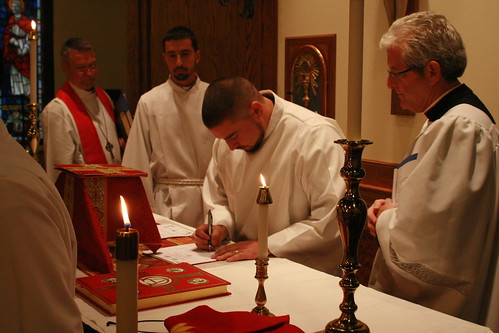
I have a guilty little secret to tell you.  On the day I was ordained to the priesthood, right at the beginning of the ordination service, I knelt on a cushion at the altar rail at Grace Cathedral in San Francisco, along with eight other people.  And the bishop came to each of us in turn, and the archdeacon of the Diocese of California held out a pen and a stiff folder containing a piece of paper for me to sign.  And there, in front of the bishop, and my family, and a few hundred other clergy and lay witnesses, I signed my name to a declaration that read: “I do believe the Holy Scriptures of the Old and New Testaments to be the Word of God, and to contain all things necessary to salvation.”

Which I find to be a really elegant, and very Anglican, way of handling this sensitive but crucial matter.  You notice it doesn’t say that all the words of the Bible are the words of God, just that the whole thing altogether is the Word.  It doesn’t even foreclose the possibility that there might be things outside of it that can be extremely helpful.  It just says that everything that you really need to know is there.  It suggests that there is something necessary and inevitable about the Bible—again that embarrassing threat to our autonomy—but it also suggests that we have the freedom to discover for ourselves what is in it that we need.

That combination of necessity and freedom pretty well describes the path that the Bible asks us to take, what the Prayer Book ordination rite calls “salvation.”  On the one hand there is the warning that the things we are pursuing are not the things that really matter, and the things that do matter will be all that’s left standing in the end.   On the other hand, it says, here’s what you need to know to get back on track.  But instead of spelling it out for us in a simple formula, the Bible gives us rules about agricultural practices, and racy love poetry.  It gives us political polemics and grief-stricken laments, puns and proverbs, histories and folktales, dreams and nightmares.  Most of all it gives us a story. 

And a story that is moving towards an end is a story that means something.  It is always open to new interpretation and new information because it has faith in the skill and wisdom of the supreme author, to tie up all the loose ends.  That hope is what gives ultimate importance to all the myriad details of the story itself.  It says our lives have meaning, and the actions we take matter, and that we are more than bubbles drifting on the surface of the void, waiting to our turn to burst.  We are part of God’s story, with significance not just for this fleeting moment but for all eternity.

That suggests a lot of responsibility, but it is a responsibility that comes along with an extraordinary freedom.   This is the freedom of the apostolic communities, who found in the life and death and resurrection of Jesus a new way to imagine the whole story, from beginning to end.  They saw that the Day of the Lord will be his day, the full revelation of his purpose to gather people from every family, tribe, language and nation into the kingdom that is already present in his body and blood.  This is also the freedom of the slaves in the Gospel parable, whose master entrusted them with huge sums, and then went away and left them to do with it what they will.  It is a big responsibility, but it is only too much for the one who fears and distrusts the master, the one who buries his treasure in a hole in the ground, because he thinks that not being punished is the best he can hope to do.

Thursday, November 13, 2014

A Vision for St. John's


First published in The Beloved Disciple, the monthly newsletter of St. John's Episcopal Church, Petaluma: http://www.saintjohnsepiscopalpetaluma.org/page/newsletter

People sometimes ask me what my vision is for St. John’s.  It’s been a hard question to answer because a vision takes time to develop, and time to communicate.  It is not a plan of action, but a description of where we hope our actions will take us.  It isn’t about what we will do so much as about who we will be.  As priest and pastor, it is part of my job do articulate a vision, but it can’t be just something I think up on my own—it has to be something I listen for, in what others are saying, in my own heart, and in the conversations between us.  During the four years I’ve been here we’ve had a lot of conversations about what matters most, and what we hope we are becoming.  I have tried to listen carefully to what’s been said.  And during this year’s season of discernment, I’ve made time for conversations with trusted friends about what I’ve learned and what inspires me to want to make a new commitment to the work of this congregation.  I’ve also done some listening to what is being said in the wider Episcopal Church about its challenges and opportunities for the future.
What follows is the fruit of these conversations.  It is a personal statement, and I don’t claim to speak for everyone at St. John’s.  But I offer it to you in the hope that some part or parts of it will speak to you, and illuminate your vision for the parish. 

St. John’s is a place where people are drawn by the love of God, called to seek the divine image in themselves and one another; uniting in praise and thanksgiving at Christ’s table, in contemplation and discernment, and in active works of wisdom, justice, beauty, and truth, we share here on earth in the joys of heaven.  It is a place from which each of us is sent to find the unique vocation that grows from our responsibilities and gifts, and to play our part in the mission of Christ to the world.  We are a circle from which no one who is not a danger to others is excluded, in which every voice is heard, and every truth respected, where no one is above criticism, and no one is beyond hope.
We foster a religious culture devoted to the maturation of our spiritual gifts and the satisfaction of our deepest needs by the grace of God—through taking creative risks, telling the truth, making repentance, seeking reconciliation, and empowering one another for servant-leadership in the world.  We take nourishment from the testimony of the Hebrew prophets and sages and the Apostolic communities; from the teaching and example of holy women and men of the past and present; from the riches of Christian tradition in music and the arts, mysticism, theology, and social action; from our membership in a worldwide communion of Anglican brothers and sisters, and the ecumenical body of Christ; from the rhythms of the hours and the church year, and the sacramental elements of grace.  
We are a place for joyous worship, with strong participation by people of all ages, representing the cultural diversity of our community, and bringing the talents of many leaders together in stirring, centering, prayerful, and purposeful celebrations of the Holy Spirit.  We are a learning community practicing the arts of peace—compassionate dialogue, open inquiry, and courageous discipleship.  We seek personal encounter across social, political, and religious barriers, in the shared pursuit of mutual understanding and the common good.  We offer space for a deeper and kindlier look at the world in which we live, where simplicity and faith allow us to hear the voice of the earth, of our bodies, and of the heart, and to take reverent and practical steps to restore the balance of the world.
We are wise and loving stewards of the goods we receive, cherishing the past and preparing for the future without illusions about either, but placing our trust in God’s covenant faithfulness, the truth of the Gospel, and the resilience of creation.

Tuesday, November 11, 2014

Renewing the Covenant


When Joshua gathers Israel together after their conquest of Canaan is complete, he talks to them about their ancestor Abraham.  He reminds them of how God came to Abraham in the land of his ancestors beyond the Euphrates River, and led him away from there, away from the gods of that land, and brought him here --to Canaan.  Joshua tells the people this story because he wants them to understand the real significance of the moment.  He is not only a great governor and military leader; he is also a prophet, one who speaks for God.   And he wants the Israelites to know that this is not just a great event in the history of their nation.  It is also a moment in the story of God.

For just as it was God who led Abraham on his great migration, and God who gave offspring to him and to Sarah, so also it is God who is bringing the story of his descendants to this new climax.  It was God who visited the plagues upon Egypt, and brought Israel out of slavery and into the wilderness.  It was God who spoke to them through Moses at the foot of Mount Sinai and said, “If you will obey my voice and keep my covenant, you shall be my own possession among all the peoples,… a kingdom of priests and a holy nation.”  And the people all answered together and said, “All that the Lord has spoken we will do.” 

After that generation of Israelites had passed away, and Moses himself was about to die, he called together their children in Moab on the other side of the Jordan.  He reminded them of their story, of all that God had done for their fathers and mothers, and Moses gave them a choice, a choice between life and death, blessing and curse, and he urged them to choose life, for themselves and their descendants.  And now it is Joshua’s turn to speak to their children, on behalf of the God who brought them across the Jordan, who defeated kings and armies and delivered walled cities into their hand, so that they might live in houses they didn’t build, and eat the fruit of vineyards they didn’t plant. 

And Joshua also gives them a choice.    They can serve the gods of Mesopotamia, or the gods of Egypt, or the gods of the Amorites, of the people of the land where they have come to dwell.  Or they can renew their covenant with the God of Israel, whose story is their story.  They have a choice, because God wants partners and co-workers, not slaves.  It’s a choice that every generation of Israel has to make for itself, in the light of its own risks and rewards, its own prospects for renewal of the faith community, and its own fateful consequences of failure.   

Most scholars agree that this story was written down in its current form long after the events that it describes, in a time when the people of Israel had been conquered and taken away to exile in Babylon.  So there is a bitter irony in that part of the story where Joshua warns them about what will happen if they forsake the Lord and serve foreign gods.  The people insist that they know what they are getting into, and that they will be faithful.  But the people who wrote this story, and the people who read it, knew that they hadn’t been, and that Joshua’s warnings had come true.  In this context they returned again to the stories of their covenant with God, looking for meaning in the disaster that had come upon them, and for a way out of their sense of guilt, and failure, and despair.  They sought to remember who they were, the sacred purpose for which God had called them into covenant.  In that remembering they found their freedom.  They saw that they still had a choice.

Some of us here at St. John’s had an experience of the power of remembering our story just the other night.  At the urging of the vestry I’ve called together a group of four people from our 8 o’clock service and four from the 10 o’clock, to work together on a vision for liturgy and music in our parish.  We gathered last Tuesday night, and I decided that a good place to begin would be to remember the story of how we got to where we are today.  I put a time-line up on the wall, and we began to fill it in with what we could remember of how we used to worship in the past.  We called forth a few sketchy details of times long ago, but mainly we focused on the journey that began in early January 2007 with the rebirth of the Episcopal Church in Petaluma from the ashes of schism. 

Now nothing gets Christians into a lather like their opinions about what music to sing in church, or what words to say.  The fact that our two Sunday services have settled into patterns that are fairly distinct in tone and style makes some people worry that we are two different congregations working at cross purposes.  Others think that the way these services are now is the way they will always be, which can be good news or bad, depending on their point of view.  But going back and remembering the turning points that got us to where we are, the circumstances and persons who shaped the choices that we made, helped our Worship Committee see that our context is always changing.  It reminded us that we have to revisit those choices frequently, and continually make them again.   It also helped us remember that we are one people with one story, and that underlying our differences of liturgy and music is our common effort to be faithful to the mission for which God called this parish back to life. 

That is what it means to be in a covenant.  And at the heart of a covenant is a story.  The story of the rebirth of St. John’s, Petaluma is a powerful one, and like many of you, it attracted me and moved me to become part of it.   And because it is a covenant story, God has enabled us to accomplish a great deal together.  We re-established communion with the Diocese of Northern California and the Episcopal Church.  We reclaimed the historic parish property on its behalf.  We showed that this congregation could include gays and lesbians, affirming their full personhood, and their gifts for leadership in the church.  We grew in numbers and in strength to the point where we now can stand on our own as a parish, and we have discerned God’s call to me to become the Rector.

And as I have considered whether to accept that call, it has become clear that there is a real choice for me to make.  What is at stake is not merely the question of what’s best for me and my family, or even what’s best for the parish.  This moment is about making a new commitment to being in covenant with God.  It means recommitting to the story of the resurrection of St. John’s, not as something we did and can now sit back and enjoy, but as something God did so we could remember who we are.  What has happened here is a sign that we belong, not just in this building, or to this denomination, but to the covenant people of Jesus Christ.  Our life together is a sign of his death and resurrection, and it is as his body that we are sent on the mission of his Gospel. 

So I had to ask whether I was ready to renew my commitment to that mission, as God is renewing it in this community.  Could I take new risks for the sake of inclusion, to welcome our neighbors who are still kept out of this church by barriers of language or culture or physical disability?  Could I embrace a broader vision of renewal, going to work with other churches and faith communities and partners in Petaluma to recover our common story and do what we can in our modest way to rebuild a covenant society?  These were questions I had to put not only to myself but to the Discernment Committee and the Vestry.  And now I put them to you.   As for me and my house, we will stay here at St. John’s, Petaluma and serve the Lord, as long, and as well, as we are able.


About Me

My photo
Petaluma, California, United States
I am a priest in the Episcopal Church, and have been (among other things) an organic farmer and gardener, and a Zen monk. I have a lifelong interest in social and spiritual renewal on the basis of contemplative discipline, creative nonviolence, and ecological practice. In recent years my work has focused intensely on the responsibility of pastoral ministry in the humanistic, evangelical, and catholic branch of Christianity known as Anglicanism. I'm married with a daughter, and have three brothers and two parents.