Showing posts with label modernity. Show all posts

Wednesday, November 26, 2014

Necessary freedom


“The Day of the Lord” is an ancient Biblical figure of speech.  It says that the God who made light arise in the darkness with the first word, will also have the last.  It says that the one who told Moses from the burning bush “I will be who I will be” was speaking the truth.  God will be who God will be and a day will come when God’s will and our becoming and the unfolding of the universe will be one and the same.   This was what gave the ancient Jews, and later, Christians, their great hope.  They saw a day of deliverance, when joy and thanksgiving would take the place of longing and suffering, and justice would no longer be deferred or denied.  It would be the day when, as the prophets said, “the earth shall be full of the knowledge of the glory of God as the waters cover the sea.” 

The promised Day of the Lord was also our ancestors’ greatest dread.  Because they knew that there could be no justice without judgment.  And they were deeply aware that as much as they might like to think that relative to some others they weren’t doing too badly, God’s justice would require nothing less than the absolute truth, of everything they had ever done, or thought, or said. 

Now in the modern world, this Day of the Lord no longer has the power to awaken much hope, or a lot of dread.  Maybe we think about the day of our own deaths with some mix of these feelings.  Perhaps we hope for a tunnel of white light that leads us to a reunion with the loved ones we have lost.  Maybe we dread the extinction of our ego consciousness and bodily life and fear that nothing will be left when they are gone.  But the culmination of history, in which God comes in person to set the whole creation to rights, to heal and restore all that is hurt, and lost, and broken, really doesn’t speak to us very persuasively any more.  Instead of hope or dread, what it mostly evokes in us is a kind of embarrassment.

It’s not hard to understand why.  We are painfully aware of a long history of the use of this image to threaten and cajole, to make people fearful and guilty, and then to play on their feelings to manipulate and control them.  Quite apart from the vengeful glee that some folks take in the extravagant and sometimes lurid visions of Biblical apocalypse, and even more than the low comedy of preachers who make precise predictions of the End that is near and wind up with egg on their faces when the fateful date passes with no more than the usual crimes and cruelties, I think that what makes us most uncomfortable about this day of the Lord is the shade it throws on our autonomy.

Because at the heart of our world view is the idea that we modern human beings have broken free.  The faith of our civilization is that God, if there is one, will not decide our destiny, as a species or as individual persons.  We have taken control of our fate, and will become what we create.  Our ever-expanding scientific learning and its rational application to society and the natural world, will guide the endless forward march of progress.  Advances in pharmacology, with the right attitude and therapeutic technique, will make us relaxed, confident, and happy all the time.  If we run into roadblocks we will remove them, with no divine intervention required.

Or, if we are one of those who entertain the thought of a shadow on the horizon, it is because of human factors that have gotten out of control.  Some do imagine a future of overpopulation and resource exhaustion, climate catastrophe, nuclear apocalypse, and such things, but if there is to be a reckoning it will be our reckoning with what we have done.  And the thought that God might lift this curse from us, or that these might be signs of some inevitable and irreversible transformation, seems infantile, the worst kind of religious delusion.

So it makes us embarrassed to read scriptures that suggest that there is another agenda at work here, one that is proceeding without regard to what we had planned or what we have feared.   We don’t want to consider that even though we do not comprehend the ultimate purpose of our own existence, there is one, and it will reckon with us, whether we reckoned with it, or not.  And we certainly don’t care to hear that it is there for us to find in the Bible.

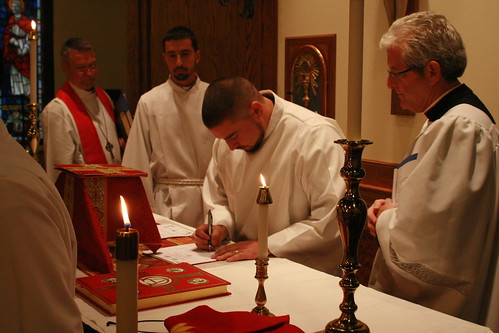
I have a guilty little secret to tell you.  On the day I was ordained to the priesthood, right at the beginning of the ordination service, I knelt on a cushion at the altar rail at Grace Cathedral in San Francisco, along with eight other people.  And the bishop came to each of us in turn, and the archdeacon of the Diocese of California held out a pen and a stiff folder containing a piece of paper for me to sign.  And there, in front of the bishop, and my family, and a few hundred other clergy and lay witnesses, I signed my name to a declaration that read: “I do believe the Holy Scriptures of the Old and New Testaments to be the Word of God, and to contain all things necessary to salvation.”

Which I find to be a really elegant, and very Anglican, way of handling this sensitive but crucial matter.  You notice it doesn’t say that all the words of the Bible are the words of God, just that the whole thing altogether is the Word.  It doesn’t even foreclose the possibility that there might be things outside of it that can be extremely helpful.  It just says that everything that you really need to know is there.  It suggests that there is something necessary and inevitable about the Bible—again that embarrassing threat to our autonomy—but it also suggests that we have the freedom to discover for ourselves what is in it that we need.

That combination of necessity and freedom pretty well describes the path that the Bible asks us to take, what the Prayer Book ordination rite calls “salvation.”  On the one hand there is the warning that the things we are pursuing are not the things that really matter, and the things that do matter will be all that’s left standing in the end.   On the other hand, it says, here’s what you need to know to get back on track.  But instead of spelling it out for us in a simple formula, the Bible gives us rules about agricultural practices, and racy love poetry.  It gives us political polemics and grief-stricken laments, puns and proverbs, histories and folktales, dreams and nightmares.  Most of all it gives us a story. 

And a story that is moving towards an end is a story that means something.  It is always open to new interpretation and new information because it has faith in the skill and wisdom of the supreme author, to tie up all the loose ends.  That hope is what gives ultimate importance to all the myriad details of the story itself.  It says our lives have meaning, and the actions we take matter, and that we are more than bubbles drifting on the surface of the void, waiting to our turn to burst.  We are part of God’s story, with significance not just for this fleeting moment but for all eternity.

That suggests a lot of responsibility, but it is a responsibility that comes along with an extraordinary freedom.   This is the freedom of the apostolic communities, who found in the life and death and resurrection of Jesus a new way to imagine the whole story, from beginning to end.  They saw that the Day of the Lord will be his day, the full revelation of his purpose to gather people from every family, tribe, language and nation into the kingdom that is already present in his body and blood.  This is also the freedom of the slaves in the Gospel parable, whose master entrusted them with huge sums, and then went away and left them to do with it what they will.  It is a big responsibility, but it is only too much for the one who fears and distrusts the master, the one who buries his treasure in a hole in the ground, because he thinks that not being punished is the best he can hope to do.

Wednesday, May 21, 2014

How can we know the way?


I have preached many times on today’s reading from the Gospel of John.  It is one of the passages that the Book of Common Prayer recommends for funerals.  For those who are grieving, it is reassuring to hear the words of Jesus that there are many dwelling places in his Father’s house, and that he is going there to prepare a place for us.  It is good news, under those circumstances, and my job is to proclaim it, for strength and consolation. 
But it is a little different to read this passage today, on a Sunday morning in Easter season.  Granted, the spring it not as fresh as it was five weeks ago, when the green on the hills had not begun to fade, and the roses that are losing their petals now were just breaking their first bloom.   Maybe the light that burst forth from the empty tomb has dimmed just a bit, and the shadows are stealing back in around the edges of the world.  But when Thomas says to Jesus, "Lord, we do not know where you are going. How can we know the way?" he is not yet thinking of the martyr’s death that he will someday die.  That is still far away. 
Thomas asks this question because he has learned that Jesus, whom he followed along the roads of Galilee, Samaria, and Judea, out across the Jordan and back again, who has led him and his friends here to Jerusalem, whom Thomas was ready to follow even to death, is going away, and leaving him behind.  Thomas’ question is not about the fate of Jesus’ soul, or about how to cope with his own grief and loss.  It is a question about how to continue the journey they have begun.  It is about carrying on in Jesus’ absence.  It’s a question about discipleship. 
It is a question we might ask, knowing that Christ is risen, but our lives are still in the midst of death.  Where we live, the Father’s house seems far away.  Jesus says he is going there to prepare a place for us, but there’s no getting around the fact that he is going and we are staying here.  He says he’s coming back for us, but he doesn’t say when.  And then he tells us that we know the way to the place where he is going, as if to say it will not be enough for us to simply wait around for him to get back, but we need to keep moving forward and he’ll meet us on the way. 
 
"Lord, we do not know where you are going. How can we know the way?"
It is a good question for a group of people, like this one, that is in a year of discernment about its future.  God seems to have some purpose for us at St. John’s because, in spite of innumerable obstacles, we are alive, after decades of debilitating conflict and the death of schism.  But the time is upon us when the miracle of our existence is no longer enough to give us a sense of direction.  We are asking to know the purpose for which God called us back to life.
For the church, the answer to that question will always have something to do with remembering.  We know where we are going, at least in part, because we know the way that we have come.  But there is a danger in this, the danger that we will be satisfied with the answer that has already been given.  We might believe we have already arrived, when the answer that Jesus gives is about being on the way.  “I am the way,” says Jesus, inviting us to keep moving, trusting his guidance;  “and the truth,” he adds, not a truth cast in bronze, or set in stone, but the truth that lives and grows as we journey further with Christ.  And finally “the life”— life that is, by definition, dynamic, and changing, and ever renewing itself, or it is not life at all. 
We are justly proud of the long history of our congregation.  Our parish archives contain handwritten minutes of vestry meetings and ledgers of accounts that go back to the pioneer days of Petaluma.  We also have a collection of old parish newsletters that is not quite that old, but covers the first four years of the 20th century, not long after this structure was built.  And what strikes me, reading those papers, is how entirely focused they are on churchly concerns.  There are little notes about parish life and reports of the rector’s travels, and appeals for the support of missionaries in Yreka, and Alaska and China.  There are long articles about ancient church history, and summaries of doctrine and biblical texts, but not a word about the social changes that are radically transforming everyone’s lives.
In those years this valley, like all of America, was rapidly urbanizing and industrializing, integrating into an expanding national and global system.  Her people were embracing the habits and values of the modern consumer society, but the only clues in the parish newsletter that all this was going on are the paid advertisements in the margins of the page.   It is as if the church lives in a different world, one that looks backward to simpler times, and forward only to heaven.  The unspoken message is that the modern world knows where it is going, and the church is just along for the ride.  And even if the world is not following Jesus, it is not for us to resist or critique.   Our role is to stand on the sidelines, keeping open a place apart for rest and inspiration, where religious culture and family tradition, and beauty, decency, charity and reverence are not completely lost.
The world still needs this from religion, but by itself it is no longer enough.  On Monday, scientists from NASA’s Jet Propulsion Laboratory released a report on the melting of glaciers in the Amundsen Sea region of West Antarctica.  Their observations show an ongoing collapse of the ice in the region that has passed the point of no return.  Just this one source is causing a rise in global sea levels of about four feet.  The thing that alarms the scientists the most is that these are changes that used to happen in geological time, in hundreds of millennia, and now they take one or two or three human generations. 
In the face of runaway change, the church can no longer sit on the sidelines.  We must get out on the way.  We have to bear witness, like Stephen in the Book of Acts, that our leaders they do not know what they are doing.   Our civilization does not know where it is going.  It has no map, but is too proud to stop to ask for directions.   Of course, some Christians have been saying this for a long time.  They say, we know a different way, the way to the exits.  We believe the truth—the unchanging, fixed, literal truth of the Bible, and its iron jaws are closing on the world.  We hope for the life, the life that is death.  We know where we are going—to heaven, and you and your world can go to hell.
But there’s another way of being Christian, one that doesn’t hope for the destruction of the world.  It’s a way that reveres what God has created out of reverence for a wisdom and design that we do not understand.  It’s a way of loving what is passing, because it is not passing away to eternal death, but passing over into the house of God.  And wherever that is, we say, with the author of 1st Peter, that it is a house that God is also building here, from living stones.  This place is not forsaken, not if we are to believe what Jesus says about his own future.  Because he doesn’t say that he is going to the Father to chill out, in a state of endless bliss and eternal rest.  He’s says he’s going to get busy. 
“Because I am going to the Father,” Jesus says, “I will do whatever you ask in my name.”  His priestly work, reconciling the world to God, making the love and wisdom, the compassion and justice of God come true and come alive in the world—the work that he used to do, so to speak, from our side, Jesus promises to continue from the other side, the side of God.  So what about us, we who are still here—what do we ask him for?  It’s a good question, since we don’t know where we are going.  I guess we ask him to show us the way.

About Me

My photo
Petaluma, California, United States
I am a priest in the Episcopal Church, and have been (among other things) an organic farmer and gardener, and a Zen monk. I have a lifelong interest in social and spiritual renewal on the basis of contemplative discipline, creative nonviolence, and ecological practice. In recent years my work has focused intensely on the responsibility of pastoral ministry in the humanistic, evangelical, and catholic branch of Christianity known as Anglicanism. I'm married with a daughter, and have three brothers and two parents.