Showing posts with label vision. Show all posts

Sunday, February 26, 2017

Visions of the Real World


Most biblical scholars agree that the New Testament book of Second Peter was not written by Peter.  Near the end of it there is a reference to “all the letters of Paul” that implies not only that those writings have been gathered into a collection, but that they also have achieved the status of Holy Scripture.  Which are things that did not take place until long after the Apostle Peter was dead.  For this and for other reasons, the general consensus is that this was the last book of the Bible to be written, and dates from well into the 2nd Century. 
Taking that into account, it seems strange that this morning’s reading from Second Peter stakes such a strong claim to being eyewitness testimony.   “We were not just passing on clever myths that someone made up,” it says, “when we told you about the power of Jesus and his coming.  We saw his glory with our own eyes.  We heard the voice of God with our own ears when it said, ‘This is my Son, my Beloved, with whom I am well-pleased.’  We were there with Jesus on the mountaintop.”  
So was the person who wrote these words lying?  Was he putting forward what some today might call “alternative facts?”  Well, the simple answer is “yes.”  But as with most things pertaining to the Bible, the simple answer isn’t really satisfactory.  It only opens the door to a lot more questions.  And there is ongoing, robust academic debate about all sorts of historical problems related to the authorship of Second Peter and other New Testament books that seem to have been written under the names of people who did not in fact write them. 
But for me as a preacher those historical-critical problems, though worth thinking about, are less important than the questions about what the texts themselves are trying to say.  And the way I see it, even if this author knew that his audience understood perfectly well that he was not the Apostle Peter, he wrote it as if it’s what Peter would say in the present circumstances if he were here.
If you read Second Peter as a whole, you’ll see that its context is an argument with other religious teachers.  And the beef it has with those teachers is that they seem to have relaxed any tension between being a Christian and just kind of going with the flow of business as usual in the world as we know it.  They are teaching that the conventional world is not going to change much, for the better or the worse, so the point of religion is to accommodate you successfully to the world: to looking out for number one, and getting rich, and doing whatever it is that seems like it will make you feel good at the moment. 
But if Peter were here, he wouldn’t stand for this.  He would say that God has called us to expect more from life than that.  He would tell us that, in fact, God has promised to radically transform the world as we know it, and to transform us along with it, so that we become sharers in the very nature of Godself.
And Peter would remind us that our faith in these promises is grounded in concrete historical experience.   Certain people got to see and hear for themselves, in a real time and a real place, what we will be like when God transforms us.  They were able to do this because they were disciples of Jesus.  In his presence, they caught a vision of what the world really is and what God really means for it to be, and how a person speaks and acts who really understands the difference and wants the world and God’s purpose to be reconciled. 
The author of Second Peter could have chosen any of the well-known Gospel stories to make a case for the unique authority that comes from having been there as an eyewitness.  But he chose the one we read from Matthew today, the story of the Transfiguration.  And I think this is because it’s the one episode in the gospels that focuses entirely on a few disciples and a transient revelatory moment in their experience of Jesus.  Jesus himself doesn’t do anything remarkable in the story.  It is Peter, James, and John who see him talking to Moses and Elijah.  It is they who see the vision of his face transfigured and shining like the sun.  It is they who are enveloped in the cloud of light and who hear the heavenly voice.  It is they who fall down on their faces like dead men, and then lift up their eyes to see no one but Jesus alone.
And as they are going down the mountain to rejoin the rest of his disciples, Jesus tells them not to speak of it until after he has risen from the dead.   So the whole thing kind of feels like a dream, like a shamanic journey to another world, and we have only the word of Peter, James, and John to tell us that it really happened.  And that might be the whole point.  Because it is of such rare material that we often must construct our faith. 
In a lifetime we may have only a few fleeting glimpses of the glory that God intends for us, a precious handful of moments on the mountaintop.   Or we may feel as if we’ve never been there, and depend on the testimony of hardier souls to tell us what it’s like.  And yet such moments, even second-hand, impress on us such a radically-different vision of reality, that they haunt us.  The longing they awaken for a greater significance to our lives, the discontent with a shallow materialistic existence they leave behind, often have to be enough—enough to sustain us through long periods of just going through the religious motions, wondering if it’s all a sham. 
Second Peter tells us that this is actually providential.  It helps us avoid mistaking the lamp we have been given to guide us on the path for the glorious dawn toward which we are going.  And it teaches us to measure the worth of our mountaintop experiences by the lives we live every day down here in the suburbs.  Which is also goes for our efforts at religious discipline.  
At the Zen temple we used to have seven- or ten day meditation intensives called sesshin, which is Japanese for “gathering the mind.”  During sesshin we would sit upwards of twelve or thirteen periods a day of silent meditation, interspersed with walking meditation and services of chanting and prostrations.  We would eat in silence at our seats in the meditation hall.  Except for a daily sermon and an optional brief, private conversation with one of the teachers, there was no talking.  There was no reading or writing during the breaks after meals. 
I can still vividly remember certain moments that occurred twenty-five years ago during sesshin, moments in which exactly nothing happened.  You could say they were moments on the mountaintop.  But our teachers used to tell us that the point of sesshin is to realize that your whole life is sesshin.   And we could say something like that about the Christian season of Lent.  The point of Lent is to realize that your whole life is Lent. 
During these forty days every spring we intensify our effort to pay attention, to let go of what is not essential, to purify our bodies and minds, to take less and pray more, and remember those whose needs are more pressing than our own.  But our purpose is not simply to “get through Lent” and move on, but to remember some basic spiritual truths to carry with us throughout the remainder of the year.  We do not approach Lent like convicted criminals being marched into prison to serve our time.   We come as those returning to the valley from the mountaintop, as those who have seen the glory of God’s beloved Son, who have felt his healing touch, and heard him say to us, “Get up; do not be afraid.”
If we come to Lent seeking silence, it is because we know there are some things for which words are inadequate.  If we come for instruction, it is because we’ve heard the voice that tells us to listen to God’s beloved.  If we come to repent, it is because we have seen the glory for which we are created, and which we have stubbornly refused.  If we come praying and fasting for justice, it is because we know that another world is possible.              

Wednesday, January 28, 2015

Where we really are


There was a lot I didn’t know when I went to the Rector of my old church of St. Gregory’s in San Francisco and told him I thought, maybe, I was called to be a priest.  I didn’t know much about the Bible, or the history of the church, or how it was organized, and what the life of a minister was really like.  I certainly didn’t know anything about the ordination process, and if I had, I might never have had the courage to start.  Because the truth is I was afraid to tell my secret even to my friend the Rector—this secret I’d been keeping even from myself.  I was afraid of what he might say, and how I might feel.  I was afraid I was mistaken, and afraid that I was not.  Most of all I was afraid to be seen.
 
And the process of becoming a priest requires that you be willing to be seen.  You go through all these formal interviews with the parish Discernment Committee and the Diocesan Commission on Ministry, and the Standing Committee and the Bishop.  You get evaluated by a psychologist.  Each time you meet with these people you’re trying to articulate your vision of yourself as a priest, but it’s extremely awkward because all the while you’re wondering if it’s real, and you know that they are, too.  Because the way we understand the call to ordination in the Episcopal Church is that my own internal sense of being called is not enough.  Other people have to see it, too. 

I had a friend at St. Gregory’s who chaired the committee of lay people in the parish that met with me over a year or more to talk with me about that call, and hosted the meetings at her home.  And I’ll never forget the time, after I’d preached maybe my third or fourth Sunday sermon, when she came up to me and said, “This time I saw that you could be my priest.”  I could not have made it through in the ordination process or my subsequent years of life as a priest without moments like that one, when someone else could see what I had lost sight of, or doubted was anything more than a mirage.

You can see something like this in the story of the call of Samuel.   Samuel is serving as a kind of apprentice to a priest named Eli in the temple at Shiloh, and one night The Lord calls to Samuel as he is lying down to sleep, and the boy runs to Eli to see what he wants.  The priest tells him to go back to bed, because he had not called him.  And the call comes a second time, and again Samuel runs to Eli, and again Eli tells Samuel that he had not called.  But when it happens a third time, Eli has the wisdom to see what was going on, and he tells Samuel that it is the Lord who is calling.  Samuel was called to be a prophet, but to set out on his path he needed Eli to see him and recognize the calling for what it was.

I believe that all of us need to be seen in order to find our calling.  It is as true for teachers and scientists, nurses and bankers, artists and farmers, as it is for prophets and priests.  It’s true of professions, but it’s just as true of other, more personal callings, as parents and spouses and friends.  Because no matter who we are—what kind of family we have, or work we do, no matter what our talents, or disadvantages, or aspirations might be—we do not earn our lives by our efforts, or take them by cunning or by force.   We receive them as a gift.   

There is a voice calling out to each of us to accept the gift of our own true life.  There is a vision in the mind of God of who each one of us is, and of who we are becoming.  That is why it is such a blessing to meet someone who can speak to us with that voice, who is able to see that vision.  A person like that gives us faith in the gift of ourselves—the power to embrace it, and come fully alive.

The stories in the Gospels about Jesus’ calling his disciples only make sense when you understand that he was that kind of person.  It seems unbelievable that Nathaniel’s skepticism (“can anything good come out of Nazareth”) should change so dramatically to whole-hearted belief, unless you imagine this kind of experience of being seen.  When Jesus says to Nathanael “I saw you under the fig tree” I don’t think the point is that he is clairvoyant.   That wouldn’t be enough to make Nathaniel call him “Rabbi, Son of God, King of Israel.” To me, it’s the fig tree that’s the key.
 
Because under the fig tree is not just someplace Nathaniel happened to be hanging out before Philip came to tell him about Jesus.  This is a passage that is dense with references to the Hebrew scriptures, and in those scriptures under the fig tree is the place of freedom, fulfillment, and peace.  The classic text would be the book of Micah, Chapter 4:
they shall beat their swords into ploughshares,
   and their spears into pruning-hooks;
nation shall not lift up sword against nation,
   neither shall they learn war any more;
but they shall all sit under their own vines and under their own fig trees,
   and no one shall make them afraid
.

And I think Nathanael’s fig tree takes us even deeper into the heart of the scriptures, all the way back to the Garden and the fruit of the forbidden tree, to a moment of seeing and being seen:
Then the eyes of both were opened, and they knew that they were naked; and they sewed fig leaves together and made loincloths for themselves.

What blows Nathaniel’s mind is that Jesus reminds him of a moment under the fig tree, a moment of being seen naked, of knowing the presence of an other with whom there can be no pretense or deceit, one who knows him as he really is; one who, at the same time, frees him from fear, makes him self-sufficient and at peace.  When Nathanael meets Jesus, he remembers that moment, and his eyes are opened to recognize the one who saw him there.

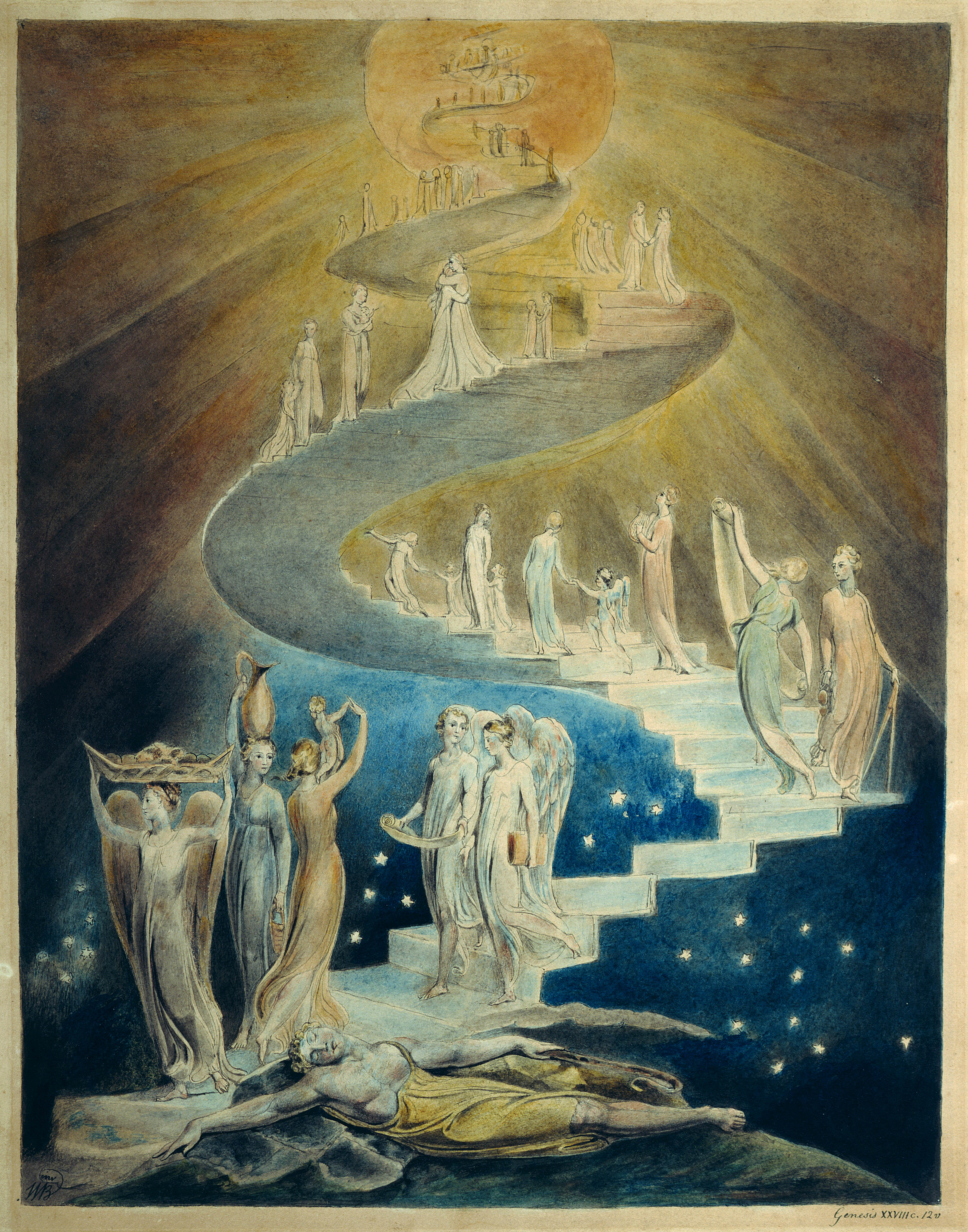
Becoming a disciple of Jesus, this story seems to say, happens when we see him as the one who sees us, as we really are.  And, as I said, the person who can do that has given us the gift of our lives.  But in the story Jesus also promises Nathanael that he will see something even greater.  He makes one more reference to the Hebrew Bible, to the legend of Jacob’s who fell asleep on a journey and dreamed of a ladder on the earth reaching to heaven and angels coming and going on it.  And he woke up and said, “Surely the Lord is in this place and I did not know it.  How awesome is this place!  This is the gate of heaven.”  And he set up an altar there and called it Bethel, the house of God.        

The call to follow Jesus starts out innocuously enough—someone says “come and see.”  And if we go and see, we soon find out that we are being seen.  We see that we are naked, with nothing on but some fig leaves.  But we also start to see a vision of the person we are truly called to be, who we are when we are not afraid, when we want for nothing, but are at peace.  We begin to recognize the one who sees that person more clearly than we do ourselves, and to trust his vision more than our own.   

As that trust grows in us, a light of hope is kindled in our hearts, the hope of seeing something even greater.  We begin to sense that we are standing on holy ground.  We begin to glimpse a vision not only of ourselves but of the whole world as it is seen through the eyes of Jesus.  We begin to understand that this very place is the house of God, and gate of heaven.  And this vision, and this hope, gives us a new calling, one that unites all our individual vocations in the calling of the church.   It has two, interdependent parts. The first is worship.  And the second is to show the whole world where we really are.    

Thursday, November 13, 2014

A Vision for St. John's


First published in The Beloved Disciple, the monthly newsletter of St. John's Episcopal Church, Petaluma: http://www.saintjohnsepiscopalpetaluma.org/page/newsletter

People sometimes ask me what my vision is for St. John’s.  It’s been a hard question to answer because a vision takes time to develop, and time to communicate.  It is not a plan of action, but a description of where we hope our actions will take us.  It isn’t about what we will do so much as about who we will be.  As priest and pastor, it is part of my job do articulate a vision, but it can’t be just something I think up on my own—it has to be something I listen for, in what others are saying, in my own heart, and in the conversations between us.  During the four years I’ve been here we’ve had a lot of conversations about what matters most, and what we hope we are becoming.  I have tried to listen carefully to what’s been said.  And during this year’s season of discernment, I’ve made time for conversations with trusted friends about what I’ve learned and what inspires me to want to make a new commitment to the work of this congregation.  I’ve also done some listening to what is being said in the wider Episcopal Church about its challenges and opportunities for the future.
What follows is the fruit of these conversations.  It is a personal statement, and I don’t claim to speak for everyone at St. John’s.  But I offer it to you in the hope that some part or parts of it will speak to you, and illuminate your vision for the parish. 

St. John’s is a place where people are drawn by the love of God, called to seek the divine image in themselves and one another; uniting in praise and thanksgiving at Christ’s table, in contemplation and discernment, and in active works of wisdom, justice, beauty, and truth, we share here on earth in the joys of heaven.  It is a place from which each of us is sent to find the unique vocation that grows from our responsibilities and gifts, and to play our part in the mission of Christ to the world.  We are a circle from which no one who is not a danger to others is excluded, in which every voice is heard, and every truth respected, where no one is above criticism, and no one is beyond hope.
We foster a religious culture devoted to the maturation of our spiritual gifts and the satisfaction of our deepest needs by the grace of God—through taking creative risks, telling the truth, making repentance, seeking reconciliation, and empowering one another for servant-leadership in the world.  We take nourishment from the testimony of the Hebrew prophets and sages and the Apostolic communities; from the teaching and example of holy women and men of the past and present; from the riches of Christian tradition in music and the arts, mysticism, theology, and social action; from our membership in a worldwide communion of Anglican brothers and sisters, and the ecumenical body of Christ; from the rhythms of the hours and the church year, and the sacramental elements of grace.  
We are a place for joyous worship, with strong participation by people of all ages, representing the cultural diversity of our community, and bringing the talents of many leaders together in stirring, centering, prayerful, and purposeful celebrations of the Holy Spirit.  We are a learning community practicing the arts of peace—compassionate dialogue, open inquiry, and courageous discipleship.  We seek personal encounter across social, political, and religious barriers, in the shared pursuit of mutual understanding and the common good.  We offer space for a deeper and kindlier look at the world in which we live, where simplicity and faith allow us to hear the voice of the earth, of our bodies, and of the heart, and to take reverent and practical steps to restore the balance of the world.
We are wise and loving stewards of the goods we receive, cherishing the past and preparing for the future without illusions about either, but placing our trust in God’s covenant faithfulness, the truth of the Gospel, and the resilience of creation.

About Me

My photo
Petaluma, California, United States
I am a priest in the Episcopal Church, and have been (among other things) an organic farmer and gardener, and a Zen monk. I have a lifelong interest in social and spiritual renewal on the basis of contemplative discipline, creative nonviolence, and ecological practice. In recent years my work has focused intensely on the responsibility of pastoral ministry in the humanistic, evangelical, and catholic branch of Christianity known as Anglicanism. I'm married with a daughter, and have three brothers and two parents.