Showing posts with label nature. Show all posts

Tuesday, May 19, 2015

Particular people, particular places


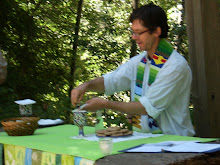
Yesterday afternoon at four, eight human beings and one small dog set out from the front door of St. John’s to make a procession through the streets of Petaluma.  Chanting litanies and canticles and psalms, we walked to the community garden between the Cavanaugh Rec Center and the ball fields at McNear Park, where we read scriptures and said prayers and sang hymns and chants, and made a sacred circle dance, to bless the garden and the people who tend it.  This is our second year doing this, reviving a Christian tradition that goes back to the fifth century, of going out of the church at this time of the year and processing around the neighborhood to pray for its health and well-being, and especially, for temperate weather, and the fertility of the earth, and an abundant harvest.  
To be honest, a month or so ago I had decided that, as much as I enjoyed last year’s event, and would like to repeat it, I just had too much on my plate.  But that was before Francis Frazier came to talk to me about the Community Resilience Challenge.  This is a grassroots campaign that’s been going on this spring, with the majority of events happening this weekend.  It aims to inspire thousands of Sonoma County citizens and groups to take actions to save water, grow food, conserve energy, reduce waste and build community.  And as Frances and I talked about how our church might participate in this effort, it became clear that the Rogation Procession and blessing of the community garden was the very thing to fit the bill.   But not only did we decide to repeat last year’s event—we expanded on it.  To generate more goodwill and participation from the community, Frances got her son Miguel to truck his handmade mobile wood-fired oven onto the community garden site, and we invited the gardeners to join us after the blessing ceremony for a potluck pizza party, courtesy of St. John’s Episcopal Church.
It was my job to plan the liturgy, and as I went to work on it I ran into a familiar problem, the problem of how to pray and worship in public as a Christian.  The Bible, the Prayer Book, and the hymnals of the church give us a wealth of beautiful material for a service like this.  We have litanies and psalms, canticles and parables that beautifully express a sacred vision of the wholeness of the world.  In texts that blend images of wild nature, human husbandry, and the realm of the divine, they speak profoundly of our faith in the goodness of creation, our gratitude for God’s merciful providence, and our desire to be restored to unity with all.   But this language is unmistakably religious—Biblical and Christian. 
And when I imagined our neighbors at the McNear Community Garden, and the sort of people who would feel drawn to participate in the Community Resilience Challenge, I worried that this language might offend.  It turns out I worried about it too much.  There was only one person who was not a member of our congregation who came to the church for the procession.  There were only a couple more who joined us for the ritual at the garden, and if our Christian prayers made them uncomfortable, they were too polite to say.  There were a few folks working in the garden when we got there, and they kept a respectful distance while we did our religious thing.  But when the prayers were over they came and joined us, and others arrived in force.  And it was then, in breaking handmade wood-fired gluten-free pizza crust together, that we found a joyful common ground.
It turns out our neighbors could take care of themselves.  They did not take part in our religious activity, and so our religious language could not offend them.  And yet they seemed genuinely glad that we had come.  Our singing, in particular, came in for several appreciative comments.  One fellow, who had continued preparing his beds all the while our ritual was going on, came up to me after it was over, and I’d already removed my vestments, and asked if I would bless his seed potatoes before he covered them with soil.  So I grabbed my holy water and started sprinkling, while speaking an impromptu, non-sectarian potato-blessing prayer.
Yesterday’s experience got me to wondering about why it is I feel I have to be so careful about other people’s feelings when it comes to practicing my religion.  If you think about it, if we had been a group of Buddhist monks or Native American elders who had come to the community garden to bless the site and what goes on there, our neighbors might have regarded us with curiosity, or thought we were kind of quaint,  or mysterious.  But they also would have felt tickled, and maybe a little honored, that this exotic little tribe thought enough of what they are doing in that place to come and perform their traditional ceremony. 
But then again, it is no secret that ours is not just one religion alongside other religions.  Our Bible states that clearly again and again, and there are plenty of our fellow Christians who keep demanding, even in this secular, multi-cultural and pluralistic age, that nobody forget it.  And for some of us that’s an embarrassment.  We want to be liked.  We just want everyone to get along.  We think of ourselves as the good guys, and don’t care to be tarred with the brush of the conquistadors and witch-burners, the religious bigots and theocrats and fundamentalists.
The Bible does say that God is one, is universal.  But it also says that the great creator of all the worlds has a particular purpose for this one.  And in order to bring about that purpose, God intervenes in this world in particular places and times. God speaks and acts through particular persons, a particular family, one particular nation.  And so the Bible give us, not myths about divine beings, but human stories—the stories of Adam and Eve, Abraham and Sarah, Moses and Miriam, David and Bathsheba.  It give us the words of the prophets, who speak to specific events in the economic, political, and military fortunes of Israel, as moments of decisive importance to God.  And this strange way of thinking about how God relates to the world is, of course, what gets us to what the New Testament says about Jesus.
As Christians we say that Jesus is the particular and personal revelation of who God really is, how God really acts.  But our circumstances today force us to ask whether this necessarily excludes the possibility that God acts in other places, in other persons, in other true and noble paths to the higher kind of human life.  And what we are coming to is that what other people think and believe is not really any of our business.  If they are redeemed by Christ, as we believe, it would hardly do to force that redemption upon them in a way that does violence to their cultures and their consciences.  It would not be consistent with the teaching and example of him who said “The one who would be great among you must be last of all and servant of all, for the Son of Man came not to be served but to serve and to give his life as a ransom for many.”
We say that Christ is ascended into heaven, and he is the universal Lord.  But his Lordship is hidden in God.  How he exercises it, and in what way it is universal, is beyond us.  It is not like the rule of the powers of this world.  All we are responsible for is the particular calling that the man Jesus of Nazareth has on our lives.  And that is something we cannot respond to in general terms.  Christ calls us to be faithful as unique persons with our own families and histories and gifts: in this particular community where we encounter him in word and sacrament; in the context of the particular place that we, as Episcopalian Christians, occupy in the cultural, political, and religious landscape of Petaluma, California in the year of Our Lord 2 Thousand Fifteen.
And that means practicing our religion without the consolation of being approved of by our neighbors.  It means letting go even of the satisfaction of damning them for all eternity if they don’t.  It means letting go of any expectation that they will join us, but seeking common ground with them even as we remain rooted in our own particular calling, knowing that if there is any trace of coercion or manipulation in the way that we relate to them, they will sniff it out and shun us like the plague.  It means going into the world as Jesus prayed we would, as those who don’t belong to the world, but who seek the world’s salvation that can only come from God.  
It’s a demanding dance, so Jesus does two things for us before he goes up to heaven.  Today’s gospel lesson tells us that he makes a prayer, a prayer that we will be protected from the Evil One, who is always trying to turn our dance with the world into a war.  And he makes a promise, a promise to send us the Holy Spirit to teach us the steps of the dance.
He makes a promise  


Sunday, November 9, 2014

Coming home


This gospel lesson, often called The Beatitudes, is one of the best known and most beloved passages of the Bible. I have heard it, and read it, and even preached on it many times.  So I was surprised to be pondering it again recently and to find myself thinking about it in a way I never had before. 

Maybe it’s the formal way that the narrator sets the scene, with Jesus going up the mountain and sitting down and then calling his disciples to him and beginning to teach.  Maybe it’s because the teaching itself is quite formal in structure, with its repetitive phrases.  In any case, I had always thought of the Beatitudes as like a kind of official pronouncement.  Jesus is the authoritative teacher for Christians, after all, and so, when you put that together with this formality, I guess it’s only natural to assume that what is being given here is a set of prescriptions—policies, rules.  Biblical scholars will often make the comparison between the depiction of Jesus in this scene and Moses, who went up on a mountain and came down with a set of rules for his community to live by.

The problem with this interpretation is that the Beatitudes aren’t rules.  They don’t exactly tell you what to do.  They aren’t even really promises of what will happen in the future if you do these things.  The Beatitudes are statements about the present, about what God is doing now.  And what is God doing?  God is blessing people.  God is blessing you.

Now when we say that someone is blessed what we usually mean is that they are fortunate:  “So-and-so is blessed with a large, loving family,” we’ll say, or we’ll hear about a big blizzard slamming the Midwest we will say, “Aren’t we blessed to live in California.”  But the blessings that Jesus is talking about here aren’t like that.  For the most part they don’t have anything to do with what life looks like from the outside.  These are blessings that are experienced and received inside, in the heart and in the mind. 

And it is this inner quality of the Beatitudes that recently struck me with a new forcefulness and gave me the idea that they are not an impersonal teaching about objective laws or principles—far from it.  What they really are is Jesus’ personal testimony to his own religious experience.  This is the most detailed exposition we have in Jesus’ own words of his own mind.  Because he experienced all these things for himself.  Jesus was poor in spirit.  Jesus was meek.  He mourned, and he was merciful.  He hungered and thirsted for righteousness, and he made peace.  He purified his heart, and he was reviled and persecuted.

And he was blessed.  He entered the kingdom of God.  He was comforted, and his emptiness was filled.  He received mercy, and heard that he was God’s beloved child.  He looked about him at the earth and saw that it all belonged to him.  He saw God.  And on the basis of these experiences he could sit down with his disciples and say to them with absolute conviction that they could experience these things, too.  They also could know themselves as beloved children of this God whose only desire is to bless them, to fill them with such love for one another and for Himself that no sorrow, no misfortune or calamity, no hatred and oppression by misguided human beings could remove that blessing from their lives.

I like this way of thinking about the Beatitudes because it encourages us to take our own religious experiences seriously.  We have all had them, those moments when we feel the touch of divine grace.  This week I’ve been remembering a crisp fall morning almost thirty years ago.  I was living in an intentional spiritual community in the hills of Western Massachusetts and some of us had gone into the forest that day to cut firewood.  The leaves had fallen from the trees and made a yellow carpet on the ground that crunched under our feet, but apart from that we were working silently, carrying logs out of the woods and piling them by the road for sawing.  And I stopped what I was doing for a moment to stand in contemplation of the delicate branching form of a wild hazel shrub, its lustrous silver bark reflecting the pale morning sun, and in that moment I saw, and I knew.

We have these experiences, and even if it is only once in a lifetime, they stand out of the ordinary run of our days like mountains soaring up out of the plain.  They occur without warning and last for a few seconds, or a minute, or a day, but they change us forever.  They give us only vanishing glimpses, but while we are in them we know that the reality they show us is more real than what we ordinarily take for granted as real life in the real world.  That contrast, between the blessedness we are shown in such moments, and the world of anxiety, meaninglessness, and pretense that we usually inhabit, is like a wound.  It can make us feel like exiles, looking to all outside appearances as if we belong here, but feeling inside that our true home is somewhere else.

This is painful, and we human beings tend to do whatever we can to avoid pain.  We anesthetize ourselves with drugs, and distract ourselves with entertainments.  We go shopping, and fill our closets and garages storage lockers with things we don’t need.  We have built a whole world system around numbing and denying the pain of knowing who we really are and who we really belong to, but it is a system riddled with violence.  It is fueled with poison.  Its pillars are injustice and cruelty, because it is founded on a lie.

But what Jesus says in the Beatitudes is that it is time to come home.  Because the shame of admitting that we are poor in spirit, and have squandered the precious gifts of grace we have received, is so much less than the suffering of keeping up the pretense that we have no need for God.  And the grief that comes from acknowledging that we are lost is so much less than the sorrow of plodding endlessly onward with a phony smile plastered across our teeth.  The cost of opening our eyes to the hypocrisy and injustice of the established order and of longing with burning hearts for equity is far less than the life-sentence of walling ourselves off in ghettos of privilege and imagining that we are free.

The saints of God are those who have heard the summons of Jesus and are determined to follow him home.  Not by seeking to fly away to a better place, but by committing themselves to finding the real world, the world created and blessed by God, right here.  I wish I could tell you that making that commitment would guarantee you more and better religious experiences.  Many of our contemporaries seem to think that this is the whole purpose of the spiritual journey.  And the tradition of Christian spirituality does allow a place for such experiences—it calls them “consolations,” and it consistently teaches not to pursue them. 

God gives them as she chooses, for her own purposes, and her ultimate purpose for us is not emotional gratification, or even individual personal transformation.  It is the perfect blessedness of uniting with all earthly and heavenly creatures in a new creation, the paradise of God.  This ultimate blessedness realizes the potential all the religious experiences of humankind, but it comes about through acts of faith in the truth of those experiences. This is a joint venture of all Godly souls, past, present, and yet to come.  What each one of us lacks in the gifts of grace, God supplies in the others, and by “the others” I mean all the others, most of whom live on the other side of the globe, in the distant past, or far in the future.  And yet each of us present in this place today has gifts, and the success of the whole enterprise comes closer when we are faithful stewards and generous donors of what we have been given. 

That is why it is such an occasion of joy when we baptize new members into this communion of saints, as we are doing at this service for Megan Klarkowski and her little girl, Elsa.  We rejoice because, in following Jesus’ voice, they are setting their feet on the way that leads home.  And we rejoice that they are adding their unique and precious gifts to the treasures that Jesus takes and blesses, and breaks and gives, for our nourishment along the road.

Tuesday, February 7, 2012

Outside religion


One of the things I hear a lot in my profession is some version of the statement: “I don’t come to church because I experience God in nature.”  And I’m not the only one who hears this--I was at an interfaith gathering of clergy recently, and one of the participants was talking about a prospective new member of her congregation, one of those most rare and highly prized of creatures, a young male who comes to church.  She told us that during a recent conversation with him he’d been explaining his resistance to getting more involved and used the “I find God in nature” line—in this case while scuba diving.  There was an outburst of groans and shaking of heads around the circle.  “How unique!” cried out another pastor sarcastically, “I’ve never heard that before.”
I knew how she felt, but I also wondered to myself if there might be some better way to respond.  Because the truth is, nature is a good place to find God.  Many of my own most profound experiences of holiness have come outside; outside the artificially-lit, socially-constructed human world.  Haven’t we all had our moments of awe at the beauty and intricacy of the wild creatures, the round of the seasons, the grandeur of the mountains, the sea, or the sky?  Haven’t they spoken to us of a greater wholeness, a majestic presence to which we are in some way related?  So why belittle those who testify to the power of such experiences to move them to reverence?  It seems to me that as religious men and women in a secular age we ought to be celebrating transcendence wherever it shows up in people’s lives.  In a time when the human race casts a long shadow over the future of the earth, we ought to be affirming the sacred meaning and value of our connection with nature.
And if we feel that such moments of solitary communion do not make for a complete religion, we ought to be able to do better than to just get grumpy.  We ought to be able to begin a conversation on the common ground of our own experiences of finding God outside. Maybe we could ask people to tell us what those moments have taught them and how they inform the way they live every day.  Maybe we could give an account of what we have learned from them, and how they fit into a larger pattern of religious faith and ethics and practice.  It may not always work, but it seems worth a try.
Because I have a hunch that even the most confirmed nature mystic has found from time to time that right at the heart of the experience of the magnificent sunset or the thundering waterfall is a uniquely sharp kind of loneliness.  In part it is the loneliness of realizing that there is no way to communicate the experience to others.  Any words you could say, or picture you could draw, or photograph you could take would be inadequate to convey what you perceived at that moment, even to a lover or an intimate friend.  And there is also the loneliness of realizing how out of accord our everyday lives are with the harmonious and sacred order of God’s creation.  We come back from that day-hike or that vacation in peaceful natural surroundings and find ourselves in the midst of noise, waste, haste, confusion, competition, and struggle.     
You don’t have to have an overly romantic and idealized view of nature, or an overly jaded view of human society to recognize that things are failing to connect up in some very important ways.  And that is one way of explaining what biblical religion is about.   Because the bible is very clear that the God who orders heaven and earth in beauty and harmony, and the God who acts in history to liberate, to redeem and restore humanity are the same God. 
That is what the passage we read from Isaiah today is arguing.  “Have you not known?” the prophet says, “Have you not heard?”  It is God “who stretches out the heavens like a curtain, and spreads them like a tent to live in.”  It is God “who brings princes to naught, and makes the rulers of the earth as nothing.”  It is God who numbers the stars and calls them by name, and it is God who gives “power to the faint, and strengthens the powerless.” God is the creator and sustainer of humankind and does so along with, and through, the goodness of the natural order, which testifies to his wisdom and power.
If human society does not reflect the harmony of God’s creation, if the goods of the earth are not shared equally but are hoarded by some and denied to others, if carelessness and greed are making a world that is violent and ugly, toxic to life and menacing to the future, it can only be in the spirit of rebellion against God.  The harsh language of the bible that is so distasteful to our contemporary ears, and leads so many people to dismiss it as the work of weird fanatics, comes out of grief, horror, and anger at that rebellion and the destruction it has caused.  The bible does not let us rest easy about the consequences of a life out of harmony with God’s work and God’s will.  But it never despairs.  It never loses faith in God’s purpose for us, the purpose that was there at the beginning.  And it never loses hope that God is able, that God is active, that God is sending another spirit to heal the spirit of rebellion in our souls and recreate us, a spirit of truth, of wisdom, of holiness and peace.
The New Testament is the good news about that Spirit, as it breaks forth into the human world in the person of Jesus Christ.  We have been reading in the Gospel of Mark about the first day of his public ministry.   It was a Sabbath day, the day of the completion of creation, and he began it at the synagogue, teaching with authority and casting out an unclean spirit.  In the Jewish reckoning of time the day ends at sundown, and immediately when the Sabbath is over the residents of Capernaum go to work, bringing the sick and the demon-haunted to Jesus to be healed. 
We don’t learn when he finally goes to sleep, but he is up again in the darkness long before dawn.  He goes out alone to a deserted place, where we can imagine him standing and gazing up into the heavens and drinking in the immensity of the universe.  We can imagine him listening to the silent music of the stars and feeling his whole being vibrate with the same song.  We can imagine his heart uniting with them in joy and praise and love for the creator of all this wondrous beauty.  And in this moment he renews his will to go out and to preach to as many people as he possibly can that the same creator is coming now to act in their lives.   He knows himself again full of the Spirit of the one he loves as Father, and he steels his resolve to confront the spirit that condemns and excludes and dominates, that fears and hates, wherever it may be at work.
In Jesus we see that the solitary encounter with God in nature has the purpose of sending us back to the human community, to find God there.  That is where our real work is.  It is there that the language of religious tradition helps us make meaning of our private moments of religious experience (which are, after all, only moments).  Religious practice extends the influence of these experiences into the choices we make and the actions we take day after day after day.    The common ground of scripture, of liturgy, of applied ethics and mutual concern, gives us a starting point for community.  It gives us a place to stand together, and a place to hold each other accountable for what it is we claim to have learned about God when we went scuba diving, or backpacking, or made that spiritual retreat.  In place of a lonely epiphany that cannot be communicated, religion gives us the proclamation of the Gospel, the shared experience of God’s love for us all.

About Me

My photo
Petaluma, California, United States
I am a priest in the Episcopal Church, and have been (among other things) an organic farmer and gardener, and a Zen monk. I have a lifelong interest in social and spiritual renewal on the basis of contemplative discipline, creative nonviolence, and ecological practice. In recent years my work has focused intensely on the responsibility of pastoral ministry in the humanistic, evangelical, and catholic branch of Christianity known as Anglicanism. I'm married with a daughter, and have three brothers and two parents.