Showing posts with label neighbors. Show all posts

Tuesday, May 19, 2015

Particular people, particular places


Yesterday afternoon at four, eight human beings and one small dog set out from the front door of St. John’s to make a procession through the streets of Petaluma.  Chanting litanies and canticles and psalms, we walked to the community garden between the Cavanaugh Rec Center and the ball fields at McNear Park, where we read scriptures and said prayers and sang hymns and chants, and made a sacred circle dance, to bless the garden and the people who tend it.  This is our second year doing this, reviving a Christian tradition that goes back to the fifth century, of going out of the church at this time of the year and processing around the neighborhood to pray for its health and well-being, and especially, for temperate weather, and the fertility of the earth, and an abundant harvest.  
To be honest, a month or so ago I had decided that, as much as I enjoyed last year’s event, and would like to repeat it, I just had too much on my plate.  But that was before Francis Frazier came to talk to me about the Community Resilience Challenge.  This is a grassroots campaign that’s been going on this spring, with the majority of events happening this weekend.  It aims to inspire thousands of Sonoma County citizens and groups to take actions to save water, grow food, conserve energy, reduce waste and build community.  And as Frances and I talked about how our church might participate in this effort, it became clear that the Rogation Procession and blessing of the community garden was the very thing to fit the bill.   But not only did we decide to repeat last year’s event—we expanded on it.  To generate more goodwill and participation from the community, Frances got her son Miguel to truck his handmade mobile wood-fired oven onto the community garden site, and we invited the gardeners to join us after the blessing ceremony for a potluck pizza party, courtesy of St. John’s Episcopal Church.
It was my job to plan the liturgy, and as I went to work on it I ran into a familiar problem, the problem of how to pray and worship in public as a Christian.  The Bible, the Prayer Book, and the hymnals of the church give us a wealth of beautiful material for a service like this.  We have litanies and psalms, canticles and parables that beautifully express a sacred vision of the wholeness of the world.  In texts that blend images of wild nature, human husbandry, and the realm of the divine, they speak profoundly of our faith in the goodness of creation, our gratitude for God’s merciful providence, and our desire to be restored to unity with all.   But this language is unmistakably religious—Biblical and Christian. 
And when I imagined our neighbors at the McNear Community Garden, and the sort of people who would feel drawn to participate in the Community Resilience Challenge, I worried that this language might offend.  It turns out I worried about it too much.  There was only one person who was not a member of our congregation who came to the church for the procession.  There were only a couple more who joined us for the ritual at the garden, and if our Christian prayers made them uncomfortable, they were too polite to say.  There were a few folks working in the garden when we got there, and they kept a respectful distance while we did our religious thing.  But when the prayers were over they came and joined us, and others arrived in force.  And it was then, in breaking handmade wood-fired gluten-free pizza crust together, that we found a joyful common ground.
It turns out our neighbors could take care of themselves.  They did not take part in our religious activity, and so our religious language could not offend them.  And yet they seemed genuinely glad that we had come.  Our singing, in particular, came in for several appreciative comments.  One fellow, who had continued preparing his beds all the while our ritual was going on, came up to me after it was over, and I’d already removed my vestments, and asked if I would bless his seed potatoes before he covered them with soil.  So I grabbed my holy water and started sprinkling, while speaking an impromptu, non-sectarian potato-blessing prayer.
Yesterday’s experience got me to wondering about why it is I feel I have to be so careful about other people’s feelings when it comes to practicing my religion.  If you think about it, if we had been a group of Buddhist monks or Native American elders who had come to the community garden to bless the site and what goes on there, our neighbors might have regarded us with curiosity, or thought we were kind of quaint,  or mysterious.  But they also would have felt tickled, and maybe a little honored, that this exotic little tribe thought enough of what they are doing in that place to come and perform their traditional ceremony. 
But then again, it is no secret that ours is not just one religion alongside other religions.  Our Bible states that clearly again and again, and there are plenty of our fellow Christians who keep demanding, even in this secular, multi-cultural and pluralistic age, that nobody forget it.  And for some of us that’s an embarrassment.  We want to be liked.  We just want everyone to get along.  We think of ourselves as the good guys, and don’t care to be tarred with the brush of the conquistadors and witch-burners, the religious bigots and theocrats and fundamentalists.
The Bible does say that God is one, is universal.  But it also says that the great creator of all the worlds has a particular purpose for this one.  And in order to bring about that purpose, God intervenes in this world in particular places and times. God speaks and acts through particular persons, a particular family, one particular nation.  And so the Bible give us, not myths about divine beings, but human stories—the stories of Adam and Eve, Abraham and Sarah, Moses and Miriam, David and Bathsheba.  It give us the words of the prophets, who speak to specific events in the economic, political, and military fortunes of Israel, as moments of decisive importance to God.  And this strange way of thinking about how God relates to the world is, of course, what gets us to what the New Testament says about Jesus.
As Christians we say that Jesus is the particular and personal revelation of who God really is, how God really acts.  But our circumstances today force us to ask whether this necessarily excludes the possibility that God acts in other places, in other persons, in other true and noble paths to the higher kind of human life.  And what we are coming to is that what other people think and believe is not really any of our business.  If they are redeemed by Christ, as we believe, it would hardly do to force that redemption upon them in a way that does violence to their cultures and their consciences.  It would not be consistent with the teaching and example of him who said “The one who would be great among you must be last of all and servant of all, for the Son of Man came not to be served but to serve and to give his life as a ransom for many.”
We say that Christ is ascended into heaven, and he is the universal Lord.  But his Lordship is hidden in God.  How he exercises it, and in what way it is universal, is beyond us.  It is not like the rule of the powers of this world.  All we are responsible for is the particular calling that the man Jesus of Nazareth has on our lives.  And that is something we cannot respond to in general terms.  Christ calls us to be faithful as unique persons with our own families and histories and gifts: in this particular community where we encounter him in word and sacrament; in the context of the particular place that we, as Episcopalian Christians, occupy in the cultural, political, and religious landscape of Petaluma, California in the year of Our Lord 2 Thousand Fifteen.
And that means practicing our religion without the consolation of being approved of by our neighbors.  It means letting go even of the satisfaction of damning them for all eternity if they don’t.  It means letting go of any expectation that they will join us, but seeking common ground with them even as we remain rooted in our own particular calling, knowing that if there is any trace of coercion or manipulation in the way that we relate to them, they will sniff it out and shun us like the plague.  It means going into the world as Jesus prayed we would, as those who don’t belong to the world, but who seek the world’s salvation that can only come from God.  
It’s a demanding dance, so Jesus does two things for us before he goes up to heaven.  Today’s gospel lesson tells us that he makes a prayer, a prayer that we will be protected from the Evil One, who is always trying to turn our dance with the world into a war.  And he makes a promise, a promise to send us the Holy Spirit to teach us the steps of the dance.
He makes a promise  


Sunday, June 29, 2014

The name of a disciple


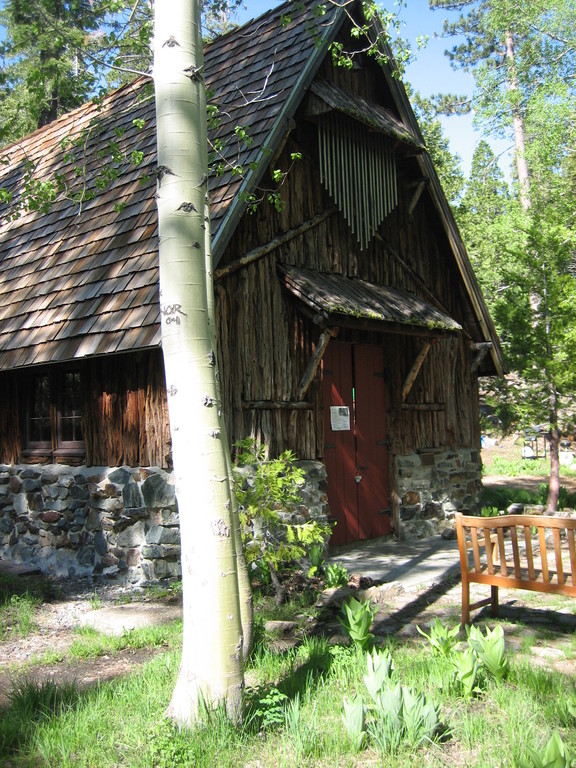
The last couple of Sundays I conducted church services at a rustic little summer chapel in the mountains near Lake Tahoe.   The attendance at the services was small, about 25 or 30 at the 10 o’clock, and the congregations were made up of summer visitors many of whom were there for just that week.  Part of the informal spirit of the place is that a few minutes before each service I would stand up in front and ask if anyone would like to volunteer to read a scripture lesson or serve the chalice for communion.  The readings I could handle by myself, in a pinch, but I really did need to have a helper with the chalice.  So if nobody stepped forward the first time, I’d have to ask again, and emphasize that “on-the-job training” was available.
So both Sundays it happened that I had a chalice bearer who had never done it before, and, because there was no time before the service to provide even the most rudimentary instruction, I would just tell them to come up after the Lord’s Prayer and the breaking of the bread, and I would show them what to do.  Which I did, in plain sight of the congregation, and they caught on right away, and did a perfectly fine job.  One Sunday it was a rugged but kindly white-haired gentleman in a windbreaker who looked like he was going to set out on a fishing trip right after the service, and the next week it was a slender, refined lady with close-cropped blond hair and modest but elegant jewelry in a flower-print summer dress.  In both cases they seemed genuinely moved by the experience, and afterward thanked me for the opportunity to serve.
I wasn’t around here then, but I gather that there was a time in the not-so-distant past of this congregation when worship services had a little bit of the ad hoc quality of that chapel in the mountains.  It wasn’t always clear who would be showing up, so a newcomer, especially if he or she arrived a few minutes early, might be recruited to read a lesson, or help pass out bulletins, or something.  And a similar kind of thing took place recently, when we put on our Big Night Out fundraising gala.  We turned to friends and friends of friends, and even strangers, and we asked them to get involved with us, to make donations and purchase tickets, to help raise funds to renovate and restore our historic church building.
And I wonder if this asking for and accepting help from strangers isn’t fundamental to the mission of the gospel, and the character of the church.  Certainly the early Christian communities of the Gospels felt it was important to hand down the traditions about Jesus’  commission to his disciples, when he sent them out on the back roads of Galilee, carrying no purse, no bag, no staff, and no change of clothes.  And as we read in Matthew today, he instructed them that when they met a stranger, it was an opportunity for that stranger to receive a priceless reward.  Every encounter they had along the way was an invitation to the ones they met to become a part of something uniquely important, and meaningful, and life-changing.   And the way to extend that extraordinary offer, said Jesus, was to invite the stranger to supply an ordinary need.    
This is a reversal of the way the church likes to think about its mission.  We would prefer to be God’s chosen vessels of grace, the ones who go out and do good for the world.  Out of our great store of virtue and wisdom we supply others with the healing, the knowledge, the forgiveness and redemption that they lack.  How odd, then, is this remembrance that Jesus sent his disciples out to make the Kingdom of God immanently available by being hot and thirsty, and accepting a cup of cool water from a stranger on the road.  Could it be that God communicates the good news of salvation to the world, not through the power, and patronage, and mastery of Christians, but through their vulnerability, and humility, and need?
This certainly puts the mission of the church into a different light.  Most of you may not think of yourselves as missionaries, or of St. John’s as being engaged in missionary activity.  But throughout and around the church in recent years, the realization has been growing that without an active impulse to reach out and connect to strangers, with a story and an invitation, the church is in danger of losing itself.  Not only because of institutional shrinkage and decline, although that’s been happening, but more importantly because of the loss of something that is at the very heart of what it means to follow Jesus Christ. 

Now, I want to say that if you are resistant to the idea that you are meant to be a missionary, and if you think that you want no part of a congregation that is self-consciously engaged in a missionary enterprise, you probably have every good reason for feeling that way.   Because when we imagine the scenarios that these words suggest, we start thinking about the kind of Christian mission that has not undergone the reversal that Jesus asks his disciples to make.  We hear talk about “mission” and we think it means adding more work to our “to-do” list.   We think it means going out and promoting ourselves, selling people on our brand of religion, persuading them that we have something to offer them that is superior to what they might get from the Unitarians, the Buddhists, or the Calvary Bible Fellowship, something that’s even better than sleeping in and reading the Sunday paper at the kitchen table in your bathrobe.  And if that’s what it means to be engaged in mission, I’m with you—no thank you very much.
But what if our Christian mission today were the continuation of the journey that Jesus sent his disciples out to make, before there was a church institution to worry about, or rival denominational bodies, or even a book called the Bible?  What if its essence were to be humanly, physically present to others, as a stranger seeking friendship with strangers?  And what if the point of connection, the field of communication and invitation, were nothing other than our own authentic needs, both our deepest spiritual hunger and our ordinary physical thirst?   What if our mission to our neighbors was not to supply them with what we have that they lack, but to call out of them gifts that they didn’t know they had because no one ever asked for them before?
 It is an intriguing possibility to consider, because it makes mission an encounter at the level of equality, and places at the center of it the common human questions about what we really need.  And yet we also have to recognize that this honesty about our needs is not a license to puff up for ourselves an over-blown sense of unworthiness, or to wear a lovingly-polished humility as a badge of pride.  Because Jesus does not send his missionaries out to beg.  They are almost empty-handed, but they do carry one thing with them, one thing that gives them the confidence and the authority to engage the world in a conversation it scarcely knew it needed to have.  They carry, says the Gospel of Matthew, a name, the name of “disciple.”
It is a name that means “one who follows a teacher.”  And this is the testimony that I think even we reticent and reserved Episcopalians are called upon to give, if we are to be the missionaries that all Christians are meant, in some sense, to be.   Not testimony that we are “saved.”   Not that Jesus helped us kick the habit, or got us out of debt.  Not that we have some special spiritual gift, or esoteric knowledge, or infallible doctrine.  Not that we are holier, or wiser, or kinder, or more wretched and penitent, than anybody else.  
But just the testimony that we are disciples, people who want to be a part of the community that throughout the ages and all over the world seeks to understand Jesus’ teachings, and apply them, to follow his example, and celebrate his sacraments, and have faith in his promises.  And also testimony that this is the way we have found that seems to speak to our souls’ most pressing needs.  Oh—and one more thing!...We could sure use your help.

About Me

My photo
Petaluma, California, United States
I am a priest in the Episcopal Church, and have been (among other things) an organic farmer and gardener, and a Zen monk. I have a lifelong interest in social and spiritual renewal on the basis of contemplative discipline, creative nonviolence, and ecological practice. In recent years my work has focused intensely on the responsibility of pastoral ministry in the humanistic, evangelical, and catholic branch of Christianity known as Anglicanism. I'm married with a daughter, and have three brothers and two parents.