Showing posts with label Jeremiah. Show all posts

Sunday, November 13, 2016

Mercy and Truth


From time to time, one of my sermons makes someone mad.  As you might expect, it happens when I wade into the troubled waters of race relations, or climate change, or some such hot-button topic taken from the headlines.  And it’s not like I don’t know that I’m stirring the pot.  I labor over those sermons more than the others, and often have a hard time sleeping the night before I give them.  To the extent that the issue has been politicized, I try not to take sides.  My intention is to find in the scriptures a perspective that reveals a spiritual dimension to the real problems of the world.  But even as I do this I have to deal with the limits of my experience, and my own inherent biases, some of which are firm convictions, and some of which are assumptions of which I am not even conscious.   So there’s always the danger that the perspective I present as “biblical” and “spiritual” truth is really just a clever way to justify my own opinion. 
And other people have their inherent biases, and limited experience, their passionate convictions, and unconscious assumptions, as well.  So I am not surprised when someone takes offense, but when it actually happens it is always painful.  It reminds me that, among the world’s many problems, none is greater than our human inability to see them in the same way.  Maybe I’d be on firmer ground if I stuck to questions of personal faith and morality, and the work of spiritual growth, to talking about salvation, and Jesus, and heaven, and God.  These are the common interests, after all, of almost everyone who comes to church—including me.   But, then, I come to church with a responsibility that other people don’t.  I’m supposed to preach, and I’m accountable in what I say, not just to what I think is important, or what I imagine you want to hear; I’m accountable to God as God is revealed in the Bible. 
This is a responsibility I took on at the time of my ordination, when I made a solemn public declaration that I “believe the Holy Scriptures of the Old and New Testaments to be the Word of God, and to contain all things necessary to salvation.”   Now, there is probably no end to the theological discussions we could have about what that means.  But it has clear practical implications for the everyday work of a preacher.   What it means for me is that at the beginning of each week I sit down with the scriptures that the church appoints for the coming Sunday and read them.  I read them out loud, slowly, several times.  I read the Gospel, at least, in its original language.  And as I read them I listen for the word or the phrase, the verse or the verses, that speak to me in a voice that is not my own.  I wait for the word that moves my heart and my mind, out of their unthinking circular grooves and into wonder, into an openness and attentiveness to meaning I take to be a little closer to the truth.
And for the rest of the week, with those scriptures in my mind, I listen to my life.   I watch for the correspondences between the active story or the image in the book, and the things that go on in my world.  Because, the God of the Bible is infinitely beyond our knowing, but has also revealed himself, as intimately acquainted, and concerned, with every aspect of our lives—from our most intimate thoughts, feelings, and relationships, to the social and political conflicts, and historic events, that shape the destinies of nations.   If I am going to preach to others to believe in that revelation, not as some abstract, impersonal truth somewhere out there, but as the light and the life of the world, I have to open my own life, my own world to the scrutiny, and interpretation, and critique that comes from the scriptures.   And like life itself, that sometimes that pushes me into places I would really rather not go. 
So it’s not like I sit down at my desk and think, “what can I say this time that will really piss people off.”   But lately, the lectionary has given us a lot of Jeremiah.  And maybe it is because of this year’s election campaign, and the general air of anxiety and crisis floating around, but Jeremiah has captured my imagination recently more than he ever has before.   The word of Jeremiah summons the whole house of Israel to look at some very hard truths, to look at their idolatry and self-deception, and their injustice to the poor, to contemplate the true nature of war, and to face a historical reckoning with the consequences of breaking faith with God.   And maybe it’s just me, but it feels like this is a moment when you and I are also being called—individually, yes, but especially collectively—to look at hard truths.  Anyway, for good or ill, I have felt compelled to give more thought than usual to Jeremiah, and I have asked you to do the same.
Now, I’m well aware that there is an aspect of my personality that gets off on this stuff, a part that is grandiose and angry, judgmental and self-righteousness, which is exactly why I’ve always wary of preaching in that vein.  And as a sinner, everything I do has mixed motives.  But, for what it’s worth, the best intention of my prophetic preaching, if you want to call it that, is love.  It is an invitation to intimacy, to move beyond the easy friendliness that we maintain by keeping silence about the things that really make us angry, or sad, or afraid.  It is offered in the hope that there is great reward in making the journey together into the heartbreak of the world, including the heartbreak of failing to see exactly eye-to-eye, and our reward is the faith that God’s word speaks even there.   
Today the Hebrew Bible shows us not the angry Jeremiah, the judgmental, accusatory Jeremiah, the prophet of doom, but Jeremiah the heartbroken.  It shows us Jeremiah who longs for the capacity to express even more fully the pain he feels over the sufferings of Israel: “For the hurt of my poor people I am hurt; I mourn, and dismay has taken hold of me…O that my head were a spring of water, and my eyes a fountain of tears.”  The word of God that can be a sharp arrow of truth, piercing ignorance and denial, or an iron rod, sternly correcting pride and vice, can also be a human heart breaking, a voice wailing for the sufferings of her children.  It is in that sharing of the cup of our suffering that the Word seems most human, most true to our world and our experience.  A God who speaks when we are lost and overwhelmed by personal tragedy or national calamity, in a human voice stricken with grief, is a source of true hope and consolation.       
Even in the midst of an unjust and conflicted world, the mercy of God invites us to have faith in a higher perspective.  That is how the author of 1st Timothy can urge that prayers be made for all people, even though only a small handful have embraced what he teaches.  Because the source of a godly, dignified, and peaceable life in a messed up world is faith in the God who desires that all people be saved.  Christians are to pray for kings and those who are in high places, even when those kings demand sacrifice and worship as if they were gods, and put Christians to death who refuse to do it.  If we defy such people in the name of the only God who really is God, how can we harbor ill-will against them whom God desires to save?  If Jesus gave himself as a ransom for all, who are we to decide who is worthy of our prayers of concern? 
Of course, 1st Timothy also says that God desires that everyone will come to the knowledge of the truth.  And in this mercy that moves us all toward the truth we see the dual nature of the word of God.  It is not always easy for us to hold both parts together.  We tend to splinter off into those who worship the God of certain revelation, of stern judgment and unchanging truth, on the one hand, or those who preach the God of mercy and forgiveness, long-suffering kindness, and reconciling love, on the other.  But the salvation of God, as the Psalmist says, is when “mercy and truth are met together: righteousness and peace have kissed each other.”  This is the salvation embodied in Christ, who holds our double-standards, our wishful-thinking, hypocrisy and lack of faith, up to the brightest, most revealing light possible —the radiant sun of his forgiveness and love.  
  

Sunday, September 11, 2016

Homeland security


With the end of the Soviet Union, on Christmas Day, 1991, many in the world heaved a sigh of relief.   Here in the United States, it felt as though a great threat had been lifted, and there was hope that a new, peaceful, world might emerge.  The internet and the globalization of finance and commerce would tie everyone together, and we were going to lead the way.  Other nations would look to our expertise in business and technology; they would adopt our democratic institutions and norms.   Our military would intervene here and there as needed, to reign in the occasional dictator who got too big for his britches, or restore order where civil conflict raged out of control.  But we would have no rivals.  Here in North America, surrounded as always by our oceans, and friendly neighbors newly integrated with us into a single market, we would prosper and live without fear, at least where foreign enemies were concerned. 
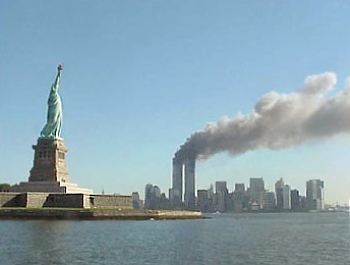
This was the dream that came to an end on September 11th, 2001.  On that day a new word rose the top of the lexicon of American political speech, the word “homeland.” Though the word itself wasn’t new, national leaders started saying it frequently, and using it in a different kind of way.  And every time we heard it, it was a reminder of the fear of that terrifying day.  Because even if we did not lose friends or family members on September 11, many of us lost something else.  We lost the belief that massive political violence against innocent civilians was something that could only happen far away.  Even those of us who lived relatively secure lives, and generally felt protected in our homes, and workplaces, and the streets of our towns, lost our sense of invulnerability.  
I was one of those people.  I was eating breakfast in the kitchen of the apartment I had just moved into with Meg in Emeryville, when the radio said that hijacked planes had hit the Towers and the Pentagon.  And I felt an great sense of dread.  I didn’t know what it would mean for the future, but I knew that it wouldn’t be good.  Like someone in a dream, I put my tools in the truck and drove off to a gardening job, but at lunch I had to quit and go home with flu-like symptoms.  The news had literally made me sick. 
The human body and spirit are resilient, and I got better in a couple of days.  But it’s hard to say that collectively we’ve made a full recovery.  After fifteen years of “War on Terror”, we still feel vulnerable than ever, and it’s clear that Muslim extremism is not the only threat: economic anemia, simmering racial tension, and egregious inequality, rampant gun violence, and the unmistakable onset of climate change call us to profound soul-searching about what it really takes to make a homeland, let alone a world, that is truly secure.

It’s a spiritual crisis, not unlike the one that Jeremiah talked about in the 7th century BCE.  The mighty Assyrian Empire had long ago dismembered the northern kingdom of Israel, but the southern kingdom of Judah remained defiant.  Although the Assyrian army invaded Judah twice, it failed both times to capture Jerusalem.   And then, quite unexpectedly, over a few short years in the 620s and 610s, the power of Assyria melted away.  Suddenly Judah enjoyed a degree of national independence it had not known for over a hundred years.  Her kings took back some territory, the priests and scribes made some religious reforms, and the court prophets began to say that the tide of history had turned, that Israel’s God was pleased with her again, and the peace and security of the days of David and Solomon would return.
But Jeremiah saw something different.  He saw that the modest religious reforms had not brought the nation back to its covenant with God.  They did not cease practices, like human sacrifice, derived from foreign cults.  He saw that the people did not carry out the social justice commanded in the law.  Jeremiah cried out in pain and anger at the apostasy of Judah, and said it was the pain and the anger of God.  Far from thinking that God was about to restore Israel’s greatness, he saw a wave of destruction coming from the north.   
Jeremiah lamented for his poor people, because God had already made a judgment against them that could not be revoked.  And in Jeremiah’s vision, the consequence of Judah’s evil doings would be worse than military defeat.  It will be worse than the loss of the homeland.  “I looked on the earth,” he says, “and lo, it was waste and void; and to the heavens, and they had no light.”  This is a vision of the undoing of the creation of the world.
History proved Jeremiah right about destruction from the north.  A new empire rose out of the ruins of Assyria, and in a few short years that empire would take Jerusalem, destroy the temple of Solomon, and carry the last king of David’s line away in chains to Babylon.  And in the loss and trauma of exile the prophets and sages of Israel began to re-think what it would mean to come home.  Some Jews would indeed eventually go back and repair the walls of the holy city, and build a second temple, bigger than the first.  But the hope of restoring Israel as a national entity would from then on always be in tension with hope of a different kind. 
This new hope sprang from a vision of renewal, not merely of Jerusalem, but of the whole of creation.  Israel began to receive a new vocation for herself, that of leading all humanity home.  Cut off from their land, they found that in repentance and prayer, in justice, compassion, and love they could still take life from the spirit of God.   And in that spirit they found the grace not just to maintain their faith, and survive as a community—they found the source of true security, abundance, and peace.  
  
Every Sunday in church we have an altar call.  It is not an invitation to individuals to come forward and confess their personal sinfulness and need to be saved.   It’s not a celebration of individual repentance and return to the community of God’s elect.  At least, that’s not the main focus.  What we do is invite everyone to come to the altar together.  After we all confess our sinfulness together, we gather at the altar in thanksgiving for what God has done for all of us to bring us home. 
This celebration continues the feasting that Jesus did, when he came to seek the lost sheep of Israel, and sat at table with tax collectors and sinners.  Nowhere in the gospels does it say how many of those sinners changed their ways.  From scattered hints we know that many of them did, but as Jesus himself says, even one is enough to make the angels in heaven rejoice.  And that is what our celebration is about: that God cares enough about that one lost sheep to send Jesus to go and find it.  That one lost coin matters enough to God to light the lamp, and sweep the house, and look under the sofa cushions until she finds it.
Jesus calls us sinners all together for a feast to celebrate the love of that God, and this inclusivity leaves it open for each of us to ask ourselves “am I that one?” “Am I the one for whom Jesus left the other ninety-nine behind to come and find?  Am I the one he is carrying home on his shoulders?”  But it also means we can look at the sinner beside us at the altar rail and wonder, “or is it him?”  “Is she the one?”  That open possibility is what makes this feast a sign of the Kingdom of God. 
Jesus says that the Kingdom of God is like a great net thrown into the sea, that catches every kind of fish, the good and the bad.  It is like a field of wheat, in which someone came and sowed some noxious weeds, and the weeds grew up with the wheat so there was no way to pull them out.  And this makes God’s Kingdom a mixed-up kind of homeland, a place where we have to be vulnerable.  It’s not a place we can hunker down behind the walls of our judgements of others, or an exclusive club, where only the people who think and act and look like us belong.  It’s a place where security and health are gifts of the spirit of repentance and forgiveness, the spirit of always being able to begin again.    
            

Letting freedom flow


Sometime last year I decided to do more to conserve water at my house.  I’d already stopped irrigating my lawn a year or two before, but with the severity of the ongoing drought here in California I considered what further measures I might take.  I’ve never been a big one for washing my car, or taking long showers, or letting the tap run while I brush my teeth or shave my whiskers, so I didn’t see much room for improvement in those areas.  But there are the toilets.  We have two of them, and as far as I know they might very well date from when our house was built in 1972, because they have those big old tanks that probably use five gallons every time they are flushed.   So, when I was at the hardware store one day getting something else and spotted a product on the shelves that seemed to offer at least a partial solution, I took a closer look. 
It was a fancy replacement for the old flapper valve, and instead of a handle like a little lever it has a couple of push-buttons, one of which will measure out a smaller flush when less water is required.   And, though I was skeptical that the thing would really work, it was inexpensive and I figured “what have I got to lose?”  I only bought one, to begin with, and installed it in the bathroom off the hall, which gets the most use, and for a while it worked as advertised.   But after a while the valve started getting stuck the majority of the times you use it.  You can release it, if you wait a second or two after flushing, and then do this thing where you push the bottom button in and then release it rapidly a couple of times until you hear the little “click” of the valve snapping shut. 
Which would only be a minor inconvenience if we remembered to do that every time.  But human nature being what it is, we don’t.  And of course the times we forget are, often enough, when we’re rushing out of the house to go somewhere, and there has been more than one occasion when I’ve returned home to find the toilet running and I know that no one has been in the house for hours.  So it’s hard to say at this point whether the contraption has saved more water than it’s wasted, and I’m grudgingly coming to accept that it’s time to bite the bullet and buy a couple of new, high-efficiency toilets. 
It hurts to know that my plumbing wastes water, but I have been able to live with the pain of it longer than I otherwise might, because there is a layer of abstraction that distances me from the problem and softens the blow.  It costs me money, of course, but lots of things cost money, and many of them cost more.  And there’s the emotional cost of feeling guilt about it, and ashamed of myself for procrastinating, because I know that we are in a drought and I am wasting a precious resource, but my actual lived experience is that there is plenty of water and however much I use, I can always get more.  That is because my toilets are hooked up to the pipelines and pumping stations of a modern municipal water system.  And that system has access to the reservoirs and the aquifers of the Russian River watershed, which not shown any signs, even in this historically-bad drought, of running dry. 
It would be far different if I lived in Judea in the 6th century BCE, which also had a summer-dry Mediterranean climate like ours, and if my household water system was a cistern containing what I’d been able to catch of last winter’s rain.  If that cistern leaked, it would soon be empty of water, and there would be no way to get more.  It is to people in a dry land, who were acutely aware of the precious and tenuous supply of water on which their lives depended, that the prophet Jeremiah spoke. He was not addressing them as individual householders, but rather, as he makes clear at the beginning of today’s first reading from scripture, he speaks to the whole “house of Jacob, and all the families of the house of Israel.”   And he did this during a time, when the nation faced an ongoing existential threat, with the shadow of expansionist Mesopotamian empires constantly looming over the land.   But there is a greater crisis, says Jeremiah, a religious crisis of which this political precariousness is just a symptom.  Speaking on behalf of Israel’s God, he says: “my people have committed two evils: they have forsaken me, the fountain of living water, and dug out cisterns for themselves, cracked cisterns that can hold no water.” 
In the eyes of our secular and pluralistic age, prophets like Jeremiah can seem kind of ridiculous.  The conventional wisdom about religion, if people are willing to accord it any value at all, is that all faiths worship the same god.  Their essential truths are the same, they just have different outward forms, different rituals, and languages, and names for the divine.  But when Jeremiah accuses Israel of having gone after worthlessness, and so become worthless, and of what changing their glory for that which does not profit, he is not talking about making the wrong choice from a menu of equivalent and interchangeable options, all of which are good.  He is talking about a critical difference in the way we think about and relate to God, a difference that we are prone to lose sight of no matter what “religion” we say we “belong to”.
As human beings we can, through various ingenious means, build an artificial fountain; but even our most advanced technology cannot create a spring.  If a spring goes dry, we can dig a well, and if the well goes dry, we can dig it deeper, but we can’t replace an aquifer.  The domain of things we can produce, predict, and control may be vast.  But it has its limits, and the Word of the Hebrew prophets comes from the other side of those limits, from the realm of the infinite and free.  From that strange and awesome remove it speaks, and strenuously, even violently, resists our attempts to give the things that we have made the honor that rightfully belongs to that which made us.   Any image of the divine in a created form, any sorcery that tries to steal power or knowledge from heaven or hell, any cultic sacrifice that claims to be able to pacify or animate the deity, is an insult to the freedom of God.
And this freedom matters to us, not least because it is the source of our own.   Jeremiah says to the families of Israel that they are in danger of losing their freedom, and this is because they stopped asking “Where is the Lord who brought us up from the land of Egypt?”  They stopped seeking the God who broke them out of the house of Pharaoh, and saved them from his army.  They stopped looking for the God who brought them through the drought, and darkness of the desert, to a land whose abundance was their gift of freedom and equality.  They contented themselves instead with a god who was a kind of domestic pet.  Forsaking the fountain of living water, and dug cracked cisterns for themselves.
In a Presidential election year in the United States, you can count on a lot of talk about greatness and freedom—our greatness, and our freedom—though very little is said about what these words might really mean.  You also hear a lot of passing references to “God”, whose job, it seems, is to bless us, in a manner of our choosing.  And none of these glib invocations shed any light on God’s greatness, let alone God’s freedom.  For that, you have to come to a place like this, where people still listen for the Word that speaks from beyond the sphere of our illusions and contrivances.   That word reminds us that freedom is a gift that grows out of the land, when we dwell there in equality and justice; that it is still an arduous journey to get there, one that leaves the false peace and illusory stability of domination and subservience behind; and that our only sure guide on that journey is a true and living God—a God who is free. 

About Me

My photo
Petaluma, California, United States
I am a priest in the Episcopal Church, and have been (among other things) an organic farmer and gardener, and a Zen monk. I have a lifelong interest in social and spiritual renewal on the basis of contemplative discipline, creative nonviolence, and ecological practice. In recent years my work has focused intensely on the responsibility of pastoral ministry in the humanistic, evangelical, and catholic branch of Christianity known as Anglicanism. I'm married with a daughter, and have three brothers and two parents.