Showing posts with label church year. Show all posts

Sunday, December 23, 2012

The visitation


One night last week, after our daughter had fallen asleep, my wife Meg and I went out into our hot tub.  The previous owners threw it in at the last minute when we bought the house a couple of years ago, and the hot tub has become a frequent part of our relaxation ritual at the end of the day.  It was a cold, starry night and I was submerged up to my neck, gazing up at the sky, when I saw something streaking across it in our direction.  For half a moment I thought it was a shooting star, but then I saw it was a bird, and no sooner had I taken that thought than it came swooping down upon us.  It stalled in the air above us, not five feet from our faces, for a couple of beats of its wings, and then shot noiselessly over us into the night.  An owl, I’m pretty sure, out hunting.   
In the moments that followed I found myself wondering what a Native American or one of my ancestors in ancient Britain, or indeed a member of any traditional society might have made of this nocturnal visitation.  Not just as a random phenomenon of animal behavior but as a message from the world of spirit.   This is a way of wondering about the world that is lost to us, that sounds kind of silly and new-agey to our skeptical and materialistic ears.  But maybe the approach of Christmas gives us permission to open our hearts and minds a little to perceive the miraculous in the ordinary.  And what could be more ordinary, and the same time more miraculous, than pregnancy, and the anticipated birth of a child? 
The Hebrew scriptures are full of stories of women who conceive unexpectedly and against the odds.  These pregnancies are not random biological phenomena, but messages from the world of spirit, signs that God still lives, that God still acts to save his people.    The movement of a fetus in its mother’s womb is an ordinary miracle, a moment of joy and wonder at the presence of the unknown that is a universal human experience.  But in the Gospel of Luke, when Elizabeth feels the fetus leap in her womb at the sound of Mary’s voice, she is filled by the Holy Spirit, the Spirit that brings good news of God and God’s workings in the world. 
Elizabeth understands that she has received a message from her unborn child, who knows what no one could know except by the Spirit—that her young cousin Mary, also improbably pregnant, bears the promised Lord of his people.  And in the Spirit Elizabeth blesses Mary, knowing by a leap of faith what she otherwise could not have known.  For Mary’s greeting is the echo of another voice, the greeting of the angel Gabriel who brought the Spirit’s news to her, saying “Hail, O favored one, the Lord is with you.”  Mary is blessed not just because she has conceived a child, but because of her faith, because she has believed that what was spoken to her by the messenger of God would be fulfilled.
And then it Mary’s turn to speak, or rather, to prophesy.  For Mary now sings talks about who God is and what God is doing.  She speaks of these things in the past tense, because for the person who believes, what God wills is already done.  Mary’s song is about the love, and the faithfulness, and the generosity of God who is only doing what was promised.  And the promise is not only for her alone.  Her song is a message from the Spirit What Mary knows, in the power of the Holy Spirit, is that that through her, through the child she will bear, God is fulfilling his promise to Israel, and through Israel to all humankind.  Her child is the one whom God has always promised to be.  Her child will do what God has always promised to do, and that what God does is to set us free. 
The Magnificat of Mary evokes other inspired songs of victory by other women—women of the Hebrew scriptures, women like Hannah, the mother of the prophet Samuel, and the warrior Deborah from the book of Judges, and Miriam, the sister of Moses, who sings and dances with the women of Israel on the other side of the Red Sea.  Their songs are songs of survival.  Not just the biological survival of the family, the tribe, or the race, but the survival of God’s mission in the world.   
Israel is a people with a particular responsibility to live the justice of God, to make it manifest in the world so all the nations can see.  She is a poor people, a marginal people, scratching out a living on some marginal land in the borderlands between the great empires of Egypt and Mesopotamia.   Israel is a people that knows what it is to be poor, to be enslaved, to be invaded and occupied and dispersed among the nations.  But she is a people that wills to survive, that must survive, for the sake of her special responsibility for God’s mission in the world.   
Mary and Elizabeth enter into a conspiracy on behalf of God’s justice—“Con-spiracy”—from “spire” meaning “breath” and “con” meaning “together”—and the breath they breathe together is the Spirit of God.  Theirs is the story of two ordinary women, actually two marginal women, one older and thought to be infertile, the other, young and scandalously unwed.  But these two women experience a visitation that makes their meeting a conspiracy of the Holy Spirit.  They will pass this conspiracy on to their sons— John, called the Baptist, and Jesus, called the Christ, and so they will ensure the survival of God’s mission of liberating justice in the world.  In fact, they will bring it to fulfillment, in the sense that what God wills is already done.  And that conspiracy of John and Jesus has indeed survived, extraordinarily and improbably survived.  It has spread like a great wind over the whole world.  It has even come to Petaluma, California.  It has survived even the end of a long cycle of the Mayan Calendar, and now stands on the threshold of the year 2013 since it began.
It is this contagious conspiracy of freedom and justice that we hope to catch anew this Christmas.  On the fourth Sunday of Advent, in the wake of the slaughter of the innocents at Newtown, we are asked to remember that, among many other things, the gospel conspiracy means this—that every child is, so to speak, an owl in the night.  Every child is a visitor from the spiritual world, bearing the seed of a holy purpose and a divine identity.  That this is especially true for the sons of Mary and Elizabeth should not blind us to the truth that each one of us is a child of God. 
Every one of our children comes into the world bearing gifts, gifts that are for all of us, and for those who come after us, who will carry on the work of God when we are no longer in the world.  This is the true of measure of justice, and the very heart of our responsibility as adult human beings, to ensure that every child gets to give those gifts, and to have them received.  This is as true for the children who are fair to middling, as the world accounts talent and promise, as for the exceptionally gifted.  It is as true for the disabled, and those born in poverty, and those whose lives will be spent in obscurity, as for those marked with a great destiny.  For it is not our place to judge the worth of any human being, but only to open our hearts and wonder, “What is the message?—what gift does this child of God bring?”

Tuesday, December 4, 2012

Beginning at the end


Last week I told a story about my sophomore year in college, a time in my life when I was haunted by the dread of nuclear apocalypse, and about a confrontation I had at the time with a man whose job it was to plan nuclear war.  This week I’m remembering something that happened about six months after that.  It was the summer, and I was on a three-week expedition at the Hurricane Island Outward Bound School in Maine.  I was on a thirty-foot sailboat with about ten other teenagers and a couple of adults, and we were cruising from island to island in the coastal wilderness of Penobscot Bay.  
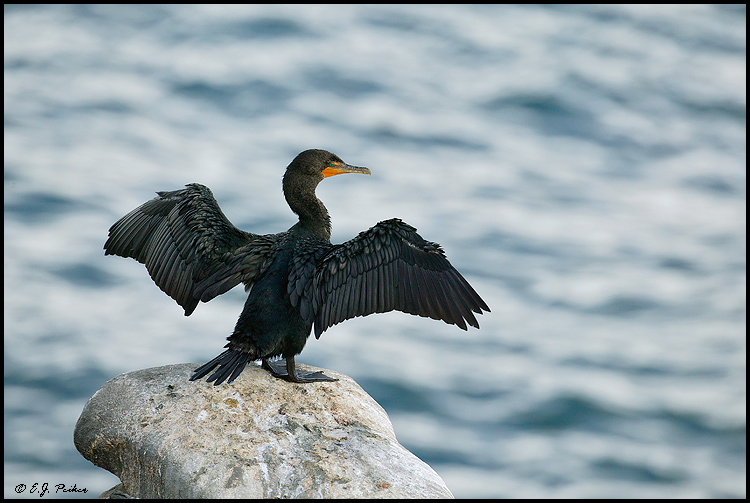
One afternoon we were out of the sight of land, sailing by dead reckoning in a light rain and fog.  There were some rocks on the chart with a bell buoy that we found right where we thought they’d be, and as we left them astern I looked back.  Rays of light were breaking through the low clouds, shining on the sea in the distance, and three or four black cormorants, what the Mainers call “shags,” were standing on the rocks holding their wings outstretched for the feathers to dry.  Something about the sight of those birds spoke to me, as they stood out there in the middle of that cold ocean, just doing what naturally needed to be done.  They spoke to me of the great life that moves through all things, of its indestructibility and its powers of rebirth.  I felt a sense of trust and peace, and I knew that no nuclear war or any other human evil could destroy that life, or thwart its sheer desire to become.  We could do it great harm, and ourselves along with it, but we could not kill it forever.
Last week we also heard another story, the end of another retelling of the tale of Jesus Christ.  He stood before the man who would shortly condemn him to death and bore witness to the truth, as he had come into the world to do.  And we bore witness to him, saying prayers and singing hymns that acknowledged Jesus as the abiding truth about what really matters in the world.  We acclaimed him as the world’s true ruler.  And with that we came to the end.   We turned the page on another year, as the church reckons years. 
So it is strange to say, here we are again.  Two weeks ago, we were in Mark’s gospel with Jesus looking out from the Mount of Olives at the great Temple of Israel’s God, and he prophesied its destruction, and his disciples asked about the end of the world.  Today we begin the new year, and open Luke’s gospel, and Jesus is in Jerusalem, in the Temple, speaking about the end of the world.  So why are we still here?  Why pick up again where we just left off?  Why begin at the end?
Well, maybe because we are still waiting.  We may know that Christ is the king, the true ruler of the world.  We may know that love is the almighty power that orders all things, that was before the beginning and will be at the end.  We may know it, I should say, by faith.  But that faith can seem pretty tenuous when we look around at the state of things.  It’s hard to see the cycles of violence and retribution in the Congo and the Middle-East, and say that love is the supreme law.  It’s hard to look at the greed and exploitation by which the rich get richer, and the poor get poorer, and the earth gets thrown further and further out of whack, and see how Jesus Christ is the ruler of this world.   And so, even though we have heard the good news, the question still hangs in the air, “How long?  How long will this go on?”
That question is at the heart of the Hebrew Bible.  And the message of the Hebrew prophets about the evil in the world and the unmerited sufferings of the innocent is that it will not continue indefinitely.   God will act.  A day will come, a great and awesome day, when God will re-assert sovereignty over creation and the whole world will see what now only the prophet can.  Because the judgment that takes place on that day will not just apply to this or that person’s immortal soul.  It will be a great cosmic upheaval, God’s housecleaning, in which the whole world will be transformed. 
Over centuries of exile and oppression, the Jews developed the promise of a coming cosmic judgment into a literary form we call “apocalyptic,” from a Greek word that means “the lifting of the veil.”   Today’s gospel text from Luke begins with language drawn from that apocalyptic tradition.  Speaking of the coming judgment, Jesus says “there will be signs in the sun, the moon, and the stars.”  On earth, people will faint from fear, “for the powers of the heavens will be shaken.”  He goes on to quote one of the most famous passages of apocalyptic in the Bible, the Seventh Chapter of the Book of Daniel, when he says “they will see 'the Son of Man coming in a cloud' with power and great glory.”
But from there Jesus’ speech takes an unexpected turn.  From the oracle of apocalypse, he suddenly becomes again the teacher who sat by the Sea in Galilee, speaking simple parables of the kingdom of God.  The imagery that he uses now also resonates deeply with the scriptures, but with a far older stratum of the tradition.  He says, “Look at the fig tree, and all the trees,” and suddenly we are not at the end of the world, but at its beginning.  We are in the garden that God planted with every kind of tree that was good for food, and gave to our first parents for a dwelling.  “As soon as they sprout leaves,” says Jesus, “you can see for yourselves and know that summer is already near.  When you see these things taking place, you know that the kingdom of God is near.”
“The kingdom of God is near”—this is the essential proclamation of the Gospel, the place where all the teaching of Jesus and the teaching about Jesus begins.  This is not just the threat of imminent destruction but also the promise of justice and liberation that are intimately present, intimately real.  And the signs of the kingdom are the miraculous life of ordinary things: of a sower who goes out to sow; of a woman mixing yeast into the dough, and a net full of every kind of fish.  While the nations fall into terror and confusion at the unraveling of the world, Jesus says “look—it’s almost summer.”
I’m going to say that it’s not a mistake that these two sayings are together--the apocalyptic vision and the parable of the fig tree.   The conjunction suggests that this is where we are meant to live—in this balance point where the end and the beginning meet, this precarious place of freedom called “now.”  That is why Jesus so strongly recommends watchfulness—staying awake and alert.  Because in the presence of Jesus people experience the justice, and the truth, and the repentance and forgiveness that are supposed to be unveiled at the end, only it is happening now.  They know the freedom, and the innocence, and the intimacy with God that were there at the beginning, only now.  And yet there are so many times we meet Jesus and we don’t see what is happening.  Our hearts and our minds are closed and we miss it.
And I suppose that’s why we no sooner finish telling the Gospel story than we start all over again.  Because missed something the last time around.  We are still waiting for God to do something.  We are still asleep, as if Jesus never came, as if the troubles in the world still have no solution, as if we still don’t know what to do.  So we start the story over again from the beginning.  And we do it with a sense of hope and expectation.  We hope that this time we really will hear it, that this time it will wake us up, and Jesus Christ will not be someone who died a long time ago, or someone who will come someday, who knows when, but that the Son of Man will come and stand before us, and live with us, and work through us.  Now. 
    

About Me

My photo
Petaluma, California, United States
I am a priest in the Episcopal Church, and have been (among other things) an organic farmer and gardener, and a Zen monk. I have a lifelong interest in social and spiritual renewal on the basis of contemplative discipline, creative nonviolence, and ecological practice. In recent years my work has focused intensely on the responsibility of pastoral ministry in the humanistic, evangelical, and catholic branch of Christianity known as Anglicanism. I'm married with a daughter, and have three brothers and two parents.