Showing posts with label Kingdom of Heaven. Show all posts

Sunday, July 27, 2014

Scribes for the Kingdom


When you think about it, the Kingdom of Heaven is a funny idea.  Clearly it is not like kingdoms on a map, where Heaven is this pink country, over here between the green and the purple ones.  It is not like the plant kingdom or the animal kingdom.  Heaven, which is Matthew’s way of saying “God” because, as a good Jew, he is shy about using the divine name, has to include all countries, all plants and animals.  Because God created everything, and sustains it, and his sovereignty over it is unlimited and eternal.  That is elementary biblical monotheism.

The Hebrew scriptures say that it really is that simple.  But they also tell us, and our own experience confirms this, that from the human point of view, the picture is more complicated.  And it is that complicated human situation that Jesus is addressing with his parables.  Jesus isn’t a theologian, he’s a preacher.  So the purpose behind his parables is not to convince people to get new ideas about God.  It is to train them for the Kingdom of Heaven.  It is to give them a way to follow that leads through the tangle of human complications to the simplicity of life in God, with God.  It is to help to see how God really is present and active and working in the world around them, in their lives.  The parables are meant to show people how to align themselves with the flow of God’s power, to go with it, and to let it carry them where God wants to go.

But when we hear parables one after another the way Matthew’s Gospel presents them, it seems that they are not all saying the same thing.  For example, there are those that compare the Kingdom of Heaven to a person who discovers something unique and particular: a pearl of great price, or a field with a buried treasure.  That person then goes and sells everything else that he has in order to purchase that one precious thing.  But others say it is like something extremely common, a mustard seed or yeast in dough, that grows and accomplishes its purpose easily and naturally.  Is it like the dragnet that catches every kind of fish in the sea, so that they can be sorted into good or bad, or like the one we had last week about the field where the wheat and the weeds are growing up together, and it does more harm than good to try separate them?  If you were trying to turn these sayings into a consistent doctrine of what the Kingdom of Heaven is and how it operates, you’d have to conclude that Jesus is a pretty poor theologian.

But, again, that would be to misunderstand what the parables are trying to do.  As we’ve said, they are not aimed at getting people to understand a concept, but to go in a different direction with their lives.  I think it helps to see how this works if we imagine that Jesus spoke each of these parables on a different occasion.  Each time, there were people in the audience who hadn’t been there before.  Each time, the setting was a little different—a market town, a fishing village, or a farming community—and the situation was different—the news from the capital, the questions people asked, the things that had been going on in their lives.  The parables seem to say different things because each circumstance and audience called for something different.

And, in particular, every person and every crowd that Jesus spoke to had its own form of resistance to his message.  We all have our habitual, unexamined ways of thinking, which are a way of keeping God at a distance.  So if you inviting people to get involved in their lives in a different way, to be a part of what God is doing in the world right now, you need words that take them where they don’t expect, and maybe don’t want, to go.  The author of Matthew understands this, and he uses Jesus’ parables in a way that he thinks will have the most impact on his audience, and will speak to their situation.  For his community of marginalized Jewish Christians, the parables manifest the unique importance of Jesus as a prophet and teacher.  They speak to the mystery of why it is that so many of their brothers and sisters not only fail to understand his significance, but strenuously, even violently oppose it.  Matthew makes the parables, with their unexpected reversals of meaning, a metaphor for the Gospel as a whole.  He turns the drama of understanding or not understanding the parables into the prelude to the final judgment of the world.   Matthew sharpens the parables into a sword, to cut through fear, confusion, and indecision and show how high the stakes are in this fight and to say that it is time to take sides.

And, just so we understand what he is doing, Matthew concludes this section on the parables in the following way:  Jesus asks, "’Have you understood all this?’” and the crowd all answered, ‘Yes.’"  (Again, the focus of the passage is that the people should grasp what they are hearing and decide about it for themselves.)  And he said to them, "’Therefore every scribe who has been trained for the kingdom of heaven is like the master of a household who brings out of his treasure what is new and what is old.’"  This could be a reference to Jesus, who quotes the law and the prophets, when it helps to get his point across, but also feels free to create surprising new teachings.  But it could just as easily refer to Matthew himself, who has the audacity to write a new book of holy scripture for the sake of his community.  He works creatively with all kinds of old material—the Greek translation of the Hebrew scriptures, different collections of the sayings of Jesus, many would say the Gospel of Mark—and shapes them into a new story that he hopes will wake people up to see what they could not see and do what they fear to do.

This process didn’t stop with the writing of the Gospel of Matthew.  The Kingdom of Heaven wasn’t frozen in that moment, like an insect in a lump of amber.  It has kept growing, like the seed of a mustard plant, so the process of trying to communicate it hasn’t stopped either.  And if we want to perceive the working of God in the world in our own day, to align our lives with it, and to help others to get into that flow, the question of what language to use looms large.  What treasures can we bring out of the storehouse, both old and new, with the power to change the way we see, and the way we walk?  Of course, as a preacher, I wrestle with this question almost every day.  But I don’t think this is just my work, or just my responsibility.  I’ve been trying to introduce it into the discernment conversation that is happening in formal and informal ways in our congregation right now—as we seek to clarify our shared understanding of who we are and what we need and what we are called to become, I keep wondering “what are the images and stories from our tradition that speak most powerfully to our circumstances?” 
And this needn’t apply only to our life together in the parish.  For our personal faith to come alive, and for us to become effective Christians in the world, we all need some training as scribes for the Kingdom of Heaven.  I think some regular reflection on the scriptures, in private reading or familiar conversation, even if it is just to take the little lectionary insert from the bulletin home after church, to read again and think about it during the week can be really important.  Not in order to construct a theological system, or to be able to quote verses for the sake of argument, but to rummage in the storehouse of our own imagination, to wonder about what those ancient people said, and why it was important to them and how it might be important to us.  And if you are already doing this you know what kinds of surprising treasures you bring out of it, some of them old, and some of them new.        


Tuesday, July 22, 2014

Bermuda Grass


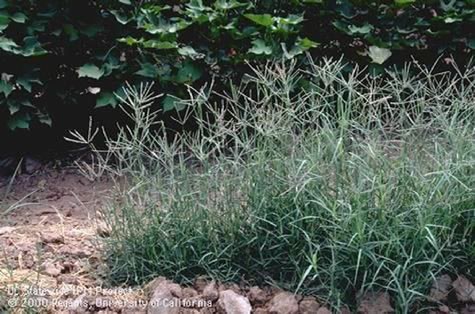
If you are familiar with Bermuda Grass you know how invasive it is, and how hard to eradicate.  It spreads rapidly, sending out lateral runners that quickly take root and send out new runners from there.  But the underground rhizomes are worse.  These also spread out in every direction, forming a dense mat that chokes out other plants, and if you dig these out, one small section of rhizome remaining in the ground is enough to propagate a new plant and start the cycle over again.  And did I mention that at this time of year the Bermuda Grass is sending up slender stalks with forked seed heads like devil’s pitchforks, and that the slightest movement is enough to shatter them and scatter hundreds of tiny seeds onto the ground? 

I come from a long line of vegetable gardeners, and one of the things I was really looking forward to when we moved to the fine climate of Petaluma, and bought a little place of our own, was being able to grow a bit of our own food.     So you can imagine how delighted I was to move into our new house and discover that the yard is full of Bermuda Grass.  I considered various solutions to this problem, but all of them involved expensive and ecologically-dubious inputs like black plastic sheeting, redwood lumber, manufactured soil products, or herbicides.  I also know from experience that such solutions are temporary, and in the long run can create new problems that are just as hard to solve.
 
So in the end I decided to just start digging in the ground, and carve my vegetable beds out of the Bermuda Grass.  Every spring I’ve dug a new one, and re-dug the ones I dug before, so I now have three vegetable beds, and I think I’ll stop there, at least for now, and work on clearing some ground for vines and fruit trees.  Each time I dig those beds, and add compost and fertilizer, the easier the soil is to work, and the less time I have to spend squatting down, picking out rhizomes of Bermuda Grass.   I haven’t eradicated it, but I’ve accepted that I never will.  And I know that if I ever stop pulling it out around the edges of the beds, or re-digging them every spring, it will take no more than a year or two for it to reclaim my vegetable garden.  But for now, man and weed are in a tenuous balance, and that is good enough for me.
  
You can understand the story of my garden even if you don’t have Bermuda Grass in your yard.  In the same way, when Jesus told the parable of the Weeds in the Wheat it made sense to the people who were listening.  They would have appreciated the realistic agricultural detail in the story, even if nothing exactly like it had ever happened to them.  From their own experience they would have been able to imagine it vividly—the perniciousness of the enemy who sowed weed seeds in a carefully planted field, the dilemma facing the householder, and the practical good sense of his solution.  And this correspondence with their own experience would have made it all the more puzzling to consider this as religious teaching, and all the more startling to hear that this is what the kingdom of heaven is like.

The parables of Jesus make sense as stories about what really happens in the world, and so they are accessible to everyone.  This is also what makes them subversive.  The God whose kingdom is like the seed of a mustard plant, or a woman kneading yeast into her dough, or a man whose wheat field is full of weeds—this God is not the exclusive possession of religious professionals.  His word is not shut up in sacred texts that are hard to understand, but it falls freely here, and there, on the path, on the rocks, and among the thorns, as well as in the fertile soil.  Its harvest of liberating truth is ripe and plentiful, as anyone can see, needing only willing laborers to bring it in.

But the church by-and-large lost the common sense of Jesus’ parables in a process that was already underway when the gospels were written.  Her authoritative teachers began to read them in a way that Jesus himself likely never intended.  Rather than offering them as open-source images of the action of God in the world, they began to convert them into proprietary code, where every figure and action in the story is the outward form of a hidden religious idea.  This soon became the normative way of reading, and teaching, and preaching the parables of Jesus, and remained so for hundreds of years.  

It has only been in last couple of centuries that New Testament scholars have developed the critical tools to make convincing arguments for the way the gospel texts were put together.  They have shown how the different authors used their source material in different ways, and that not all of that material came originally from Jesus.  The Gospel of Matthew, for example, has a particular concern for the problems of internal conflict, order, and discipline in the faith community, and includes material, not found in the other gospels, that specifically addresses those issues.  With that in mind, it is not too hard to see why Matthew is the only gospel to include the story of the Weeds in the Wheat.  It also explains the addition of an allegorical interpretation of the parable, making it about the future destruction of evil and vindication of the righteous. 

This type of allegory was common enough in the 1st century, and it spoke particularly to people enduring persecution because of their religious beliefs.  The historical-critical study of Matthew suggests that the gospel originated in a Jewish-Christian community suffering in this way.  But while this reading addressed the urgent concerns of Matthew’s congregation, 40 or 50 or 60 years after the resurrection, it doesn’t fit so well with Jesus’ own teaching on the Kingdom of God. 

There was well-established precedent in Hebrew scripture for talking about this Kingdom, but Jesus is unique for his claim that it is not only the foundation of Israel’s identity as a people; it is not merely the guarantee of the authority of the law and the prophets; it is not only the promise of ultimate deliverance from evil and oppression and of the reward of plenty and rest.  For Jesus, the Kingdom of God is most importantly a present power, visibly at work in the realms of nature and human affairs, and impinging on the history of the world in a decisive and unprecedented way in his own life and ministry. 

So it might be more faithful to the mind of Jesus not to abstract from this parable an allegory of the final judgment, but to enter into the concrete situation it describes, to see what it shows us about our present world and the choices we must make there.  We dream of a world of order, of harmony and perfection, where our mate loves and wants and needs the same things we do, and on the same schedule; or of an ideologically and culturally homogenous nation, where everyone, or at least everyone in power, agrees with us; or we imagine a pure market economy, functioning perfectly without the need for political intervention; or of fields where herbicides, insecticides, and fungicides have eliminated every pest from the endless parallel rows of genetically-identical corn.   But instead of this perfect order, we get Bermuda Grass in the yard, Weeds in the Wheat, Muslims in the Middle-East, and Central-American children on the border, a mixed-up muddled mess. 

The frustration of our dreams of perfection continually tempts us to take action to set things right.   But Jesus’ parable puts hard questions to any corrective steps we might take:  do we have the greatness of mind to acknowledge the real presence of evil in the world, with all its destructive effects, and yet also to see that God is this world’s true ruler, who is preparing in the same place, at the same time, an immeasurable harvest of blessing and good?   Beyond that, do we have the humility and the wisdom to admit that we are not able finally to discriminate between what is of God, and what is not?  And most importantly, do we have the faith and the hope to hear the news that the one who can untangle this knot is here? 

Sunday, July 10, 2011

The United States of Heaven


A couple of months ago I decided to put a new welcome message on the home page of St. John’s website.  I wanted to try to communicate something to curious visitors, right off the bat, about what makes our congregation special.  So I decided to mention the recent schism that tried and tested, and at the same time renewed, this community.  I wanted to do this for two reasons; first, because it highlights our commitment to being an inclusive church, where people of all different kinds are welcome and affirmed.  This commitment, and the high cost that St. John’s paid for it, is nothing to be ashamed of, and indeed is attractive to some people. 
The second reason was that a lot of people in our surrounding community know that something happened here, something painful or scandalous or at least controversial, and I thought we should set the record straight at the outset, so visitors aren’t left wondering what we’re hiding.  So I wrote my new little welcome blurb that contained this sentence: We are proud of our commitment to inclusion, having recently reclaimed our parish from a breakaway sect opposed to equality for women and LGBT Christians within the church. 
Then, in early June, I got an email from a woman who described herself as a frequent visitor at St. John’s over the years, who keeps up with us via our website.  She copied that sentence in her email, with the words “breakaway sect” highlighted in red.  And then she wrote the following:
“Really?  
It is revealing that you find it necessary to attract new members by denigrating your fellow Christians. Were I to consider joining your congregation for one Sunday, or forever, I could not set foot in the place based on that statement alone.”
I wrote her a reply in which I thanked her for staying in touch with us, and assured her that I didn’t mean to give offence or to denigrate anyone.  I told her everything I just told you about the reasons why I’d put those words up there, and that I’d merely been trying to describe, as accurately as I could, what happened.  I explained that the American Heritage Dictionary defines “sect” as, "a religious body, especially one that has separated from a larger denomination", and that I’d used that word because it was the most precise one I could find.  But I also told her that I had a grave concern that she had interpreted that language as insulting, and, because others might read it the same way, I’d have to seriously re-consider using it.
I meant to communicate one thing, but what that woman heard was something very different.  Saying what we want to say, in a way that others can understand it, is one of the great challenges of being human.  This is true even with the people we trust the most and love the best.  But it is especially true with strangers, and when the subject matter is something people have passionate feelings and firm convictions about, such as politics or religion, it’s that much more difficult.  We might think that if we were more eloquent, or charismatic or persuasive, we’d be more successful in getting others to understand us, and that might be true up to a point.  But the fact is, people are going to hear what they want to hear, or are ready to hear, no matter what we say or how we say it.
Maybe we can take some comfort in knowing that Jesus had the same problem.   When Jesus spoke to groups of people, he had a very specific purpose.  He wasn’t trying to impress them, so that they would go away saying, “Wow—that was awesome.  I can’t wait to tell my friends what I heard.  Maybe they’ll want to come with me next time I go hear him speak.”  He also wasn’t trying to persuade them to agree with his opinions, so they’d say “You know, I’ve always been skeptical about ‘eternal life’, but Jesus really made a convincing argument.  I think I’m going to believe in that from now on.” 
No, I think what Jesus was trying to do with his teachings was to bring his listeners into a completely different perception of reality.  He was trying to use words that would break through into their hearts and awaken a profound response of recognition.  He was betting on the possibility that if they could see themselves the way he saw them, and know God’s loving, and empowering presence the way he did, that they would be changed forever. 
Just in case we might think that he was talking about something vague and subjective, some kind of private experience that only certain people can have but that isn’t actually relevant to your average person or everyday life, Jesus called this reality the “kingdom of heaven” or “the kingdom of God.”  No “Kingdom” is one translation of the Greek word basilea.  Basilea is a word that the people gathered on the beach at the Sea of Galilee would have known very well.   They would have already heard an earful about a certain Basilea that some people said was divinely ordained to bring peace, order, and prosperity to the world.  They would have heard that anyone who opposed this Basilea was a public enemy, a criminal who should be killed as an example to others.  Another translation of Basilea is “empire.”  The Basilea that Jesus’ listeners would have known best was the one centered in Rome.   
I think we have to assume that Jesus knew what he was doing when he used that word.  He knew what associations it would have in the minds of his audience.   He had to know that when he talked about the Empire of Heaven there would be some people who wouldn’t understand. Some who would think that he was setting himself up as a rival Caesar, that he was calling them to join him in a war of liberation.  Which he certainly he was not.  But he also understood that as long as they lived in fear of that other Basilea, so long as they believed in its claims to be the hope of humanity, and the supreme and eternal reality in an uncertain world, they would never know what he knew, or see what he saw.
So when he spoke to them about the Empire of Heaven, he used parables.  He used figures of speech drawn from the everyday experience of farmers and fishermen, so his audience might understand that this Empire was not governed from some great city far away, but was fully present in and around them.  He knew that some people would not understand, and that the spirit of violence and rivalry would snatch this vision away from them before it could sprout in their hearts.  There would be others who would embrace it for a time, but lose it when faced with the blazing hatred of the uncomprehending.   Others might be drawn to the message but find it only good for Sunday morning sermons, and not for the gritty realities of trying to feed your family and get ahead in the world. 
But there would be some people who did understand.  Not very many.  At the end of Jesus’ life it would be clear how very few there were.  Some of his closest disciples wouldn’t get it until he was raised from the dead.   But when that happened they remembered what he’d said.  They remembered the parables of the Empire of Heaven, and the seed that fell on the good earth and bore fruit.  And the new life in the spirit, the indwelling power of the God who raised Jesus from the dead, was suddenly not just some nice words, not just  a “religious idea”—it was a reality.  It was the reality, in comparison with which all their former lives were a living death.
They in their turn became sowers of the word, and we are their harvest.  And because a share of the harvest is the seed of the next year’s crop, we, also are sowers.  St. Francis of Assisi told his followers, “preach the Gospel at all times—even, when necessary, using words.”  We don’t have to be knowledgeable and articulate.  We just have to share, to the best of our understanding, what is in our own hearts about The United States of Heaven.  The birds will get some of it, some will land among the rocks, and the thorns.  But some of what you communicate will land in the good soil, and bear fruit, one hundred-, sixty-, thirty-fold.  

About Me

My photo
Petaluma, California, United States
I am a priest in the Episcopal Church, and have been (among other things) an organic farmer and gardener, and a Zen monk. I have a lifelong interest in social and spiritual renewal on the basis of contemplative discipline, creative nonviolence, and ecological practice. In recent years my work has focused intensely on the responsibility of pastoral ministry in the humanistic, evangelical, and catholic branch of Christianity known as Anglicanism. I'm married with a daughter, and have three brothers and two parents.