Thursday, August 27, 2009

Preaching Politics


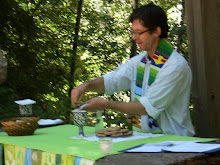
I gave this sermon on August 23rd at All Saints Church, Carmel. The texts for the day's worship were:


Today I’d like to preach a little bit about religion and politics. Now before you all heading for the exits let me just say that I’m not doing this because there are some hot-button political issues out there right now, in the church and the nation, and I’m really steamed about something and I’ve kept my opinions to myself just about long enough. That’s not what’s going on. Instead, I came to this topic because the lectionary readings kind of forced it on me. Let’s start with the collect of the day—

Grant, O merciful God, that your Church, being gathered

together in unity by your Holy Spirit, may show forth your

power among all peoples.


That, my friends, is a political prayer. Then there is this morning’s reading from Joshua. This is one of the nicer bits from Joshua, a book without a lot of nice bits, and yet we hear—

and the LORD drove out before us all the peoples, the Amorites who lived in the land; therefore we also will serve the LORD, for he is our God.


Yes, I understand that the people are renouncing other Gods of other lands, and pledging their fealty to the God of the land of promise, who acted so mightily on their behalf. But we can’t obscure the nature of the blessing that is being celebrated—the violent seizure of territory in the course of a victorious Holy War.

When people get up to preach about religion and politics, they generally set out to use the scriptures of their particular tradition to prove that one side or another in a controversy of the day is the right one, and therefore that it is our religious duty as good Muslims, or Hindus, or Jews or what have you, to join the fight. If we are going to be honest with ourselves we have to admit that Christianity has lent itself infamously well to this type of enterprise over the years. As the commercial and military expansion of European empires engulfed the globe, the bible marched alongside the gun. And this isn’t a thing of the past. About three years ago, I accepted an invitation from a neighboring faith community to attend a National Day of Prayer gathering in Devendorf Park, here in downtown Carmel. It turned out that the accent was on the National rather than the Prayer. There were prayers for God to grant conquest of the Middle East to American troops, and the conversion of the regions Muslims to Christianity. Many of the prayers that were offered that day used what sounded to me like code words for common Right Wing political causes.

Now in the interest of full disclosure I have to say that when it comes to sectarian politics my own heart is right where it belongs—on the left. And my ilk are just as susceptible to turning religious language into political cant. Words like “peace” and “social justice” and “inclusion” can become little more than ciphers for a particular political ideology. It’s insidious, it’s been going for centuries and it still is happening all the time.

No wonder that Jesus, when he realized that the crowd was coming to make him king, disappeared into the mountains.

That part of the story alone should be enough to tip us off that the Sixth Chapter of John, which we’ve been dwelling in for the past month or more has something to do with politics. I don’t think it diminishes the spiritual significance of the gospel at all to say that part of the liberating work of Jesus is to set us free from politics, or at least the kind that ensnares us, that makes it easy for us to fool ourselves into thinking that we are doing the will of God when we are really serving some lesser master. The earliest Christians knew this kind of so-called “religious” language very well because they’d had it used against them, to single them out as “blasphemers” and “apostates” by Jews and as “atheists” and “enemies of the state” by agents of Rome. It would have been a temptation to fashion verbal weapons for a counterattack, and there were those even then who succumbed to that temptation, and were caught in the snare.

But faith in Jesus shows us a different way to go. It is not an escape from the world and its dilemmas and pressures into an ideal spiritual realm. A decision for Christ and the kingdom of God, means taking a stand, with real political risks and consequences. I say “political” because the words that Jesus has spoken about eating his flesh and drinking his blood, are, as we hear in the gospel, “spirit and life.” The spirit that Christ gives to those who have faith makes them come alive. It fills them with the power to face their fears, and the power to change their ways. It gives them the power to speak the truth, and the power to love people they don’t even know. It gives them the vision and hope to wager their lives on the total transformation of the social order in spite of all evidence that the powers that be are supreme and invincible. Spirit is power and life is power, and politics is about power.

Any genuine spiritual power that the church has comes from God. But this is not the God of Joshua, who takes what he wants by force and gives it to those he chooses. This is the God who calls those he chooses and gives them himself. As his members, we partake of the power of life that is the Spirit within and among us, not the power of some authority wielding the threat of death over us. For us to abide in Christ as active participants in institutional life of the world, with Christ abiding in us, is to renew the promise of politics itself, freeing it from the grip of empty slogans and entrenched positions. It is to be continually on the lookout for possibilities for hope, healing, and insight, rather than relentlessly probing the enemy for weakness. It is to be always listening for the hunger for meaning and belonging that underlies expressions of partisan aggression, and to offer the food of understanding. It is to resist evil with truth, and hatred with an unyielding kindness. To be in public like this is to confound the conventional division of Left from Right. Ironically, it is often also means inviting attack from the left and the right simultaneously. Jesus’ gift of himself to the world was so total that he willingly entered the trap of its politics, letting it close upon him, so that God’s redeeming work could happen even there.

Jesus’ willingness to suffering and die for the life of the world were his political platform, if you will, so it’s no wonder that a lot of people decided to jump off the bandwagon. You’ll notice that the Gospel gives no indication that Jesus tried to keep them from going. He doesn’t tell them they’re wrong, or that the ones who stayed are right. “No one can come to me,” he says, “unless it is granted her by my Father.” I suppose those of us who try to believe, with Peter, that Jesus is the Holy One, could take some elitist pride in our unmerited and gratuitous election. We could use as the grounds for organizing a “Christian” political party. But I love what Peter says when Jesus asks him if he’ll leave too. Not “you’ve got the best chance of winning” or “I think that of all the candidates, you will do the most to protect my interests.” No--Peter says, “Lord, you have the words of eternal life. To whom shall we go?” We should aspire to the same humility when we proclaim Jesus as the savior of the world. It’s not that we wouldn’t leave him if we could, and it’s not like we won’t betray him. It’s just that we understand how deep our predicament really is, and that we own that without the continual nourishment of God’s compassion and wisdom, all we’ve got is politics.

CALL FROM THE FUTURE


CALL FROM THE FUTURE
BARRY LOPEZ considers what is really being asked of us.
(O Magazine, April 2009, p. 156)

IT's NOT AS IF WE DON'T KNOW. EVEN
if we live in the inner city and can't manage
to get to the countryside, we understand
that reconnecting with what is subtle and
profound in nature can take some of the
burning out of our souls. And we know,
too, that global climate change is upon us,
indifferent to our fate and menacing on a
colossal scale.
The question now is no longer about the
old polarity between nature and culture.
The effects of nature and culture on us are
intertwined. Each lends something to the
other; together they sustain us. The better
question is: Where from here? How do we
react so smartly to the complex social and
natural threats before us that a stranger to
our planet, looking back at our history; will
be moved to call us a just, courageous, and
reverent people?
Establishing better ethical relations in
every quarter of our lives-political, social,
environmental-is arguably the starting
point, one that will require, first, an instinct
for reconciliation. Instead of the numbing
rhetoric of"us" and "them," we will have to
invent a new kind of "we." It's the "we" al-
ready welling up in many of us, born out of
empathy, out of genuine love for each other
and the Earth, and out of sober assessments
about our predicament. It's a grittier, less
jingoistic "we," born of hard work.
We hear too often now that times are
rough. Considering global climate change
alone, we can argue convincingly that, in
fact, we're in a far worse spot than those
who have come before us. There are threats
to our physical and mental well-being on
the horizon the like of which humanity has
known only in the most limited way. These
unanticipated developments -collapsing
ocean fisheries, the human disturbance of
viral ecologies, the accumulation of non-
biodegradable plastic- are, rather suddenly
a scary part of everyone's everyday life. And
our apprehension, too, is of a different order than, say,
the fears of Europeans during the spread of
the Black Death or of peasants throughout history;
living precariously before nature's forces and at
the whim of despots. It's an apprehension calling
for something untapped in us.
What we need is uncommonly mature
people. A kind of courage is required we've
not seen before, that "we" in us that wants
to make a simple bow of recognition, with-
out judgment, toward all other people
caught in the same travail, and then simply
to start the work. As individuals we can,
each of us, assess our own faiths and beliefs,
measure our stores of energy; take account
of our own pressing personal responsibili-
ties, and then respond, inventing together
another way of life, one less harmful, less
cruel than the one we have now
We risk trying one another's patience
when we put too fine a point on precisely
which threats we face as a species or make
overbearing claims about the divine attri-
butes of"nature." Simply put, the impact of
human enterprise on nonhuman systems
has created an unusual and strange urgency;
In a relatively short time, we're going to
learn whether we are indeed a match for the
various threats science enumerates. We are
going to find out whether we can actually be
as empathetic toward one another, as toler-
ant, as imaginative as we believe we can.
To develop less cruel and better gov-
erned societies, we're going to have to begin
by trading in the old questions about what
kinds of darkness are forcing us into the fu-
ture and ask instead another question:
What is calling to us? What lies buried in
our destiny that is calling out to us now?
I look at my own task as a writer and hu-
manitarian and know this one thing: With-
out other men and women, hard at work
devising a safer future for every life on Earth,
my task is like the song of a man living alone
in a box: beautiful, perhaps, but of no great.
help to humanity. I need these men and
women. Before long, each of us will be look-
ing to our right and to our left for eyes that
we can believe in. It is with these women
and men that we will initiate the work that
will impel those still to come, including our
children, to praise us-and to understand
the fierceness of our determination that
they not be born in vain because, facing
great threats, we fell down.
Barry Lopez has traveled to more than 60 countries and worked on international humanitarian projects with Mercy Corps and Quest for Global Healing.


Wednesday, June 3, 2009

Trinity Sunday


For Trinity Sunday here's a quote from page 72 of Why Go to Church: The Drama of the Eucharist by Timothy Radcliffe:

I do assent to various propositions, such as that God exists, even if I do not understand what it means for God to exist...But that is not enough. Aquinas points out that even the Devil accepts the truth of these propositions. Friendship with God changes how I see everything. The persons of the Trinity are not three 'imaginary friends', in the words of [Richard] Dawkins, three people with whom I can have fantasy conversations. Rather friendship with the Triune God reshapes my perception of the world. Believing in the Father, the creator of heaven and earth, I see everything with gratitude. Believing in the Son, I delight in its intelligibility and seek understanding. Believing in the Holy Spirit, I am thrown beyond myself in love. The doctrine of the Trinity, therefore, should not make me a bigot, intolerant of those whose faith is different or non-existent. It should fill me with gratitude for their existence, open my mind to them and help me to see them lovingly. Dogma matters. Orthodoxy liberates one from prejudice and petty-mindedness, and unlocks our hearts and minds.

Another way to come at the same understanding is to own that Trinitarian Orthodoxy is the outcome of a great adventure into the truth of existence, a quest at once passionately and exigently personal and at the same time communal. It is the crystallization of the most profound religious experience, wedding contemplative discernment of the highest order and the progressive development of revelation. And the frontier of this adventure is the nature of reality itself.

Wednesday, May 13, 2009

On the Ways


My profile for this blog identifies me as having made, at one point in my life, a commitment to the Buddha way, and tacitly (and correctly) implies that I have not repudiated that commitment. So I was interested, and uncomfortable, to hear one of my sisters in Christ suggesting last month that the recent nomination of a “lay-ordained” practitioner of Zen meditation to be Bishop of Northern Michigan in the Episcopal Church is a sign of the death of the church. I didn’t get a chance to follow up with her and find out more about what she meant—indeed, lacking any knowledge of the circumstances of the case, I just kept my mouth shut. When I got home I did an internet search and learned a little more about the controversy, which turns not to be a simple question of the fitness of a Buddhist meditator to occupy the seat of a Christian bishop, but also involves canonical issues about the manner of his nomination and election. Nevertheless, it is the Buddhist connection that raises the emotional temperature and makes for the eye-grabbing headlines, and the outcry (such as it is—so often these ecclesiastical fracases arouse passions in the few that one wishes were spent on causes of actual importance, and justified indifference in the many) has put me suddenly on the defensive, if only in my own mind.

Nobody has asked me for my opinion about this affair, but then again, why should they? Besides my overall obscurity as a junior clergyman in an out-of-the-way place, I don’t make a big show of my Buddhist credentials. Indeed, I don’t really consider myself a Buddhist anymore, if I ever really was. And because I was baptized some years after my initiation into the Bodhisattva way, my story could, one might assume, fit quite neatly into a narrative like: “I was wandering lost in the wasteland of false religion (Buddhism) until Jesus found me, and then I came home to a true and living faith (Christianity).” And, indeed, if you told my story that way you might not really be that far from the truth. But there are some crucial variables that determine whether you’d be right or not.

The first one is, what exactly was false religion about Buddhism for me? Was it that the Buddha and his successors have taught erroneous doctrines? Well, no, actually I don’t think so. Was it that Buddhist ethics, philosophy, psychology, ritual and discipline are incapable of producing wholesome transformations in persons and communities and leading toward the realization of the human spiritual destiny? No, not that either. I can’t speak for any one else in the world here, but Buddhism was false religion for me because I had unfinished business with Jesus, with God, with the Bible, with Judeo-Christian civilization and the Euro-American heritage that is my cultural, psychological, and religious blueprint. And in avoiding that business, there was a quality of play-acting about my spiritual intention and practice.

But that doesn’t mean I didn’t profit immensely from my seven years of concerted effort in the realm of the Buddha, and I still profit from it. It doesn’t mean that it was a waste of time or that I reject either what I learned from it, or the people who I learned it with, many of whom continue laboring in that vineyard. I know that there is profound and liberating truth to be found there because I tasted it, and that taste is what converted me, by the grace of God, to taking Christ seriously. It was the purification of intention, the studious application of the mind and body to the truth of each moment, the solid grounding in the rhythms of communal spiritual discipline that I found in the Buddhist monastery that broke through the hard covering cutting me off from God. The conviction that the way of Jesus had to be just as liberating and profound, and more so, because it is engages more of the totality of who I am, was my lodestar for many years. Because, truth to tell, that wasn’t always apparent to me from my experience. While I recognized immediately in my first forays back into church that I was returning home, it was a home I had never lived in, full of strangers. I held onto my intuition of the richness and meaningfulness of the Christian life by analogy with my Buddhist religious experience, and that kept me going until I began to recognize the distinctive gifts of the Holy Spirit in my life, and found my way to follow Jesus.

Which brings me to the second critical variable that confirms or invalidates the classic version of my “conversion” story—the part about a true and living faith. The way I see it, anyone can make an idol out of tenets of belief and fence them around with high walls of exclusivity, fortified with self-righteousness and a pitiless need for certainty. But that is different from a true and living faith, which is always a dialogue between the Truth as it is revealed and transmitted through the community of tradition, and the persons-in-community who are trying to live it and work it and pray it every day right now. And that dialogue is something organic and dynamic that thrives on doubt and questioning, on dismantling and rebuilding, on stretching and synthesizing. That was as true for Jesus and Buddha as it is for us. Their genius, from a human point of view, was that they were willing to radically re-think and re-work their religious traditions, so radically, in fact, that rather being seen as reformers of their respective religions, they come down to us as founders of something entirely new.

While I made a conscious decision in 1994 to leave Buddhism behind and apprentice myself to Christians, and I no longer venerate Buddhist icons or read Buddhist scriptures or attend Buddhist retreats, it wasn’t because I repudiated these things, but because I knew that I needed to learn the language of a true and living Christian faith the same way you learn any new language—by immersion. So I am still learning to pray the Psalms, to study and meditate on the Bible, to celebrate the Holy Eucharist and to proclaim by word and example the good news of Jesus Christ. At this point I feel at home here and know with excitement that this journey is taking me farther than I could have imagined when I started. Yet I have deep and abiding respect for the way I have come, and know that there could have been no shortcuts. My Buddhist years are a crucial, indispensible part of my spiritual autobiography, and not merely because they’re over. They continue to bless my life every day with their own particular gifts, and I would be a poorer person, and a worse Christian, without them.

So I think I’ll keep it in my blogger profile, that part about the being the lay Zen initiate, if only because it says something about the kind of Episcopal priest I am. Some would say “liberal”, even “unorthodox” because in their minds my refusal to repudiate that part of my past is a sign of a “watered-down” faith. But for me it speaks of a mystery, a divine mystery at that. The theologians and teachers of the Church have yet to really do justice to this mystery, and this may be because I’m not sure abstract doctrinal definitions and systematic categories can do much to explicate it. It is a mystery centered on the third person of the Holy Trinity, the Holy Spirit, and the Church (especially in the “West”) has never done a good job with Her. Our theology, forged in the fires of controversy and tested by erroneous doctrine, has tended to create a fortress/prison of positive absolutes, but the Holy Spirit blows where she will, and her work is hidden, only discernible in the who and what that happens, in the living, breathing dialogue of faith.

The mystery I speak of is the Wisdom and Providence of God in offering salvation to humankind in more than one way. Actually, that in itself is not a mystery—it is very easy to understand. The mystery is that God could send “His” only-begotten Son, the unique Incarnate God-man, Jesus Christ, the “only name under heaven given to mortals by which we must be saved” and that this could be completely true, and at the same time, there could be a path of salvation in the Buddha way, in the way of the Vedas and Upanishads, in the way of Islam, and yes, even in the path of the Torah. It will require more blog posts to entertain this question more fully, but I firmly believe that as Christians the most we can claim is that Jesus is the Way, the Truth, and the Life, and that no one comes to Father except through Him, and that in this truth we have found saving grace and the forgiveness of our sins. We cannot claim on that basis that those who follow other paths are damned, or liars, or ignorant, because we have not followed those paths. To do so would be to twist the words of Jesus into a weapon he never intended to wield.

Tuesday, May 5, 2009

Through a glass darkly

20 Years from now

3 principal ministries:

  1. Priest in congregation

Liturgical design and leadership

Teaching

Preaching

Spiritual direction of community and individuals

The mission of this parish would be congruent with, but not limited to, my two “outside” ministries.

  1. Christian Spirituality teacher and retreat leader

Leading retreats for laity and clergy in retreat centers, seminaries, and parishes.

Writing poetry, books and articles on Christian prayer and life from catholic Episcopal-Anglican perspective.

Participant in ecumenical, interfaith and interdisciplinary conferences and dialogues on topics such as: Sacred Text and Silence, Chant and Meditation, Prayer and Social Action, Spiritual Anthropology and Cosmology, Universal Religion and Local Practice, Embodiment—Personal, Cultural and Ecological.

  1. Spiritual Advisor, Public Thinker, and Organizer for decentralized, cooperative and inter-institutional network focused on local/regional sustainable economic development and cultural revitalization.

This effort would have no distinct institutional boundaries, so would be potentially global in scope of mission, but would focus on several nodes of connection and organizing:

    • Revitalizing the public sector and grassroots democracy.
    • Regional environmental planning and design based on principles of subsidiarity, sufficiency, precaution, human-scale and appropriate technology.
    • Rural revitalization and land reform.
    • Incubating worker-owned cooperative enterprises in agriculture, industry, housing, transportation and the service sector.
    • Demilitarization and disarmament of state and society.
    • Nonviolent civil action for structural change.
    • Penal reform.
    • Redefining state sovereignty for global cooperation, local and regional empowerment, and effectiveness and transparency of state institutions.
    • Renewal of public education system.
    • Fostering a new American ethos of non-violent global leadership, mixed ownership, ecological economics and restoration, integral personality education, community responsibility, multi-polar historical consciousness, unity in diversity, and focus on human needs, especially of the most vulnerable.

Thursday, April 23, 2009

Weighing the torturers' defense


Any ambiguity about the significance of the newly declassified memos on torture is due only to the moral incapacity of the subservient media—these documents are incontrovertible evidence of conspiracy to commit heinous crimes. It is also a clear indication of the political corruption of our judicial system, and the crippling of constitutional restraints on executive power, that

Dick Cheney is defending his actions on Fox News rather than in a courtroom.

That being the case, it seems likely that this trial-by-punditry is the closest Mr. Cheney and his co-defendants will ever come to answering for their crimes (at least in this country), and as we the people are being appealed to, however cynically, to judge the case, we should be diligent in doing so. So I have three points for us all to consider that I haven’t heard made elsewhere. The first is that Cheney is not contesting his guilt of the crime. Rather, he is basing his argument on the so-called “necessity defense.” Defendants in trials involving crimes of nonviolent civil disobedience have used this tactic many times over the years, not disputing that crimes were committed, but that they were necessary actions to prevent far worse crimes. To my knowledge, no judge, at least at the federal level, has acquitted on the basis of this defense. Most often, evidence of the crimes--nuclear holocaust, genocide, etc. that protesters tried to prevent, was disallowed in the courtroom. Are we, then, to establish a legal precedent for a principle of necessity in the commission of war crimes and torture that does not apply in cases of trespass and destruction of property? The second point is that when Cheney and the other torturer masterminds were in power they sought to suppress evidence of their crimes, saying that it would threaten national security to reveal information about their techniques to those who might someday be tortured. It seemed a feeble and self-serving argument at the time. How curious it is that the same people are now crying out for the declassification of evidence obtained through those techniques, to build the case for their necessity defense. Never mind that common sense tells us that intelligence about the working of terrorist organizations, their members and methods, is of far more tactical importance to the anti-terrorist campaign, and has a far more legitimate claim to classification, than information about how it was extracted. It is curious to see so-called “hardliners” demanding that the wall of secrecy they erected be heedlessly dismantled in the hope of bringing exculpatory details to light. Finally, the torture apologists decry the President’s action in declassifying this information on the grounds that this helps terrorists resist torture. If the tortured know the limits beyond which the torturers will not go, they say, they are better able to maintain their psychological resistance to torture, and conceal information that could save lives. Leaving aside the question of the efficacy of torture as an interrogation technique, which, though highly pertinent, others are more qualified to address, I am prepared to concede that this argument makes sense. However, it only underscores the fundamental illegality of what Cheney, Tennant, and their lawyers conspired to do. The limits of humane treatment of prisoners under interrogation are not for CIA operatives, or the CIA director, or the Vice President of the United States, or the Office of Special Counsel, to decide. They are established by international humanitarian conventions, to which the United States is signatory, and further codified in United States statute and a massive body of precedent. The argument that the freedom to exceed those limits was expedient for the torturers in extracting information is no doubt factually true. It is also a naked admission of guilt.

About Me

My photo
Petaluma, California, United States
I am a priest in the Episcopal Church, and have been (among other things) an organic farmer and gardener, and a Zen monk. I have a lifelong interest in social and spiritual renewal on the basis of contemplative discipline, creative nonviolence, and ecological practice. In recent years my work has focused intensely on the responsibility of pastoral ministry in the humanistic, evangelical, and catholic branch of Christianity known as Anglicanism. I'm married with a daughter, and have three brothers and two parents.